
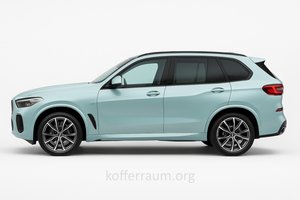
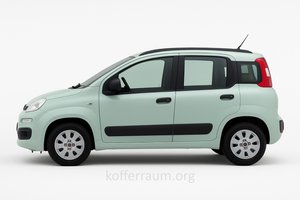
Trunk comparison: BMW X5 vs Fiat Panda
Key Differences
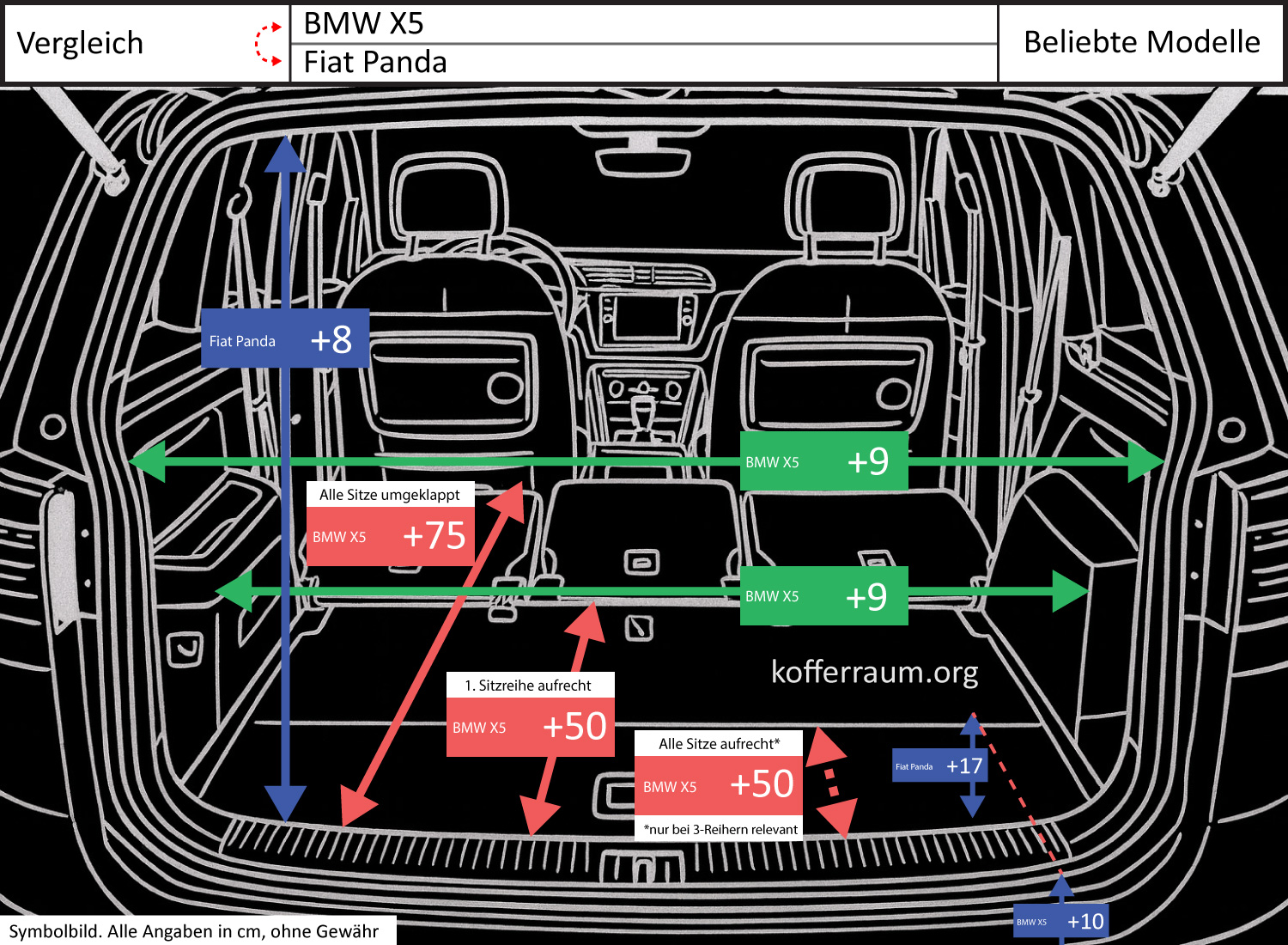
The models differ significantly in cargo space: When all seats are folded down, the BMW X5 offers a 29.5 in (68%) longer trunk than the Fiat Panda.
With the first row of seats upright, the BMW X5 is 19.7 in (93%) longer. The depth of the trunk (distance from loading edge to trunk floor) is 6.7 in (1700%) greater in the Fiat Panda.
The loading edge of the BMW X5 is 3.9 in (14%) higher above the road than that of the Panda. The trunk opening of the Fiat Panda is 3.1 in (10%) higher, while the narrowest width and the opening width are each 3.5 in (9%) larger in the BMW — these differences are ≤10% and therefore not highlighted here.
What are the implications of these differences for usability?
The BMW X5 clearly has the advantage when it comes to length and thus loading long items: With significantly longer cargo areas both with folded seats and with the first row upright, longer furniture parts, sports equipment, or bulky boxes can be transported more easily and flexibly.
The slightly greater width at the narrowest point and at the opening also makes it easier to store wide items.
The Fiat Panda scores points for the practical usability of the cargo space: The trunk opening is higher and, above all, the distance from the loading edge to the trunk floor is significantly greater, combined with a lower loading edge relative to the road.
This means heavy or awkward loads can be placed on the cargo area with less lifting effort, and for stacked goods, deep, "sunken" storage options are available. However, the shorter cargo length of the Panda limits the length of transportable items.
In short: For frequent transport of long or bulky items, the BMW X5 is more practical. For easy handling of heavy, more compact loads (easier loading and unloading, deeper cargo compartment), the Fiat Panda is ergonomically advantageous.