
Trunk comparison: BMW X5 vs Hyundai Kona

Key Differences
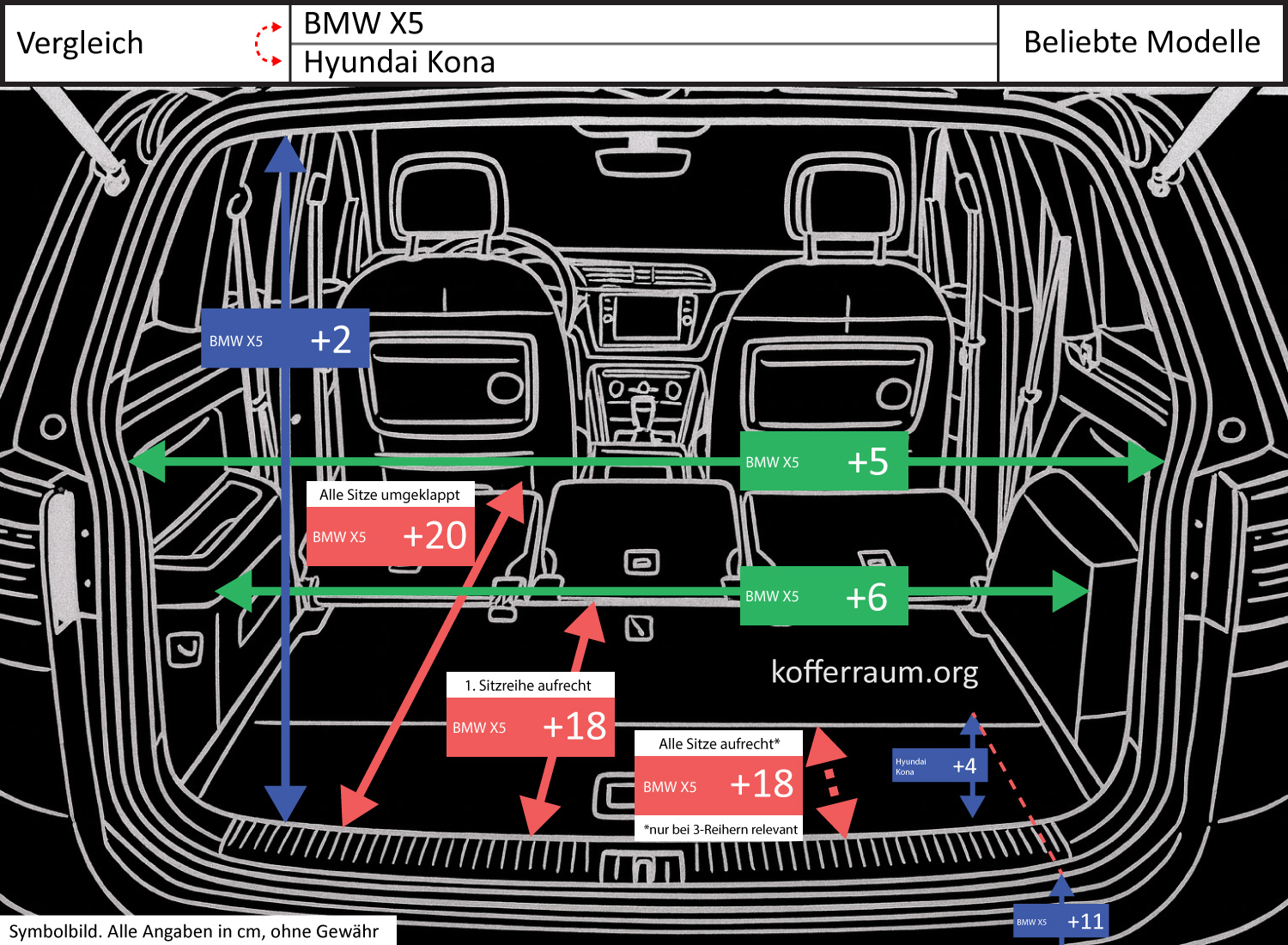
The BMW X5 offers a significantly longer cargo area: +7.9 in (≈12%) with the seats folded down and +7.1 in (≈21%) with the first row of seats upright compared to the Hyundai Kona.
The Hyundai Kona, on the other hand, has a significantly deeper trunk well (distance from loading edge → trunk floor): +1.6 in (≈400%) compared to the BMW X5. Additionally, the loading edge of the BMW X5 is +4.3 in (≈16%) higher above the road than that of the Kona.
The other differences are small (<10%): opening height +0.8 in (3%) in favor of the X5, narrowest trunk width +2.4 in (6%) in favor of the X5, width of the trunk opening +2 in (5%) in favor of the X5.
Impact on Usability
Due to the longer cargo length of the BMW X5, longer items (e.g., slats, skis, longer furniture parts) can be transported more easily — both with folded and upright seats. Those who frequently transport bulky, longer loads or need more usable depth for packed boxes benefit from the X5.
The Hyundai Kona scores with its significantly deeper trunk well and lower loading edge. This makes loading heavy items (groceries, strollers, heavy boxes) much easier because less lifting effort is required and heavy loads can be slid into a deeper well.
A deeper well can also prevent standing items from tipping over the loading edge as easily.
In short: For longer or bulkier cargo, the BMW X5 has the advantage. For frequent, comfortable loading and unloading of heavy or bulky everyday items, the Hyundai Kona is more practical. Smaller differences in width and opening size are usually negligible in practice.