
Trunk comparison: BMW X5 vs Mazda Mazda CX-60


Key Statement
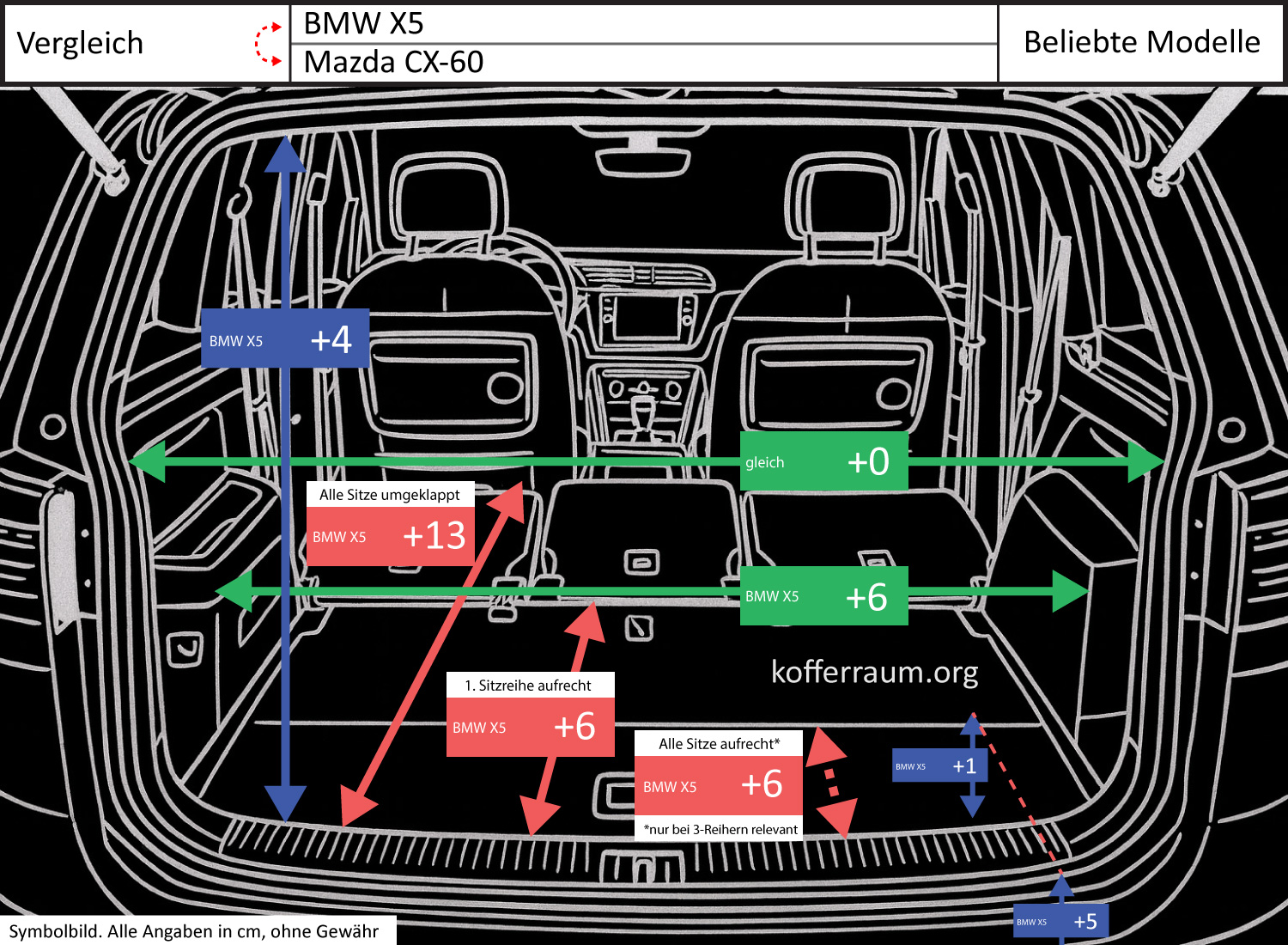
Both vehicles differ only in small but practically relevant details: No value exceeds a difference of 10%. The BMW X5 offers moderately more usable space overall and a slightly higher opening, while the actual pass-through width dimensions are identical.
Main Differences in Detail
The largest gap is in usable loading length with the seats folded down: the BMW X5 is 5.1 in longer here (±8%). With the first row of seats upright, the X5 remains 2.4 in longer (±6%). The trunk opening is 1.6 in higher on the X5 (±5%), and the loading edge is 2 in higher above the road (±7%). The narrowest width in the trunk is 2.4 in larger on the X5 (±6%), while depth and opening width practically do not differ from the CX‑60.
Impact on Usability
Because no difference exceeds 10%, there are no radical usage advantages — but subtle practical effects are clearly noticeable: The longer loading surface of the X5 makes transporting very long items (e.g., furniture parts, long skis, or building materials) easier, especially when the rear seat is folded down. The higher trunk opening facilitates fitting tall cargo, while the higher loading edge makes lifting heavy items somewhat more strenuous than in the CX‑60. The greater narrow width in the X5 offers more room for wide luggage in everyday use, but the comparable opening width means that very wide items fit equally well (or equally poorly) through the door opening in both models. Overall, the X5 tends to be more practical for longer or bulkier cargo; the CX‑60 remains equivalent for normal luggage and everyday needs.