Trunk comparison: BMW X5 vs Peugeot 308 SW 3-row

Key Differences and Usability
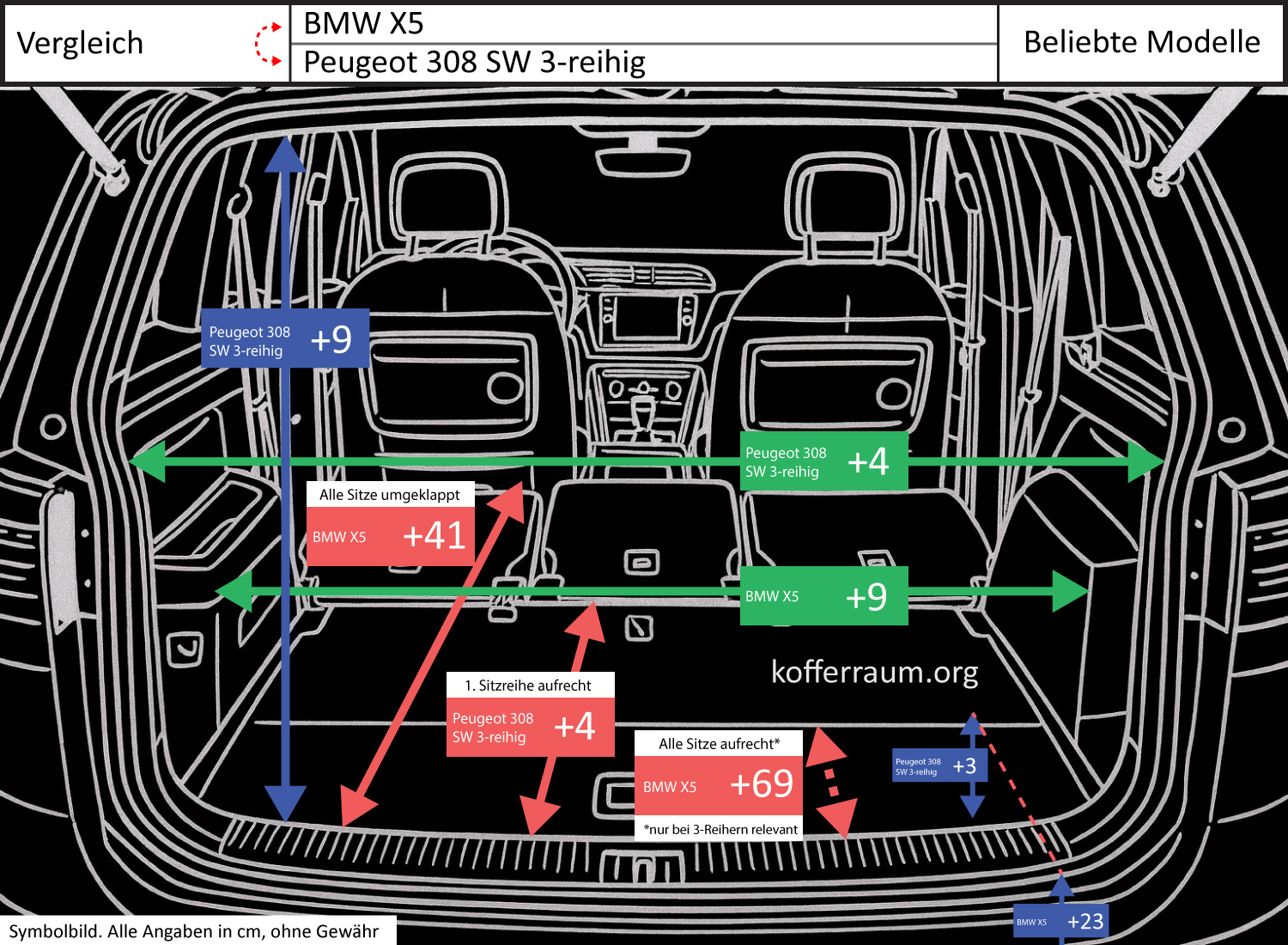
In terms of cargo volume, the BMW X5 shows clear length advantages: with the seats folded down, the BMW X5 is 16.1 in (28%) longer and with all seats upright even 27.2 in (197%) longer than the Peugeot 308 SW 3-row.
This makes the X5 significantly more practical for long items and for transporting large volumes, especially when all seat rows are used and luggage still needs to be carried. The Peugeot, on the other hand, has only a marginal advantage of 1.6 in (4%) with the first row upright, which hardly matters in practice.
Regarding loading geometry, the Peugeot scores in vertical terms: the height of the trunk opening is 3.5 in (11%) larger on the Peugeot and the depth from the loading edge mirror to the trunk floor is 1.2 in (+300%) greater than on the BMW (the high percentage indicates a very small reference value on the BMW).
Additionally, the width of the trunk opening is slightly larger on the Peugeot (+1.6 in / 4%). These features make it easier to load tall or bulky items and improve accessibility in daily use.
On the other hand, the loading edge of the BMW X5 is 9.1 in (41%) higher above the ground, which is a clear disadvantage when lifting heavy loads — but the higher ground clearance better protects against ground contact and can offer advantages when loading with ramps or during highway transport.
In the lateral direction, the differences are small: the narrowest trunk width of the BMW is only 3.5 in (9%) larger and thus practically comparable.
In summary: For users who want to transport longer items or a lot of luggage while using all seat rows, the BMW X5 is the more practical choice.
For everyday usability when frequently loading and unloading bulky or tall goods (better opening height, greater depth, lower loading edge), the Peugeot 308 SW 3-row offers advantages.