Trunk comparison: BMW X5 vs Seat Tarraco


Main Differences (>10%)
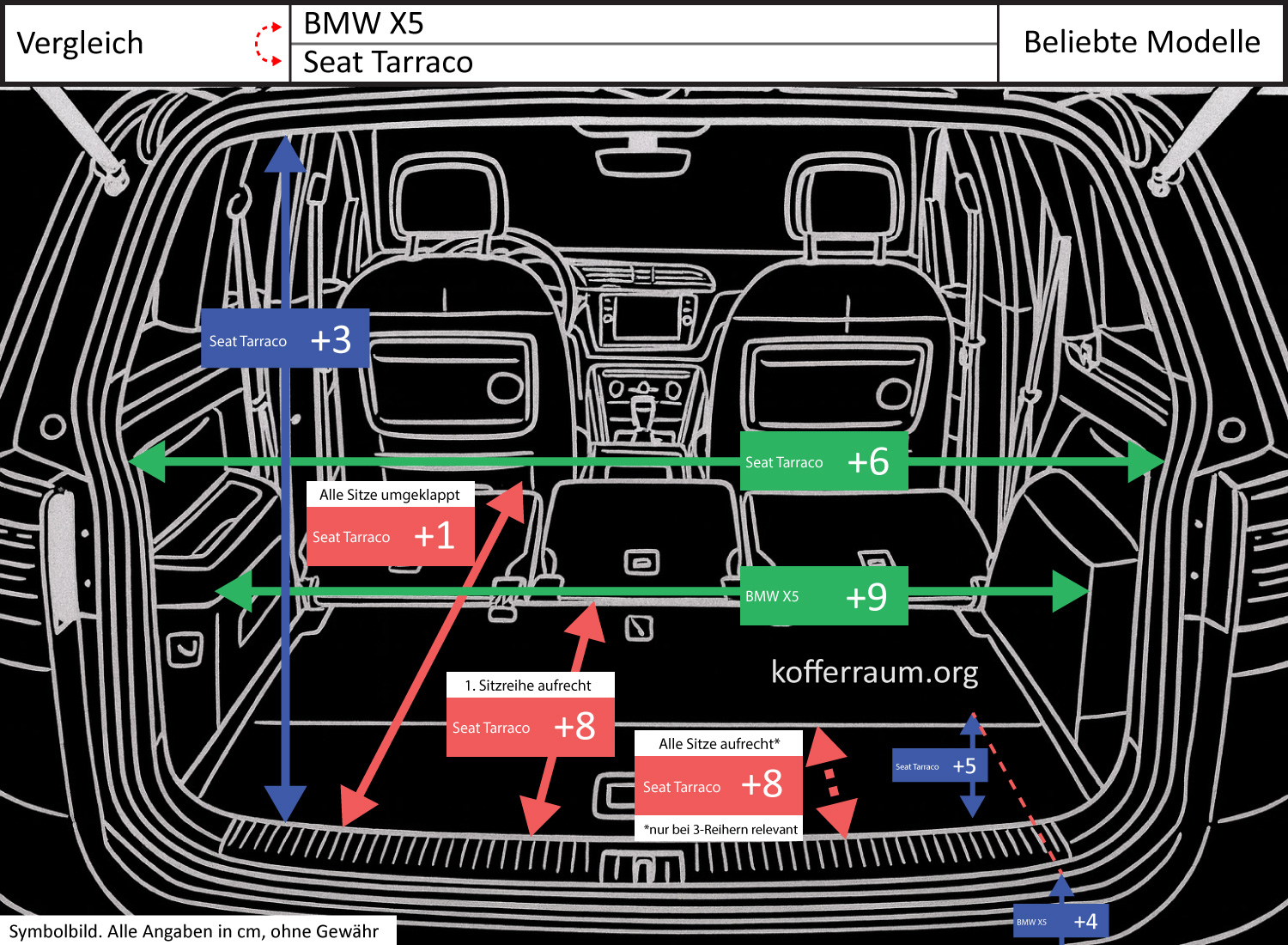
The most noticeable difference concerns the depth of the trunk (distance from loading edge to trunk floor): The SEAT Tarraco has +2 in (±500%) more here than the BMW X5. Practically, this means that the trunk floor in the Tarraco lies significantly deeper behind the loading edge — creating a much deeper cargo compartment.
Impact on usability: A deeper cargo compartment offers more usable volume below the loading edge, is better suited for securely sinking luggage, more effectively prevents small items from rolling out, and allows bulky or tall loads to be partially pushed under the loading edge.
Disadvantages can be that very deep cargo compartments make lifting heavy items from the lowest point more difficult and that loading with flat cargo surfaces involves more bending over.
Other Differences (under 10%) and Their Consequences
- Trunk volume with seats folded down: Tarraco +1% — negligible in practice.
- Trunk length with first row seats upright: Tarraco +8% — more usable loading length with occupied seats, practical for long items without folding seats.
- Height of trunk opening: Tarraco +1.2 in (≈4%) — slightly more space above when loading tall items.
- Loading edge height above road: BMW X5 +1.6 in (≈5%) — the X5’s loading edge is higher, meaning more lift when loading and unloading heavy loads; conversely, loading is easier in the Tarraco due to the lower loading edge.
- Width at the narrowest point: BMW X5 +9% — the X5 offers more space at tight spots, advantageous for wide, bulky items.
- Width of trunk opening: Tarraco +6% — the opening is somewhat larger, making it easier to load and unload wide objects despite narrower interior width at the narrowest point.
Conclusion
The clearest practical advantage lies with the SEAT Tarraco due to the significantly deeper cargo compartment: more space below the loading edge and a lower loading edge make loading easier and create hidden or deeper volume.
The BMW X5, on the other hand, scores with slightly more interior width at the narrowest point and a higher loading edge, which can be advantageous for certain wide loads and a flatter cargo surface.
Overall, the type of regular use (very tall/tall or wide/bulky loads, frequent lifting of heavy items) determines which model is more practical.