Trunk comparison: BMW X5 vs Tesla Model 3

Summary of the Key Differences
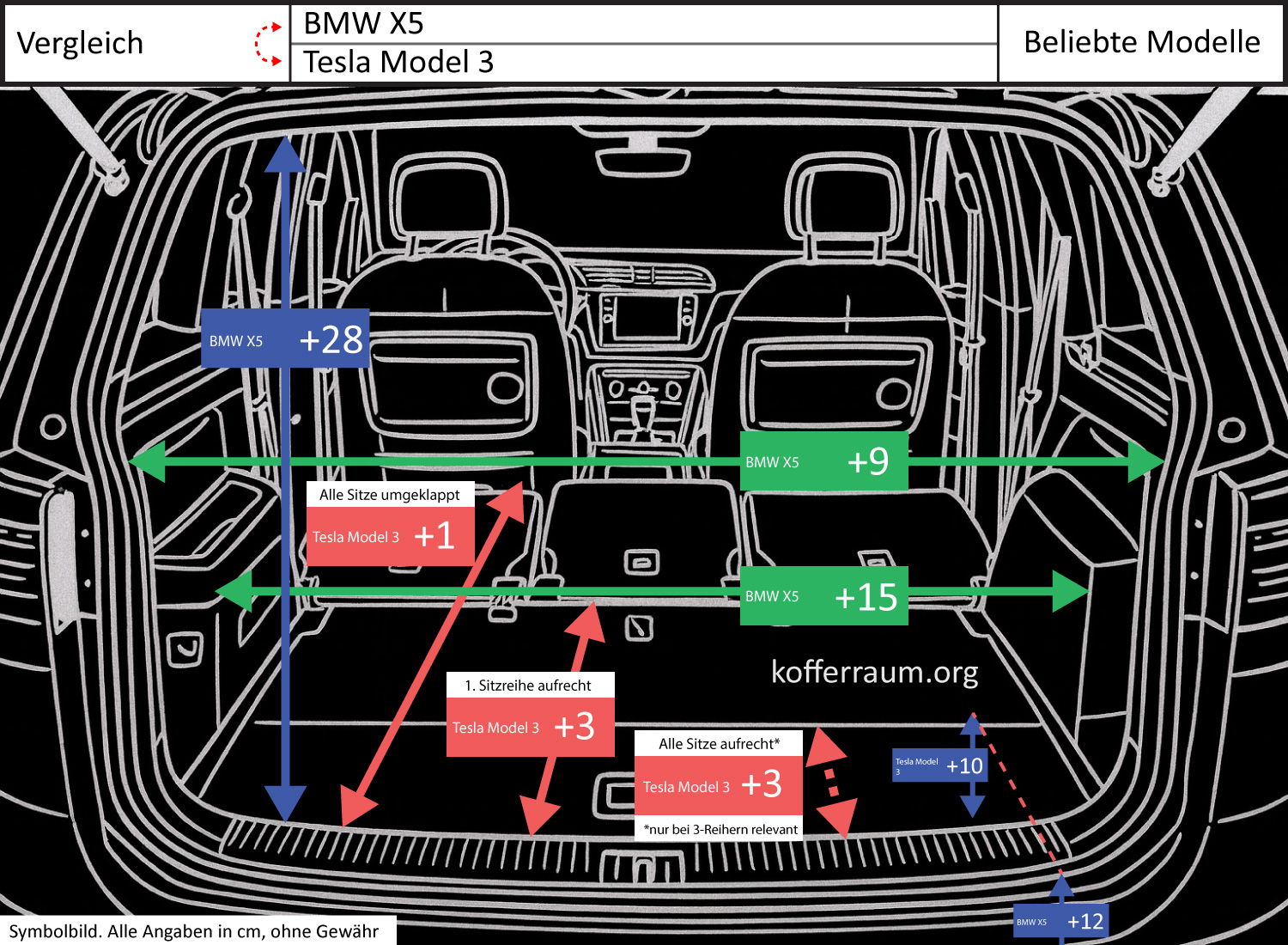
There are significant differences in the relevant dimensions: The height of the trunk opening is 11 in (54%) greater in the BMW X5 than in the Tesla Model 3, the depth from the loading edge to the trunk floor is 3.9 in (1000%) greater in the Tesla, the loading edge of the BMW X5 is 4.7 in (18%) higher above the road, and the narrowest width of the trunk is 5.9 in (16%) greater in the BMW X5. Smaller differences under 10% exist in the total trunk length (Tesla +0.4 in folded down, +1.2 in with front seats upright) and in the width of the trunk opening (BMW +3.5 in / 9%), which are not highlighted here.
Implications for Usability
BMW X5 — Strengths: Due to the significantly higher trunk opening and the greater narrowest width, bulky, tall, and comparatively wide cargo (e.g., furniture pieces, tall boxes) can be loaded and unloaded more easily and more often fits without folding down seats.
Weakness: The 4.7 in (18%) higher loading edge increases the effort required to lift heavy items over the threshold.
Tesla Model 3 — Strengths: The significantly greater trunk depth offers more usable space along the loading axis; together with the lower loading edge, loading and unloading heavy or longer items is more ergonomic.
Weakness: The lower opening height and the smaller narrowest width limit loading of tall or wide items — for very tall or wide cargo, folding down seats or other loading techniques are often necessary.
Conclusion: For frequent transport of tall or wide items, the BMW X5 is advantageous; for longer or heavy cargo that can be well stored in depth and where lifting effort should be reduced, the Tesla Model 3 is more practical.