Trunk comparison: BMW X5 vs Tesla Model Y

Key Differences
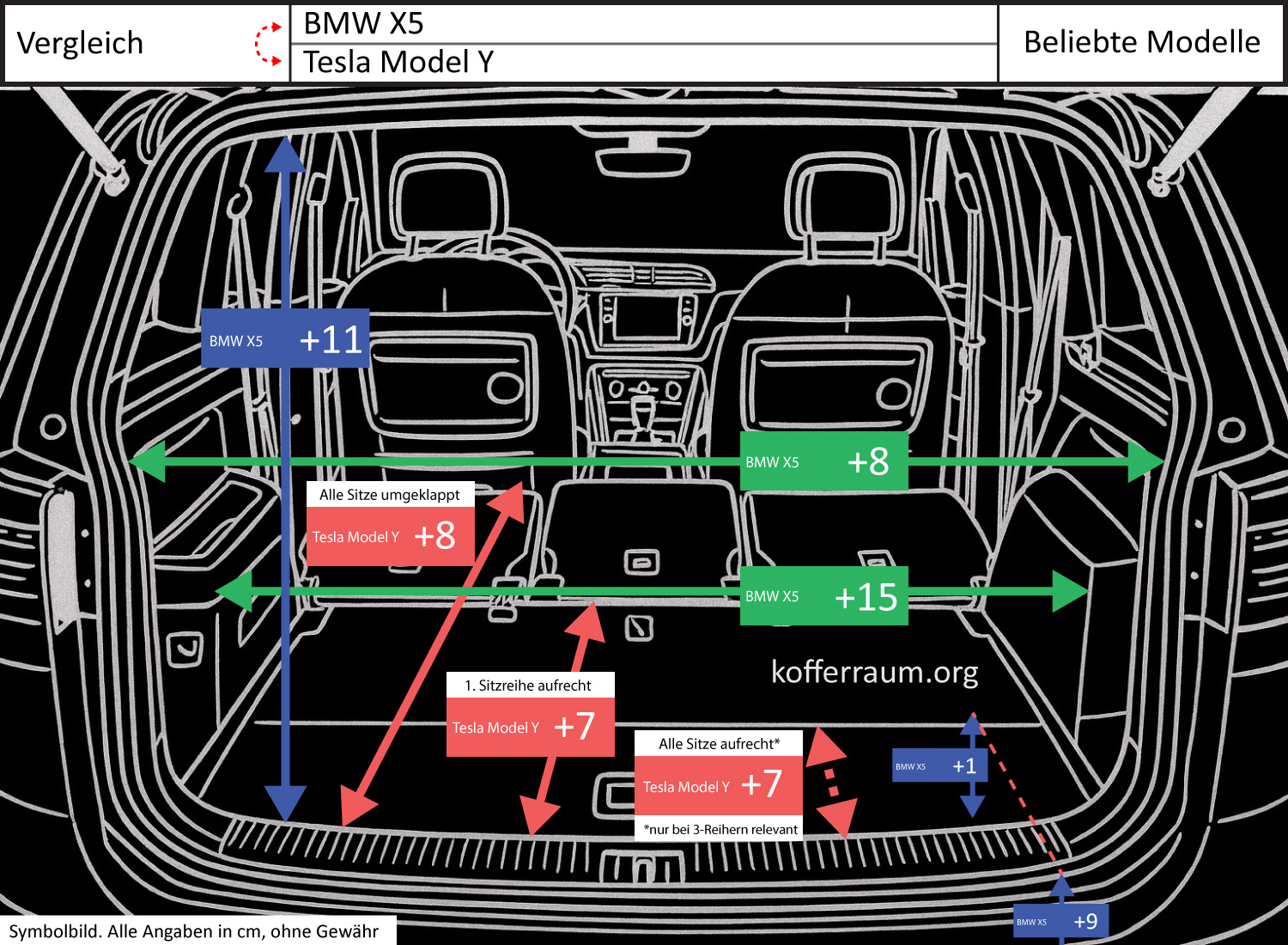
Both models show only minor length differences in the trunk: the Tesla Model Y is about +3.1 in (≈4%) longer with the seats folded down, and about +2.8 in (≈7%) longer with the first row upright – these are hardly noticeable advantages in practice for longer items.
The differences are significantly larger in opening height, loading edge height, and usable width: the BMW X5 has a +4.3 in (16%) higher trunk opening, its loading edge is +3.5 in (13%) higher above the ground, and the width at the narrowest point in the trunk is +5.9 in (16%) larger than in the Tesla Model Y.
The width of the trunk opening on the X5 is also +3.1 in (8%) larger, but this is below the 10% threshold.
Impact on Usability
The higher trunk opening of the X5 makes loading tall or bulky items easier because less tilting or turning is required. The greater interior width at the narrow point allows for wider cargo (e.g., furniture parts, wide boxes, or pallets) and increases versatility with bulky loads.
At the same time, the higher loading edge of the X5 makes lifting heavy items somewhat more strenuous; here the Model Y scores with a lower loading edge that facilitates loading and unloading suitcases, roll containers, or heavy boxes.
For users who frequently lift heavy items or travel often with wheeled luggage, the Model Y therefore offers more practical advantages despite the narrower width and lower opening.
Conclusion: For transport tasks involving wide or tall items, the BMW X5 is clearly advantageous due to opening height and interior width. For simple, frequent loading and unloading of heavy or rolling cargo, the Tesla Model Y is more ergonomic and user-friendly for everyday use.