
Trunk comparison: BMW X5 vs VW Golf Wagon (Mk5)

Key Differences
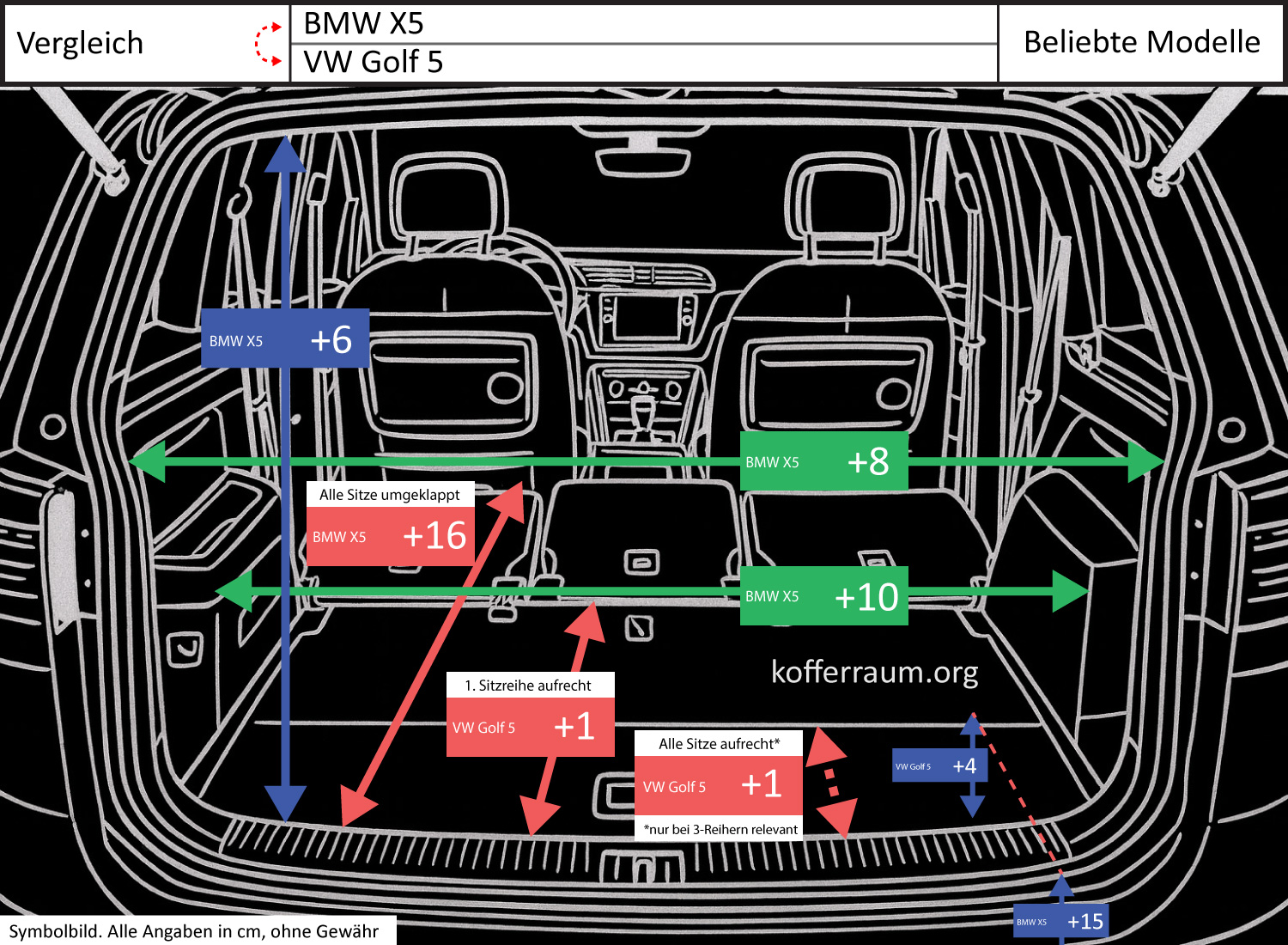
The two most noticeable differences concern the depth of the trunk and the height of the loading edge. The VW Golf 5 has a significantly deeper cargo floor (+1.6 in, approx. +400% compared to the BMW X5), meaning the trunk floor is relatively lower below the loading edge.
The loading edge of the BMW X5, on the other hand, sits significantly higher above the road (+5.9 in, approx. +23%).
Impact on Usability
The deeper cargo floor of the Golf practically means more "vertical space" below the loading edge: bulky, taller items can be better recessed into the trunk and lie lower, which reduces shifting and can utilize volume with the rear seats upright.
However, a pronounced recess can make sliding flat, long items over the loading edge more difficult and cleaning dirt in the recess more laborious.
The higher loading edge of the BMW X5 makes lifting heavy items into the trunk more strenuous and increases the distance from the road when loading and unloading.
A higher build can offer advantages when transporting bulky items if the loading edge is meant to align flush with a loading surface or trailer hitch; however, for frequent lifting of heavy loads, the higher loading edge is clearly a disadvantage.
Other, less pronounced differences: The BMW X5 offers a wider loading opening at the narrowest point (+3.9 in, 10%) as well as a slightly wider trunk opening (+3.1 in, 8%) and a longer cargo floor with the rear seats folded down (+6.3 in, 9%).
The VW Golf 5 has minimally more length with the rear seats upright (+0.4 in, 1%) and a somewhat greater depth at the loading edge (see above).
In summary: For wide or very long, flat loads and overall more generous width, the BMW X5 is advantageous. For easier handling of heavy items, better support for lower-lying cargo, and more usable depth below the loading edge, the VW Golf 5 is better suited.