Trunk comparison: BMW X5 vs VW T-Cross
Key Differences and Impact on Usability
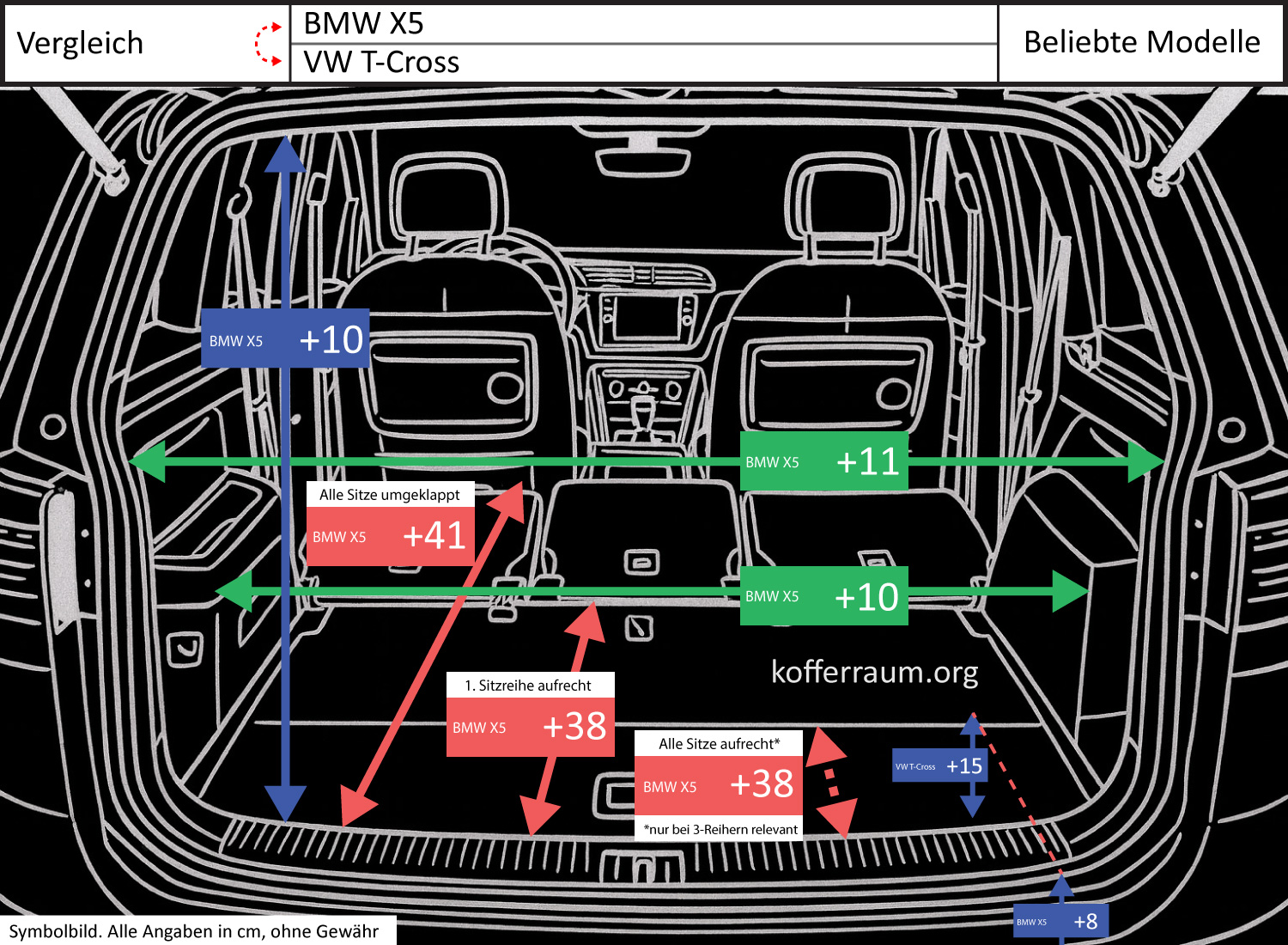
The BMW X5 offers a significantly longer cargo space when the seats are folded down: +16.1 in (28%) compared to the VW T-Cross, and even +15 in (58%) with the first row of seats upright.
Practically, this means the X5 clearly accommodates longer items and more luggage length – advantageous for furniture transport, skis, or longer pieces of luggage.
The trunk opening of the X5 is both higher and wider: the opening height is +3.9 in (14%) greater and the opening width +4.3 in (11%). This makes it easier to load taller and wider parts, and bulky items fit more easily through the opening.
In contrast, the VW T-Cross has a significantly greater depth between the loading edge and the trunk floor: +5.9 in (1500%) compared to the X5. This means the trunk floor of the T-Cross lies much deeper below the loading edge – more usable stacking height in depth, but also a larger "step" effect when loading and unloading.
In the BMW X5, the floor is closer to the loading edge, making it easier to slide in heavy or long items.
The loading edge of the X5 is +3.1 in (11%) higher above the road than that of the T-Cross. For heavy or regularly loaded cargo, this is a disadvantage because more lifting is required; for less frequent, lighter luggage or when parking on uneven surfaces, this matters less.
In summary: the BMW X5 is better suited for longer, wider, and taller loads as well as for situations where as much usable length as possible is needed. The VW T-Cross scores with a lower trunk floor and a lower loading edge, which can facilitate regular handling of boxes or easy sliding in of luggage.
The choice therefore depends on whether you more often need to carry bulky/extensive loads (X5) or frequent, back-friendly loading in everyday use (T-Cross).