
Trunk comparison: Citroen C3 vs Mazda Mazda CX-60


Key Differences (highlighted: >10%)
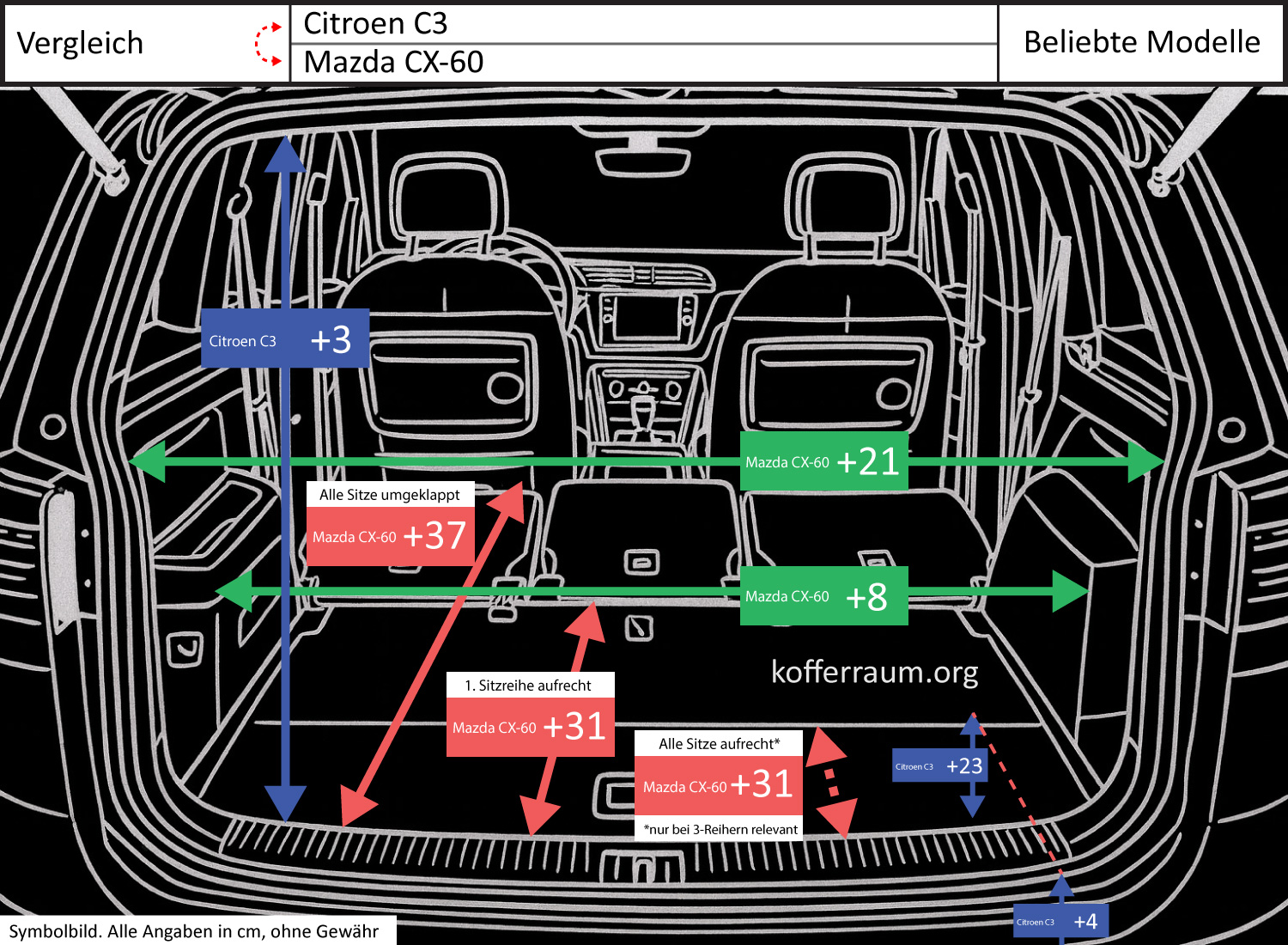
Clear strengths emerge on both sides when it comes to cargo space: The Mazda CX‑60 offers significantly more length in the trunk — +27% with the seats folded down and even +46% with the first row upright compared to the Citroën C3. Additionally, the width of the trunk opening on the Mazda is 24% larger, making it easier to load wide items.
In contrast, the Citroën C3 has a considerably greater depth between the loading edge and trunk floor — +9.1 in (2200%) — which means a much deeper cargo well.
What this means practically for use
The strengths of the Mazda CX‑60 make it better suited for long or bulky loads: the longer flat loading area with folded seats and the significantly wider opening facilitate loading furniture, long boxes, or skis. In many cases, longer items can be positioned without complicated folding or heavy lifting.
The Citroën C3 scores with a significantly deeper cargo well. This means practical storage space where items can be recessed deeper (better concealment, more stable storage with a lower center of gravity).
Combined with a slightly higher loading edge compared to the Mazda, loading and unloading heavy items can be somewhat more strenuous since items must first be lifted over the loading edge.
Smaller differences such as the slightly higher opening height of the C3 (+4%) or the slightly higher loading edge (+5%) are less relevant in practice. The slightly greater width of the Mazda at its narrowest point (+8%) remains below the 10% threshold and only moderately affects usability.
Conclusion
For transport tasks involving long or wide items, the Mazda CX‑60 is the more practical choice (more length and larger opening).
For users who value a deeper, more concealed storage space, the Citroën C3 offers advantages with its significantly deeper cargo well — though at the cost of somewhat more cumbersome lifting over the loading edge.