
Trunk comparison: Citroen C3 vs Mercedes Benz GLC


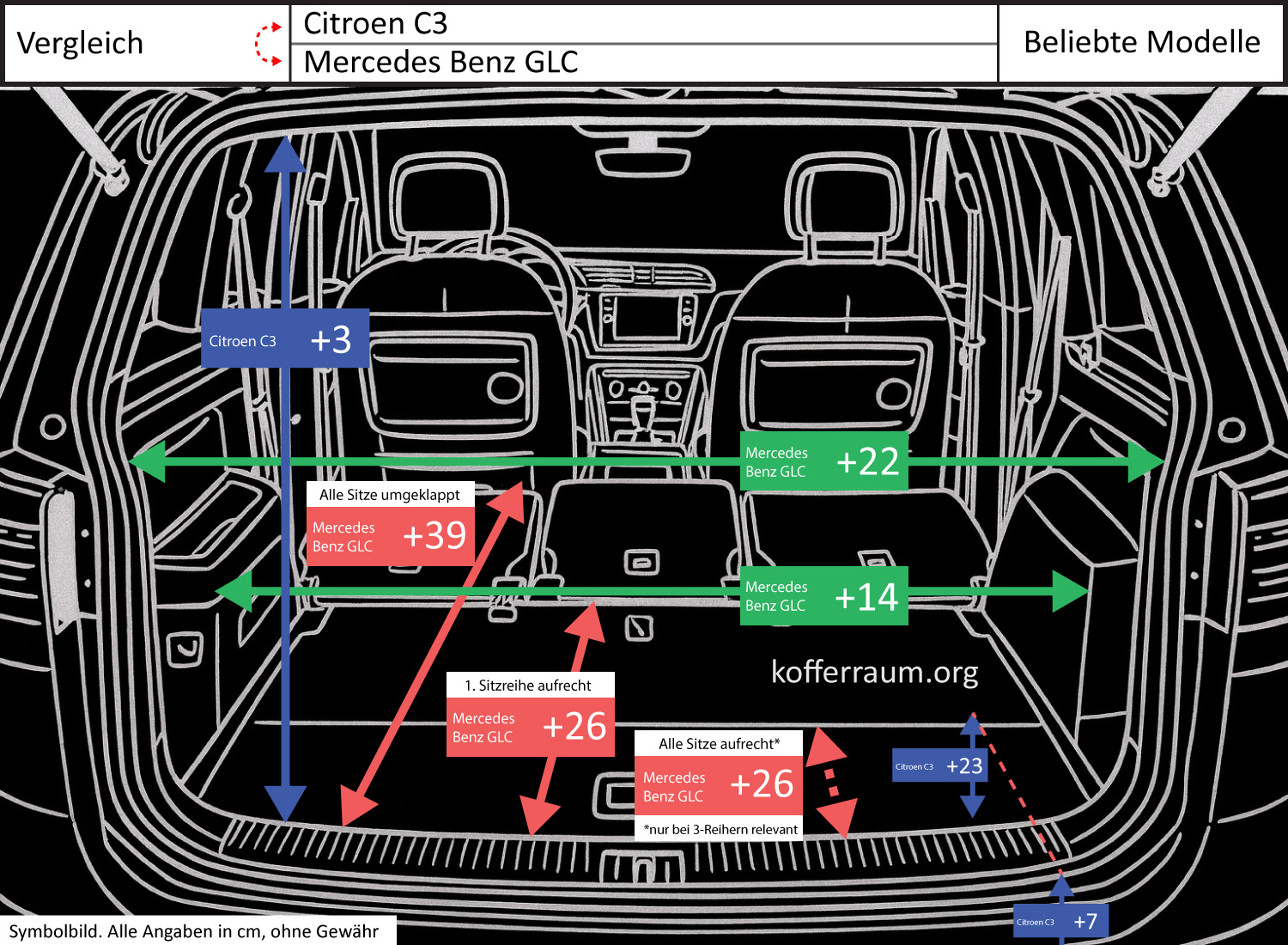
Key Differences
The Mercedes‑GLC offers significantly more usable length and width: with the seats folded down, its trunk is **15.4 in (≈29%) longer** than the Citroën C3, and with the first row of seats upright, it is **10.2 in (≈39%) longer**.
The GLC also leads in width: the narrowest point of the trunk is **5.5 in (≈15%) wider**, and the width of the trunk opening is **8.7 in (≈25%) larger** than the C3. In contrast, the Citroën C3 has a significantly deeper interior space between the loading edge and the trunk floor: this distance is **9.1 in (≈2200%) greater**, and the height of the trunk opening on the C3 is slightly higher (+1.2 in, ~4%).
The loading edge of the C3 is positioned higher above the ground (+2.8 in, ~10%).
Impact on Usability
For long or wide cargo (e.g., furniture, long packages, skis), the Mercedes‑GLC is better suited: the longer dimensions and larger opening make it easier to load bulky items and increase flexibility when loading. The greater minimum width in the cargo area also means wide items need to be angled less often.
The Citroën C3 scores with deep, low loads: the significantly larger distance from the loading edge to the trunk floor creates a deeper interior where items can lie further below the loading edge (useful for stackable or tall but not very long cargo).
The slightly higher trunk opening facilitates sliding through tall items. However, the higher loading edge makes lifting heavy loads into the trunk more strenuous than with the GLC.
In summary: For volume, long, and wide loads, the GLC is more practical; for low-lying, compactly stackable cargo and somewhat higher pass-through height, the C3 offers advantages but suffers in loading ergonomics due to the higher loading edge.