
Trunk comparison: Citroen C3 vs VW ID.4
Key Differences
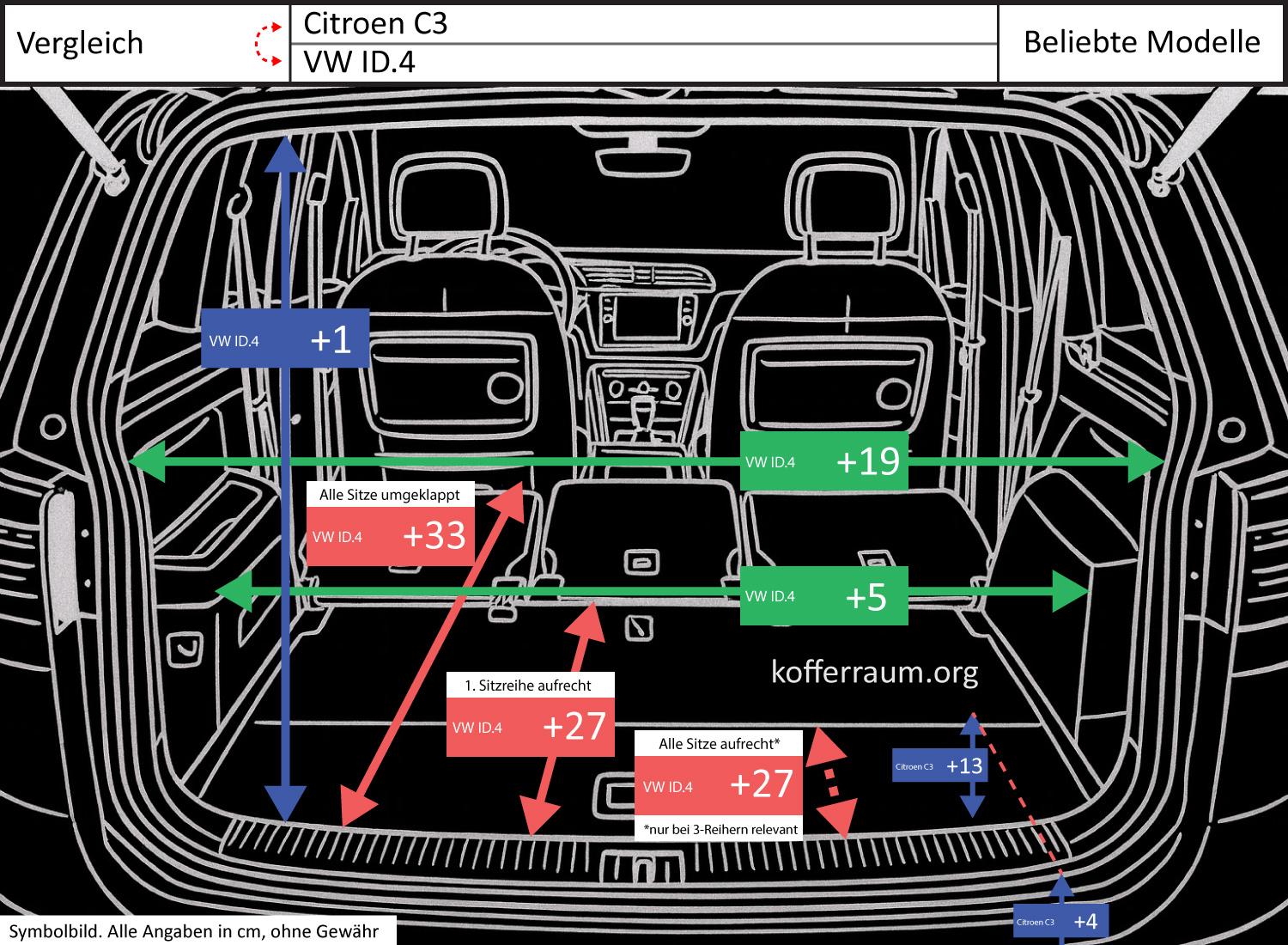
The VW ID.4 offers significantly more cargo length: with the seats folded down, the trunk is 13 in (+24%) longer, and with the first row upright, it is even 10.6 in (+40%) longer than in the Citroën C3. Additionally, the width of the trunk opening in the ID.4 is 7.5 in (+22%) larger, and the narrowest internal width is 2 in greater in the ID.4. In contrast, the Citroën C3 has a significantly greater trunk depth (loading edge to trunk floor): 5.1 in (+130%) higher than the ID.4. The height of the trunk opening is 1% higher in the ID.4, and the loading edge of the C3 is 1.6 in (5%) higher above the ground.
Impact on Usability
The larger length and opening dimensions of the VW ID.4 (each +24% / +40% and +22%) make it clearly more practical for long or bulky cargo: furniture, skis, bicycles, or long boxes can be more easily accommodated and loaded. The wider opening also facilitates maneuvering large items during loading.
The greater depth value of the Citroën C3 (+130%) means that the cargo space has a deeper well — this can be useful when transporting smaller, stackable items, as they lie more stably in the recess.
At the same time, the deeper well can limit the usable, flat loading surface and make loading or unloading heavy items more difficult. The slightly higher loading edge of the C3 (1.6 in) minimally worsens ergonomics when lifting heavy loads.
Conclusion: For regular transport of long or wide cargo, the VW ID.4 is the more practical choice.
For items that benefit from a deeper trunk well or need to be securely “recessed,” the Citroën C3 offers advantages; ergonomically and for a flexibly usable loading area, however, the ID.4 is more advantageous in everyday use.