
Trunk comparison: Citroen C3 vs VW Passat Wagon
Key Differences
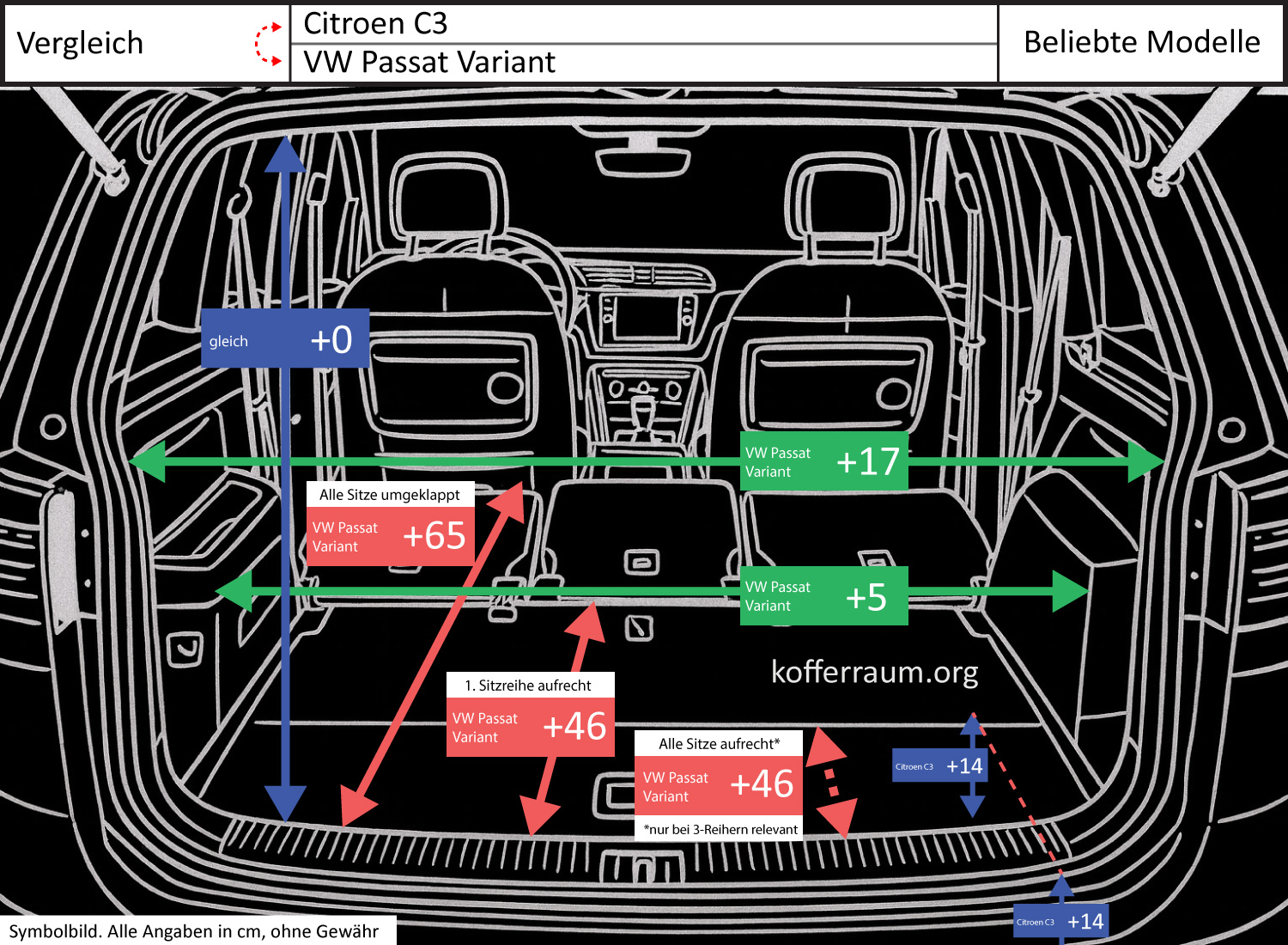
The VW Passat Wagon offers significantly more loading length: with the seats folded down, the trunk is 25.6 in (48%) longer, and with the front seats upright, it is even 18.1 in (69%) longer than the Citroën C3. The width of the trunk opening is 6.7 in (19%) larger on the Passat.
Two values are notably higher in the Citroën C3: the depth of the trunk (loading edge to trunk floor) is +5.5 in (156%) greater, and the loading edge itself sits +5.5 in (22%) higher above the ground.
The height of the trunk opening is the same on both models; the narrowest width inside the cargo area differs only slightly (Passat +5%, not significant).
Impact on Usability
Transporting long or bulky items: The Passat clearly has the advantage. The significantly greater loading length (both with folded seats and with the seat row upright) and the wider opening make it easier to load long furniture pieces, boards, skis, or bulky boxes and provide overall more usable cargo space.
Loading heavy items: The Passat has the lower loading edge, making lifting and sliding heavy loads into the trunk easier. The wider opening supports maneuvering large parts. In the C3, the 5.5 in higher loading edge makes lifting more strenuous; the higher loading edge also increases the force required when loading.
Handling smaller, less delicate cargo: The greater trunk depth measurement in the C3 suggests a deeper cargo well. This can be advantageous when items need to be securely recessed and less likely to shift, but it limits loading long flat items since the usable loading length is shorter.
Conclusion: For users who regularly need to transport long, wide, or heavy cargo, the VW Passat Wagon is the more practical choice.
The Citroën C3 can be sufficient for everyday shopping and smaller luggage but is less suitable for larger transports due to the higher loading edge and significantly shorter loading length.