
Trunk comparison: Dacia Duster vs Hyundai i10
Key Differences
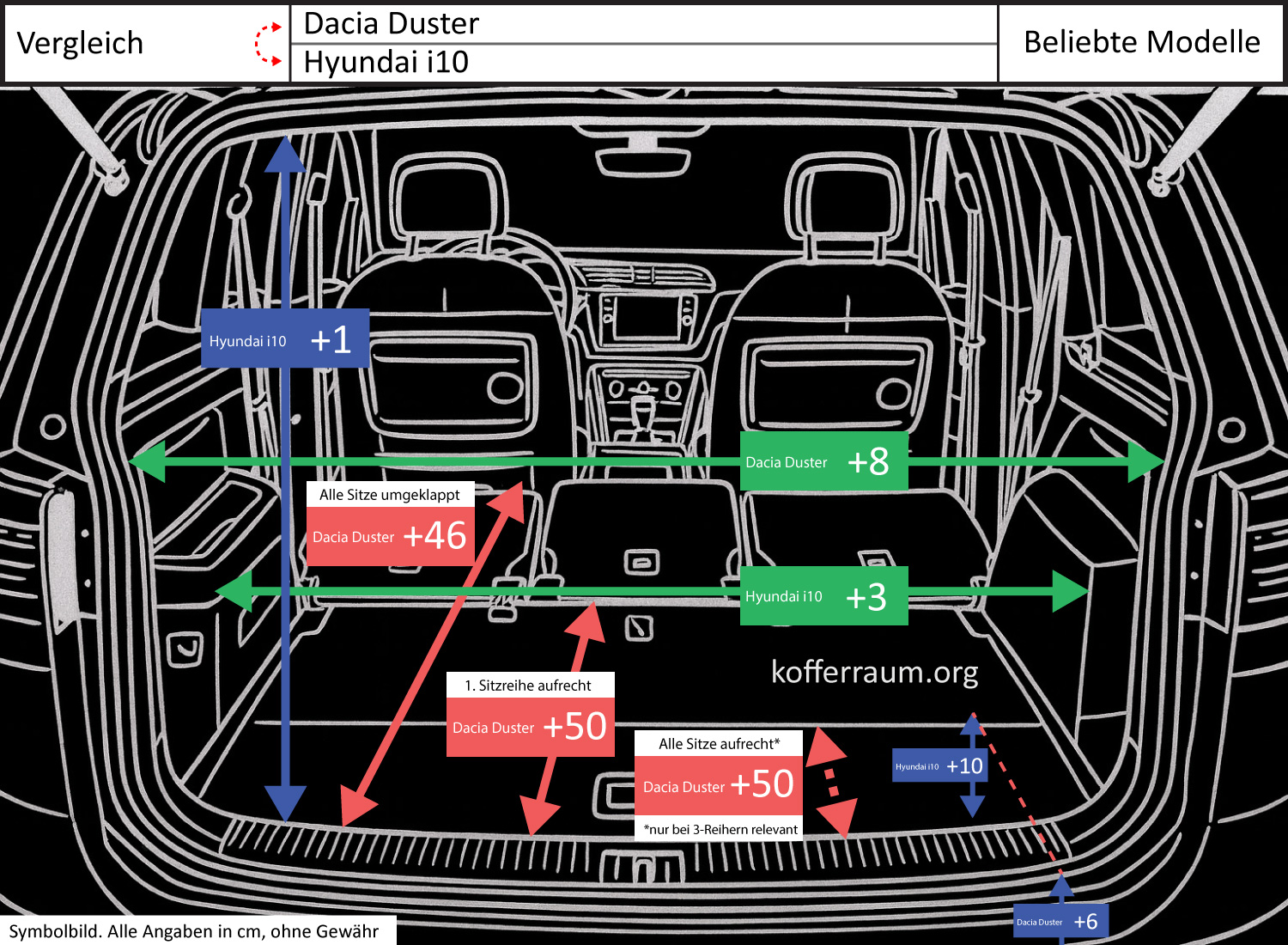
The Dacia Duster offers a cargo area that is 18.1 in (≈39%) longer with the seats folded down than the Hyundai i10. With the front row upright, the difference is even more pronounced: the Duster has a trunk depth that is 19.7 in (≈106%) longer.
On the other hand, the Hyundai i10 has a real strength: the vertical depth (distance from loading edge to trunk floor) is 3.9 in (≈125%) greater than that of the Duster.
Impact on Usability
These differences lead to clearly distinct use cases: Due to the significantly greater length, the Duster is better suited for long items (e.g., slats, long packages, skis with seats folded down) and for larger cargo volumes when passengers are transported (more usable depth even with the seat row upright).
Practically, this means: those who frequently load long or bulky items or regularly transport additional luggage with several passengers have more flexibility with the Duster.
The i10 scores with its greater vertical depth between the loading edge and trunk floor. This creates more usable space for stacking or for taller items that don’t require length but do need height. For short but tall loads or for interior stowing of boxes, the i10 can be used more efficiently.
Other, smaller differences hardly affect everyday usability: The trunk opening of the i10 is about 0.4 in higher, the loading edge of the Duster is about 2.4 in higher above the road, the opening width of the Duster is about 3.1 in wider, and the narrowest width of the i10 is about 1.2 in.
These values are small compared to the percentage differences mentioned above and usually have only marginal effects on loading and unloading.