
Trunk comparison: Dacia Duster vs Hyundai Kona
Key Differences
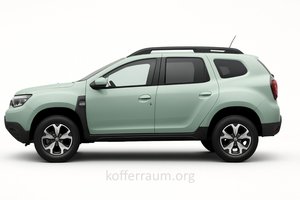
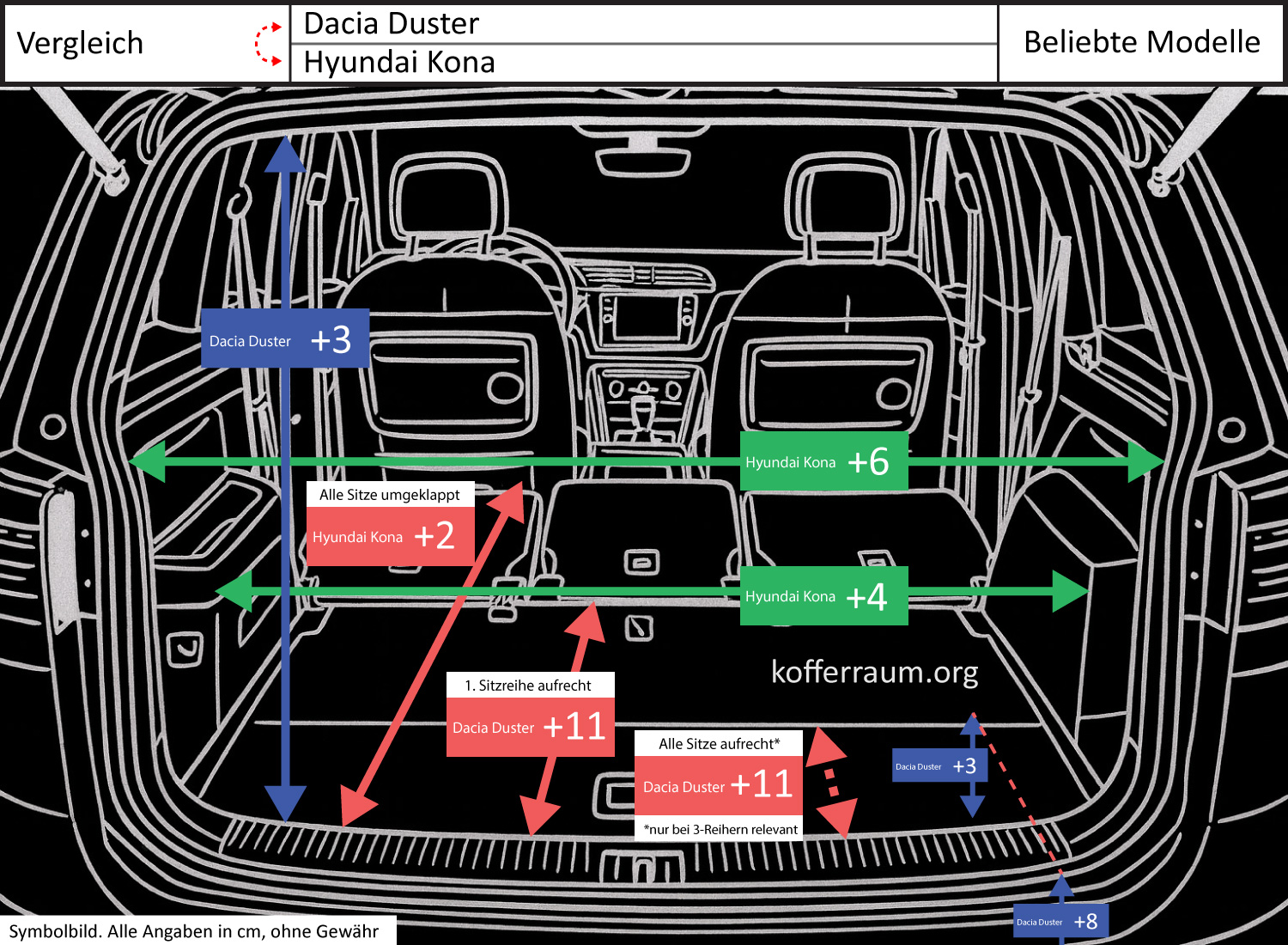
In a direct comparison, three measurable differences stand out clearly: the Dacia Duster offers a trunk that is 4.3 in (≈13%) longer with the first row of seats upright, the trunk depth (loading edge to trunk floor) is 1.2 in (≈60%) greater in the Duster, and the loading edge of the Dacia Duster is 3.1 in (≈12%) higher above the road.
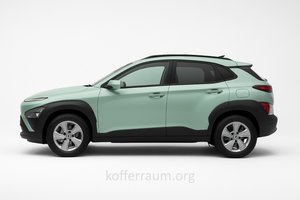
Smaller deviations: the Hyundai Kona has a minimal +0.8 in (+1%) longer length with folded seats, a 1.6 in (+4%) wider width at the narrowest point, and a 2.4 in (+6%) larger opening width; the opening height of the Duster is 1.2 in (+4%) greater.
Impact on Usability
These differences clearly affect everyday usability: Due to the greater usable length with the rear seat upright, the Duster is better suited when long items need to be transported frequently without folding down the seats (e.g., slats, skis, long boxes).
The significantly greater trunk depth in the Duster means items sit deeper and therefore more stably; this helps with securing loads and more easily prevents cargo from shifting during braking or obstructing rear visibility.
At the same time, the 3.1 in higher loading edge makes lifting heavy loads into the Duster more strenuous and less practical for frequent loading – for heavy boxes or groceries, the Kona with its lower loading edge is more ergonomic.
The Hyundai Kona shows advantages with wide, flat items: larger opening width and slightly more width at the narrowest point make loading wide suitcases or furniture parts easier. The marginally longer loading length with fully folded seats (+0.8 in) is practically irrelevant.
Overall: Those who want more length and deeper, more secure cargo will find the Duster the better choice; those who more often want to load wide, flat, or heavy items comfortably onto a lower loading edge will benefit more from the Kona.