
Trunk comparison: Dacia Duster vs Kia Stonic
Main Differences (highlighted: >10%)
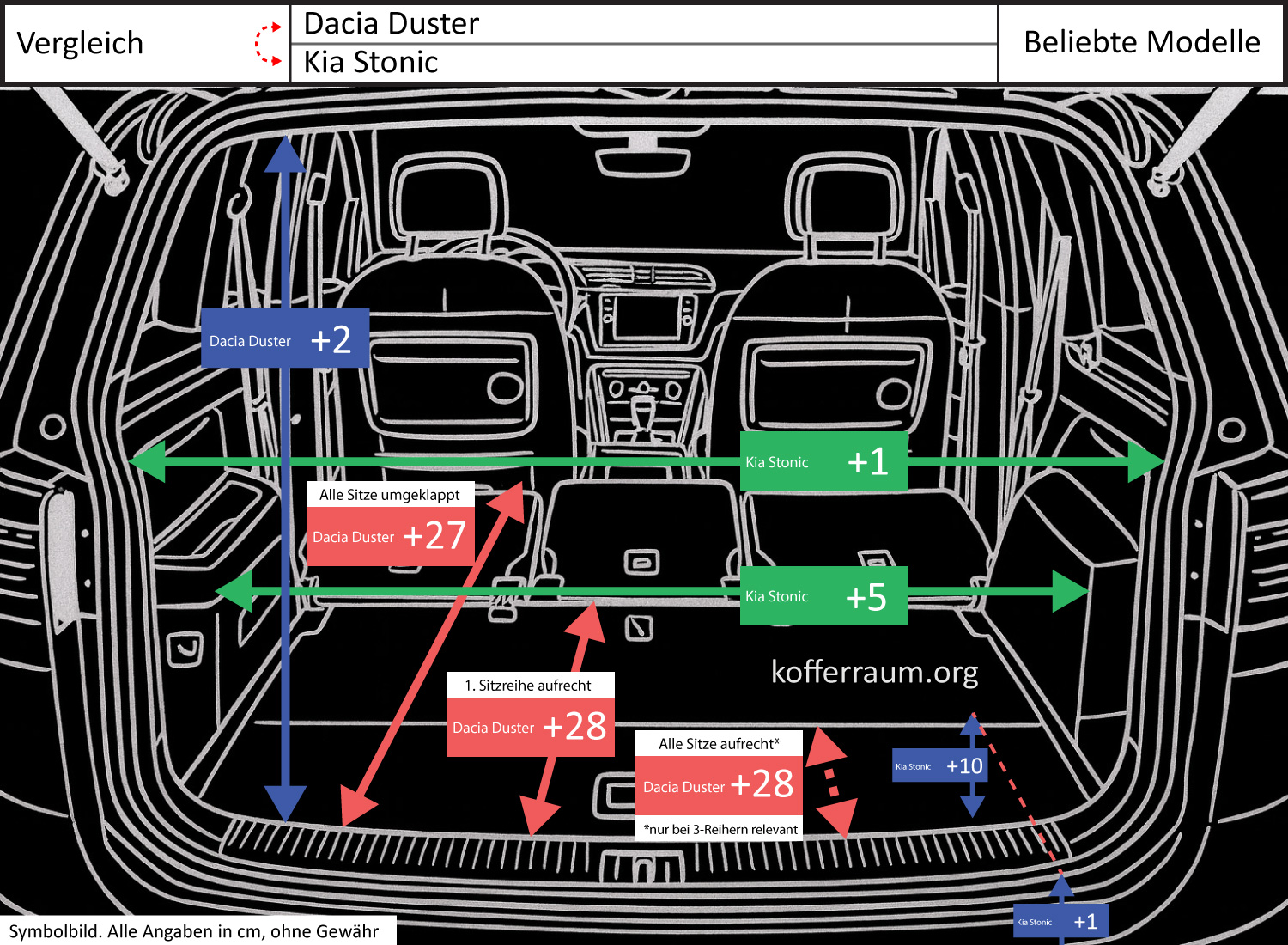
The Dacia Duster offers significantly more cargo length: with the seats folded down, the trunk is 10.6 in (≈20%) longer, and with the first row of seats upright, it is 11 in (≈41%) longer than the Kia Stonic.
In contrast, the Kia Stonic has a significantly greater trunk depth between the loading edge and the trunk floor: it is 3.9 in (≈125%) "deeper" there than the Duster.
Practical Implications for Use
The greater cargo length of the Duster makes it better suited for long or bulky items (skis, slats, furniture parts, longer luggage) and for situations where a continuous loading surface is needed by folding down the seats. For moves, outdoor equipment, or longer items, the Duster clearly offers advantages.
The significantly greater "depth" of the Stonic (loading edge → trunk floor) means that volume disappears further down in the trunk: bulky, tall, or loose luggage can be stored deeper and thus out of sight. This is practical for shopping bags or equipment that should not shift.
However, a deeper trunk floor often results in a somewhat lower loading level – depending on the loading edge height, lifting may require a bit more effort (the loading edge itself is only about ~0.4 in higher here).
Smaller differences that hardly matter: The Duster's trunk opening is only about ~0.8 in higher, the Stonic's width at the narrowest point is about ~2 in greater, and the opening width is about ~0.4 in larger.
These deviations are minor and only marginally affect everyday usability (such as easier sliding in of wider items with the Stonic).
Conclusion
Those who frequently transport long or very long items or seek the most flexible, continuous loading surface benefit from the Dacia Duster.
Those who value a deeper, better "hidden" trunk space (e.g., for groceries, suitcases, or taller stacks that should disappear under the loading edge) find advantages in the Kia Stonic. Smaller dimensions (width, opening height) are secondary in practice.