
Trunk comparison: Dacia Duster vs Mazda Mazda CX-60


Key Differences
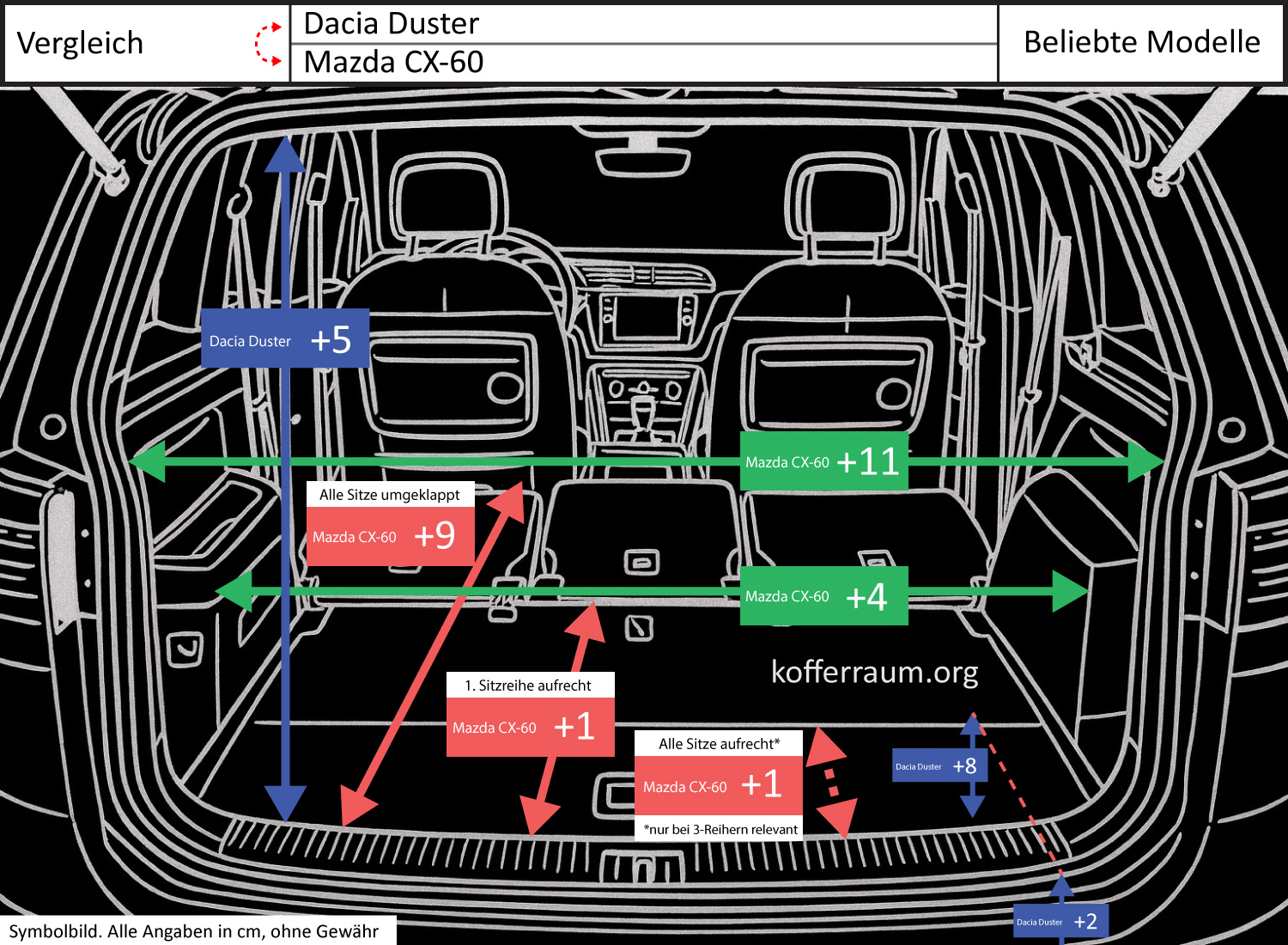
Both models differ in several trunk dimensions. The Mazda CX‑60 offers a cargo area that is 3.5 in (≈5%) longer with the seats folded down and 0.4 in (≈1%) longer with the first row upright.
The trunk opening of the Dacia Duster is 2 in (≈7%) higher. The loading edge of the Dacia is 0.8 in (≈3%) higher above the ground. The narrowest interior width is 1.6 in (≈4%) larger in the Mazda.
Notable are two values showing >10% deviation: the trunk depth (loading edge to trunk floor) is listed as 3.1 in greater in the Duster — indicated as +700%, and the width of the trunk opening is 4.3 in (≈11%) larger in the Mazda. (Note: The very high percentage for the depth suggests a very small reference value for the Mazda; the absolute difference is 3.1 in.)
Implications for Usability
The significantly larger trunk opening of the Mazda (+4.3 in, highlighted) makes loading and unloading wider items (strollers, furniture parts, wide boxes) easier and reduces the risk of bumping.
Together with the overall slightly greater width at the narrowest point (+1.6 in), the Mazda is more practical for wide or bulky cargo.
The greater depth between the loading edge and trunk floor in the Duster (absolute difference 3.1 in, highlighted by the high percentage) means the cargo space sits relatively "deeper." This can increase usable interior space immediately behind the loading edge and offer advantages when transporting taller items under the loading height.
Combined with the loading edge being 0.8 in higher, lifting heavy items in and out can be somewhat more strenuous — the height to lift over is greater.
In summary: For wide/bulky items, the Mazda CX‑60 clearly has the advantage due to the larger opening and width.
The Dacia Duster offers noticeably greater depth behind the loading edge, which provides more space for certain loading tasks, but the slightly higher loading edge makes handling heavy loads a bit more difficult.
For more precise decisions, it is recommended to check the absolute trunk dimensions on site, as percentage figures (especially the very high percentage for depth) can be misleading.