
Trunk comparison: Dacia Duster vs Renault Clio
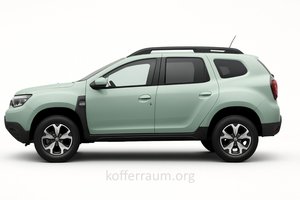
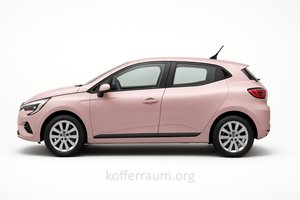
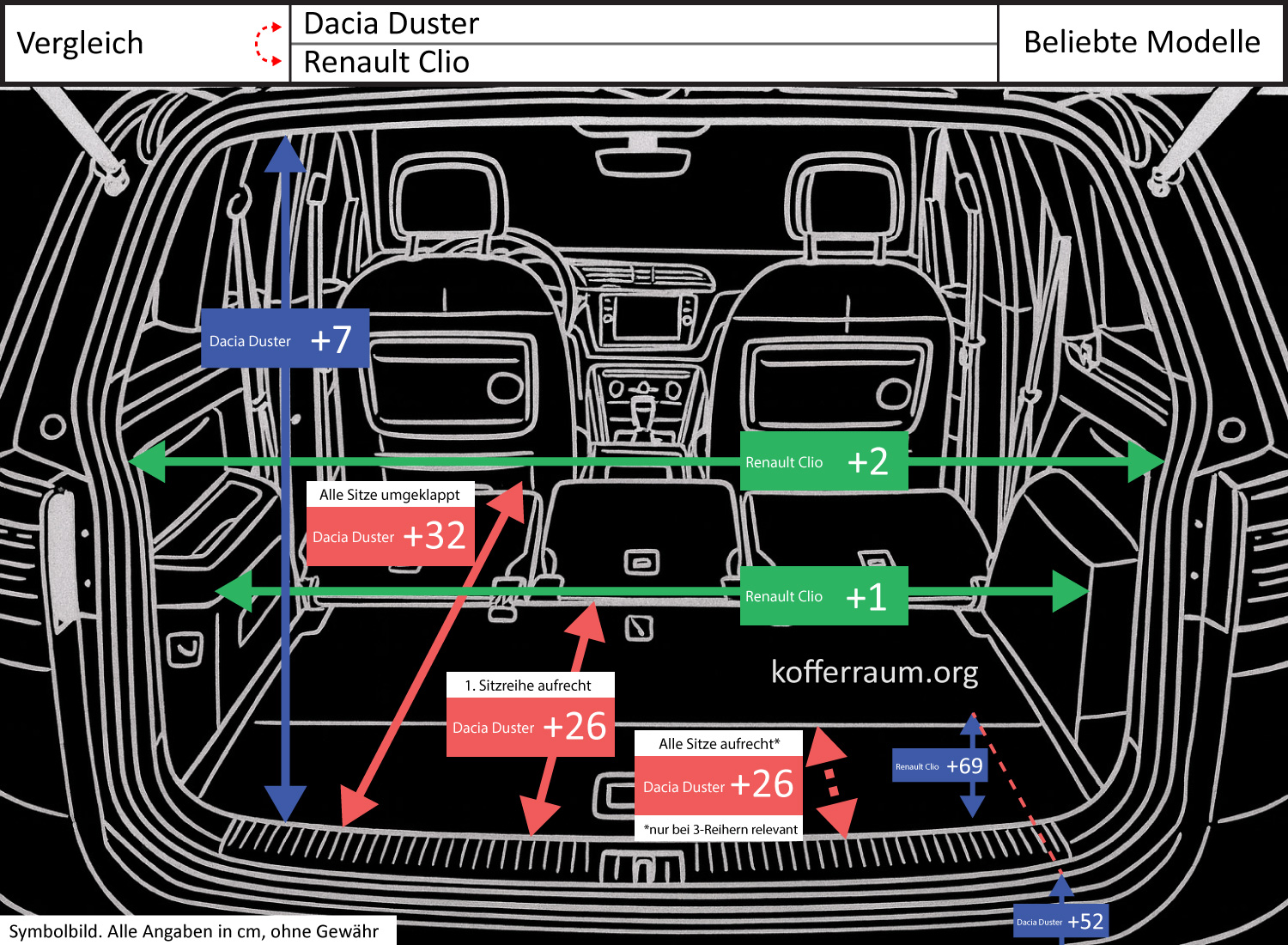
Key Differences (highlighted: >10%)
The Dacia Duster offers a 12.6 in (≈24%) longer cargo area with the seats folded down than the Renault Clio and with the front row upright, a 10.2 in (≈37%) longer trunk floor. The loading edge of the Duster is 20.5 in (≈217%) higher above the road than the Clio.
Conversely, the Renault Clio has a significantly greater depth between the loading edge and trunk floor: +27.2 in (≈863%) compared to the Duster. Smaller differences in widths (1–0.8 in) and opening height (2.8 in / 9%) are below the 10% threshold and are not highlighted here.
Impact on Usability
Practically, this means: The Duster is clearly better suited for long items and larger usable cargo space in lengthwise direction – such as furniture, long roof rack-compatible loads, or bulky items that need to extend beyond the rear seats.
However, the higher loading edge makes loading heavy items more strenuous: those who frequently lift heavy boxes or bulky things will have to exert more effort with the Duster.
The Clio offers more "depth space" below the loading edge due to the significantly greater depth between loading edge and trunk floor, which can make storing bulky but shorter or taller items easier and allows a deeper loading position (e.g., for tall luggage, boxes, or when a low center of gravity is desired).
However, the usable length is limited: the Clio is clearly less suitable for long items.
In summary: Duster = better for long and bulky cargo tasks, but with a higher loading edge (more lifting effort). Clio = better depth/vertical capacity and lower loading edge (easier lifting), but significantly shorter cargo length.