
Trunk comparison: Dacia Duster vs Skoda Karoq
Key Differences (more than 10%)
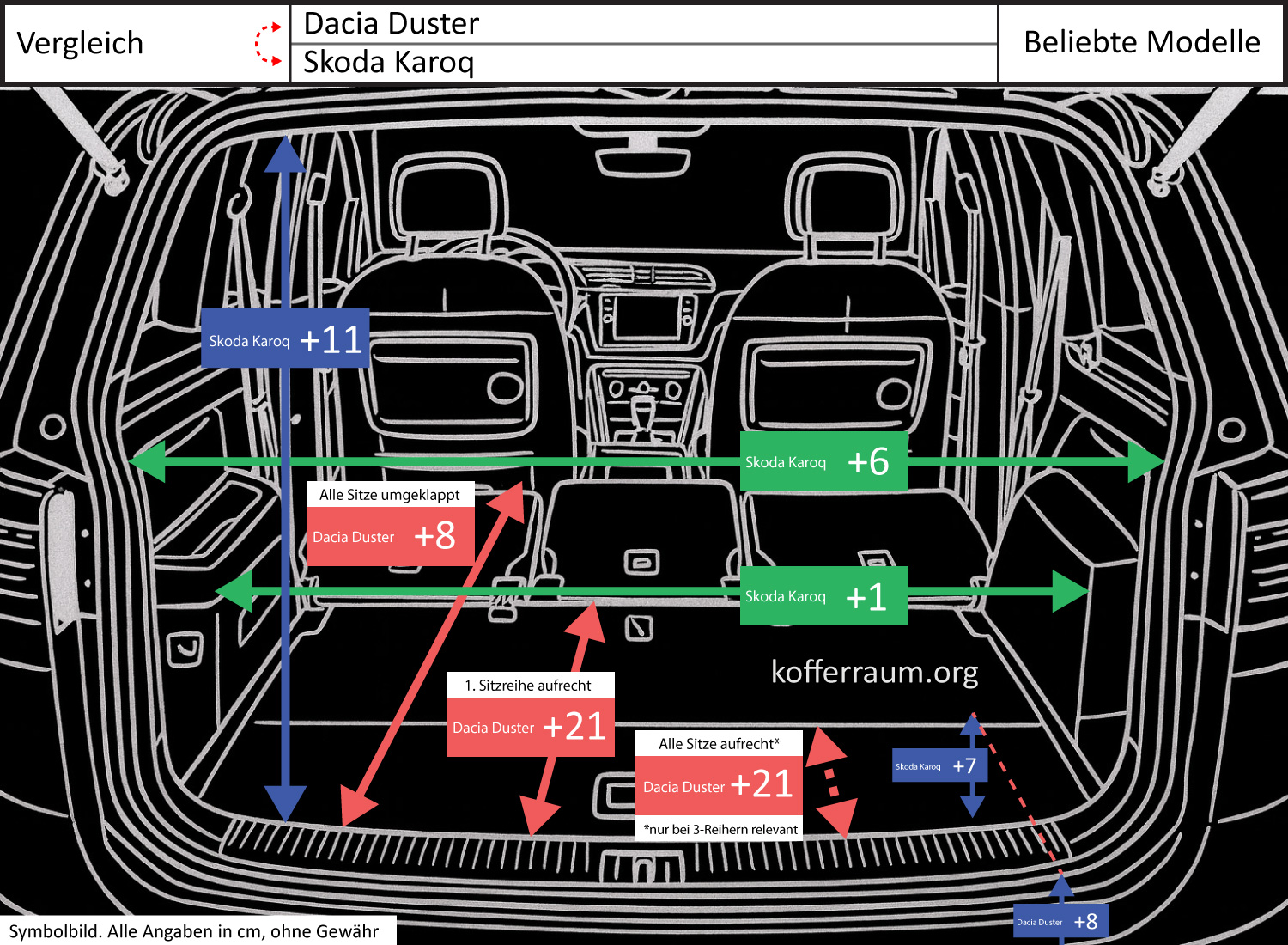
The Dacia Duster offers a significantly longer cargo floor with the front seats upright: +8.3 in (28%) compared to the Škoda Karoq. This makes the Duster more practical for everyday use when carrying long, flat loads (e.g., slats, long boxes, skis) with the rear seats in use.
In contrast, the Karoq has a higher trunk opening: +4.3 in (14%), which means taller items need to be tilted or angled less often when loading and bulky, upright cargo is easier to stow.
Another major difference concerns the depth of the cargo area (measurement from loading edge to trunk floor): the Karoq is +2.8 in (88%) "deeper" here.
Together with the lower loading edge of the Karoq (see below), this results in significantly more usable volume below the loading edge and makes storing bulky or voluminous items easier.
Conversely, the loading edge of the Duster is +3.1 in (12%) higher above the road, which makes lifting heavy loads in more difficult and loading heavy, low-lying items less comfortable.
Impact on Usability
For users who often need to transport long, flat items, the Duster with its longer cargo floor and upright rear seats is advantageous.
For those who frequently move bulky, tall, or heavy loads (e.g., moves, large boxes, furniture parts), the Karoq is better suited due to the higher opening, greater cargo depth, and lower loading edge: easier loading and more usable volume.
Other, Less Relevant Differences
Width differences are minor: the Karoq is +0.4 in (1%) wider at its narrowest point and the opening width is +2.4 in (6%) larger than the Duster. With the cargo area fully folded down, the Duster is only +3.1 in (5%) longer — here the practical difference is small.