
Trunk comparison: Dacia Duster vs VW ID.3
Key Differences
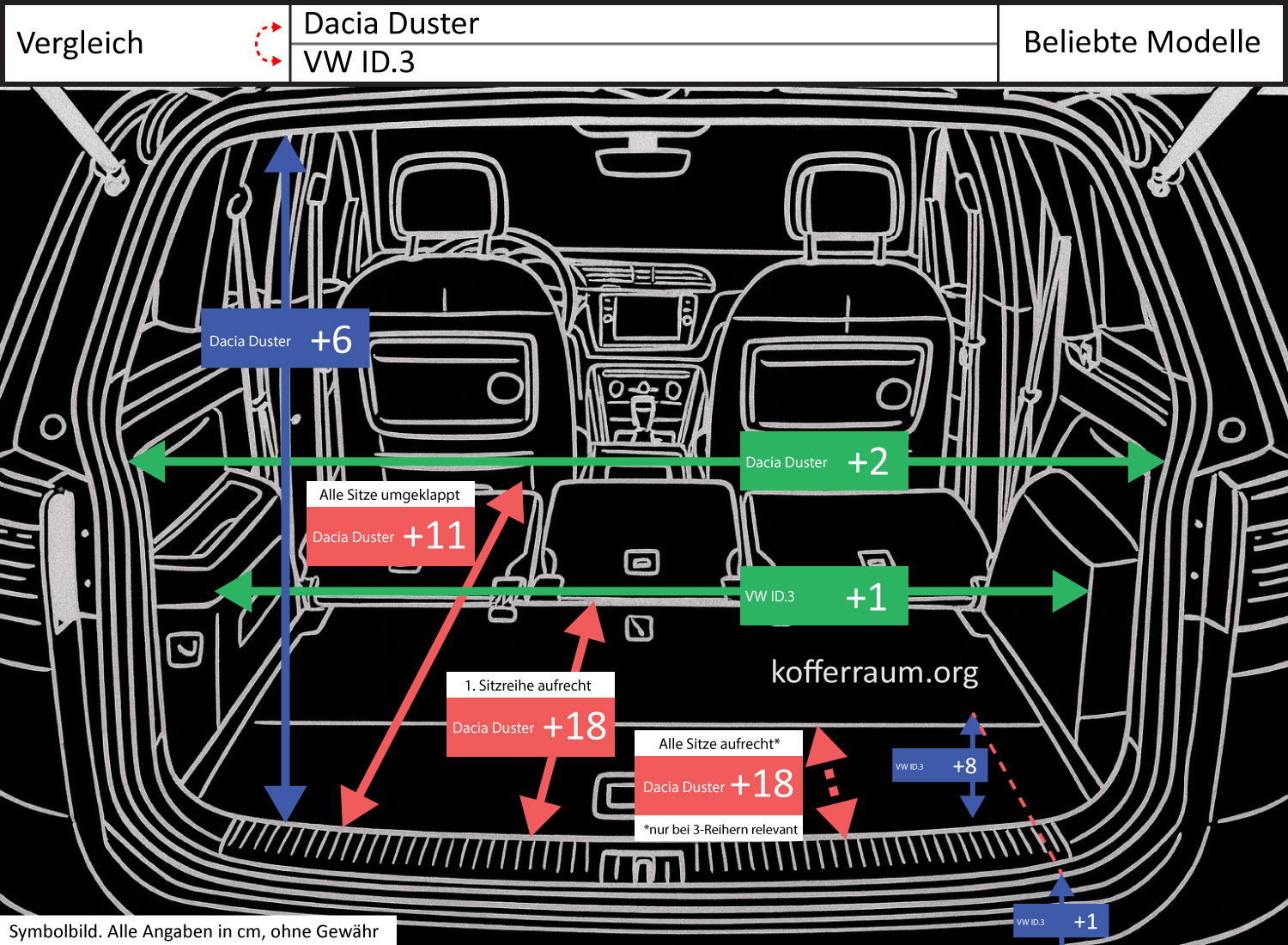
In the comparison, it is particularly noticeable that the Dacia Duster offers +7.1 in (23%) longer cargo length with the front seats upright, providing more space behind the rear seats than the VW ID.3. Conversely, the VW ID.3 has a significantly greater trunk depth between the loading edge and trunk floor: +3.1 in (100%) compared to the Duster.
All other mentioned differences (length with seats folded +4.3 in/7% in favor of the Duster, opening height +2.4 in/8% in favor of the Duster, loading edge height +0.4 in/1%, and width differences 1–0.8 in/1–2%) are comparatively small and fall below the 10% mark.
Impact on Usability
The longer cargo length of the Duster with the front seats upright makes it more practical when passengers need to remain in the rear seats while transporting long items (e.g., skis, slats, longer furniture parts, or bulky goods).
The Duster is therefore better suited for situations where cargo length with occupied seats is important.
The ID.3's twice as deep trunk means more space below the loading edge: heavy or stackable items can sit lower and thus be better recessed or concealed, which increases the usable interior height and volume in the lower area.
This is advantageous for bulky but not necessarily long cargo (large boxes, suitcases, groceries), but it can slightly complicate loading and unloading heavy items because they extend further into the trunk.
In practice, this means: for longer items with occupied rear seats, the Duster is often the more practical choice; for better usable volume in depth and for hiding/stacking cargo, the ID.3 scores points.
Smaller differences in width, opening height, and loading edge height are marginal and have little impact on everyday usability.