
Trunk comparison: Dacia Jogger vs Hyundai i10
Key Differences
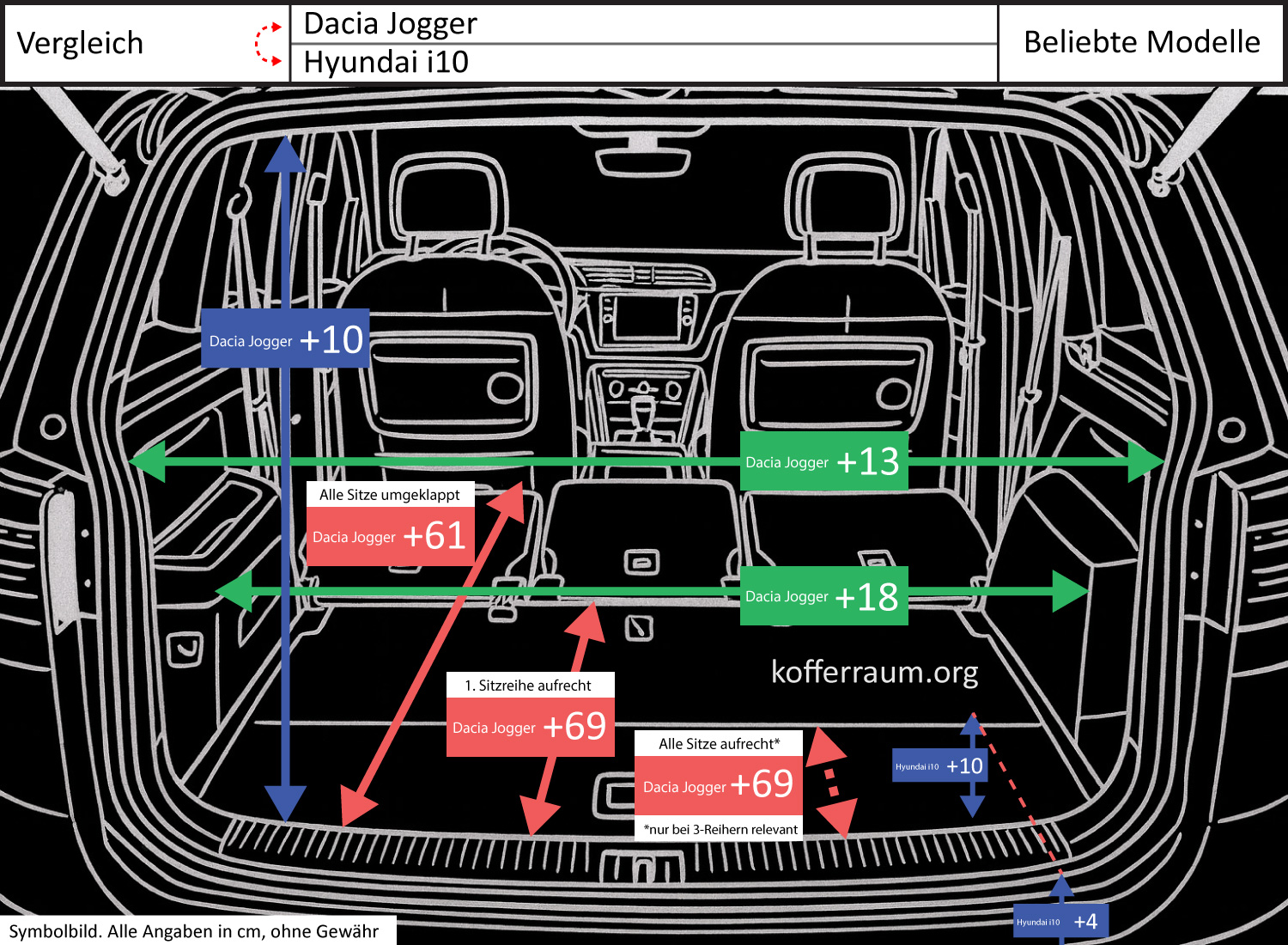
The Dacia Jogger offers significantly more usable cargo space: with the seats folded down, it is 24 in (52%) longer, and with the first row of seats upright even 27.2 in (147%) longer than the Hyundai i10. The trunk opening of the Jogger is also 3.9 in (12%) higher, the narrowest width in the trunk 7.1 in (17%) larger, and the opening width 5.1 in (14%) wider than in the i10. In the Hyundai i10, the trunk depth (distance from loading edge to trunk floor) is 3.9 in (125%) greater than in the Jogger; however, the loading edge above the road is only slightly (+1.6 in / 6%) higher in the i10.
What Impact Does This Have on Usability?
These differences make the Jogger overall much more practical for bulky and long cargo: the greater interior length (both with folded seats and with the first row upright) as well as the greater width and higher opening make it easier to load furniture, sports equipment, or long items and allow for more flexible use (family use, vacation luggage, DIY projects).
The higher opening reduces bumping when loading tall items.
The Hyundai i10, on the other hand, scores with a deeper cargo floor (greater depth between loading edge and trunk floor), so cargo sits deeper — this can make storing smaller, highly stable boxes safer and slightly lower the cargo’s center of gravity.
Due to the significantly shorter length and narrower opening, the i10 is less suitable for long or wide goods; it remains more of a practical city car for shopping and compact cargo. The slightly higher loading edge of the i10 moderately increases lifting effort when loading but has little effect on usability.