
Trunk comparison: Durchschnitt SUV vs Durchschnitt Subcompact


Key Differences
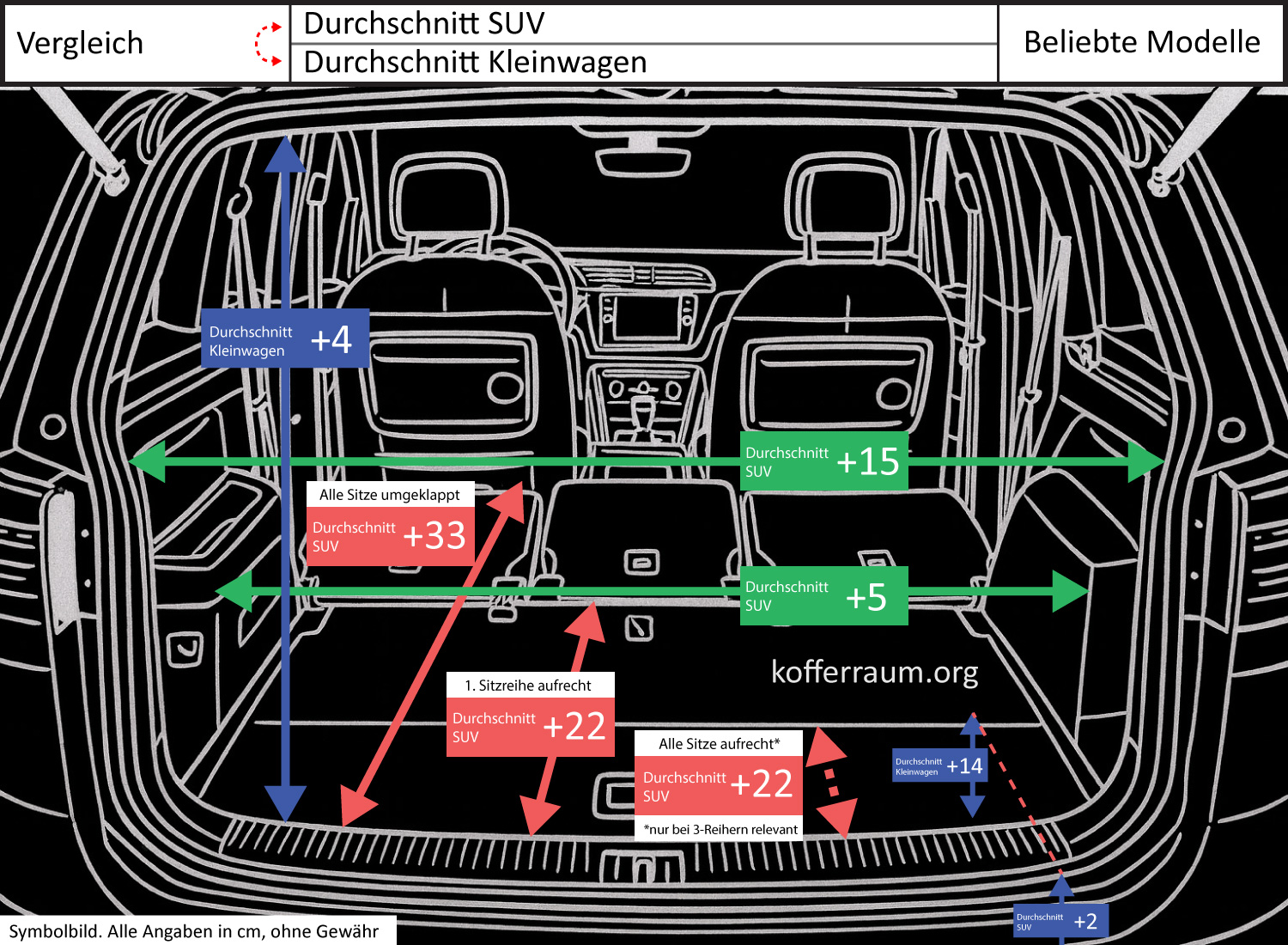
The average SUV offers significantly more cargo space lengthwise: with the seats folded down, its trunk is 13 in (+26%) longer, and with the first row of seats upright, it is even 8.7 in (+35%) longer than the average subcompact.
The width of the trunk opening on the SUV is also noticeably larger: 5.9 in (+16%). In contrast, the depth of the trunk (from loading edge to trunk floor) is significantly greater in the average subcompact, by 5.5 in (+280%).
Impact on Usability
The greater cargo length of the SUV improves usability for long items (e.g., skis, furniture parts, longer boxes) and increases total capacity with the seats folded down. The wider opening of the SUV makes it easier to maneuver wide or bulky cargo in and out, as less tilting or turning is required.
The significantly greater depth in the subcompact means the trunk floor lies further below the loading edge.
This creates more vertical space inside below the opening for flat or stacked items, but can make lifting heavy loads over the loading edge more difficult and offers less clearance to the opening for tall loads (the opening height is only slightly larger in the subcompact).
Practically speaking: for occasional transport of long or wide items and flexible loading during moves or shopping, the SUV is often the better choice.
For storing flat or vertically low-positioned cargo in a deeper load well, the subcompact can offer advantages, though at the cost of somewhat more awkward lifting of heavy loads.