
Trunk comparison: Durchschnitt SUV vs Durchschnitt Wagon

Key Differences
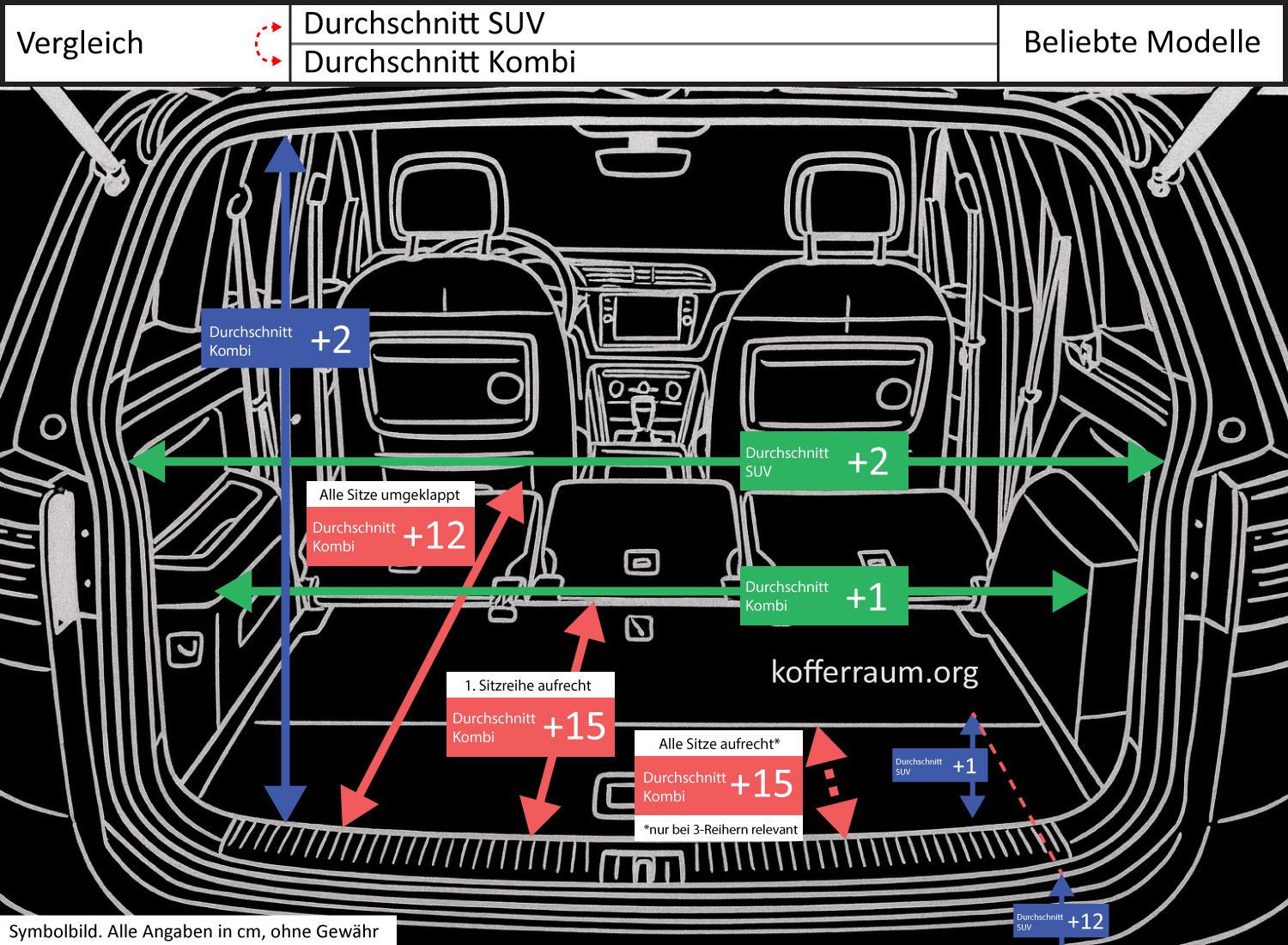
The most significant advantage of the wagon lies in the loading length with the first row of seats upright: The average wagon has a loading surface that is 5.9 in longer (+18%) than the average SUV, making it clearly more suitable for long items.
On the SUV side, two larger differences stand out: The depth of the trunk (from loading edge to trunk floor) is 0.4 in deeper (+25%), and the loading edge is 4.7 in higher above the road (+19%) than in the wagon.
Impact on Usability
The longer loading length of the wagon with the rear seats upright means specifically: long items (e.g., boards, skis, ladders) can be transported more easily without folding down seats. For users who frequently carry long or bulky items, the wagon is therefore more practical in everyday use.
In the SUV, the greater trunk depth measurement (despite only a 0.4 in absolute difference) means the loading floor lies slightly deeper; this can create a bit more vertical space above the loading edge inside, but in practice, this is only a marginal advantage.
The much more relevant effect is the higher loading edge: lifting heavy items into the trunk is more strenuous and less practical than with the wagon.
The combination of a higher loading edge and a slightly deeper floor results in a similar total loading height relative to the interior edge but does not make loading heavy loads easier.
All other differences are minor (<10%): trunk length with seats folded down (+7% in favor of the wagon), trunk opening height (+3% in favor of the wagon), as well as width differences at the narrowest point (+1% for wagon) and at the opening (+2% for SUV). These deviations hardly affect everyday usability and make the vehicles largely comparable in these aspects.