
Trunk comparison: Fiat Panda vs Durchschnitt Subcompact
Key Differences
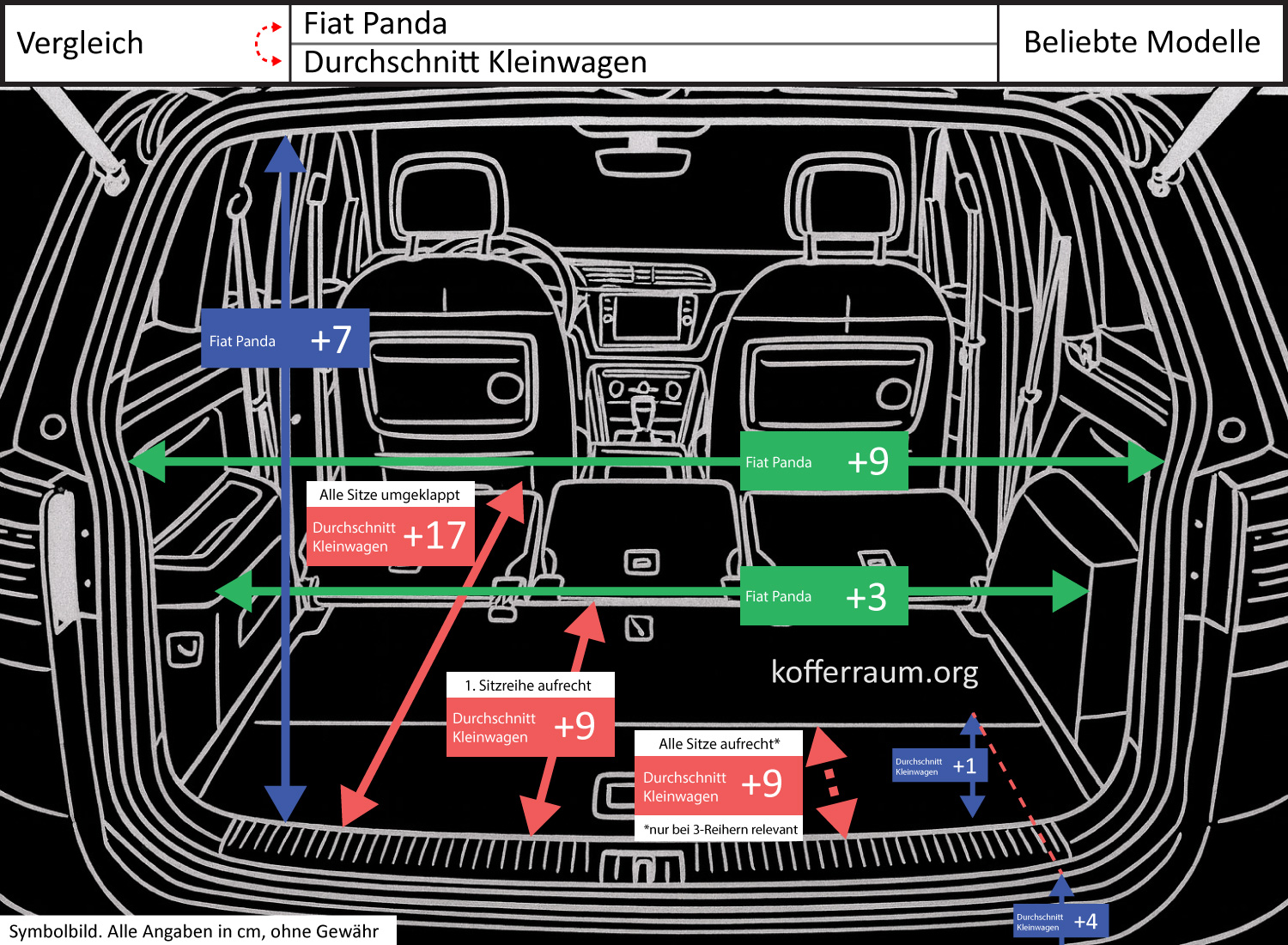
The main advantage of the average subcompact lies in the loading length: With the rear seat folded down, the average subcompact offers 6.7 in (15%) more trunk length than the Fiat Panda. Even with the front seats upright, the difference is clear: the average subcompact has 3.5 in (17%) more cargo length.
Other measurements (under 10% difference): The Panda's trunk opening is 2.8 in (9%) higher, the opening width of the Panda is 3.5 in (10%), the narrowest width in the Panda is 1.2 in (3%) larger, the loading edge height of the average is 1.6 in (6%) higher, and the trunk depth difference is 0.4 in (6%) in favor of the average.
Impact on Usability
More cargo length in the average subcompact means practically: longer items (e.g., skis, parquet slats, pipes, or longer luggage) can be more easily and often completely transported inside the vehicle — both with the rear seat folded and with the normal seating position.
In everyday situations, this means greater flexibility when shopping, moving on a small scale, or achieving a flat loading surface for long items.
The Fiat Panda scores in shape and accessibility: the higher trunk opening and larger opening width make loading tall or bulky items easier (e.g., boxes, tall suitcases, strollers).
The lower loading edge of the Panda makes lifting heavy loads somewhat easier. These advantages are especially relevant when length is less important, but easy loading and space for bulky, not-so-long items matter.
Conclusion: Those who frequently transport long goods or regularly need maximum cargo length are better served by the average subcompact. Those who often load bulky, tall, or heavy-to-lift items and value easy accessibility benefit from the Fiat Panda.