
Trunk comparison: Fiat Panda vs Ford S-MAX
Key Statement
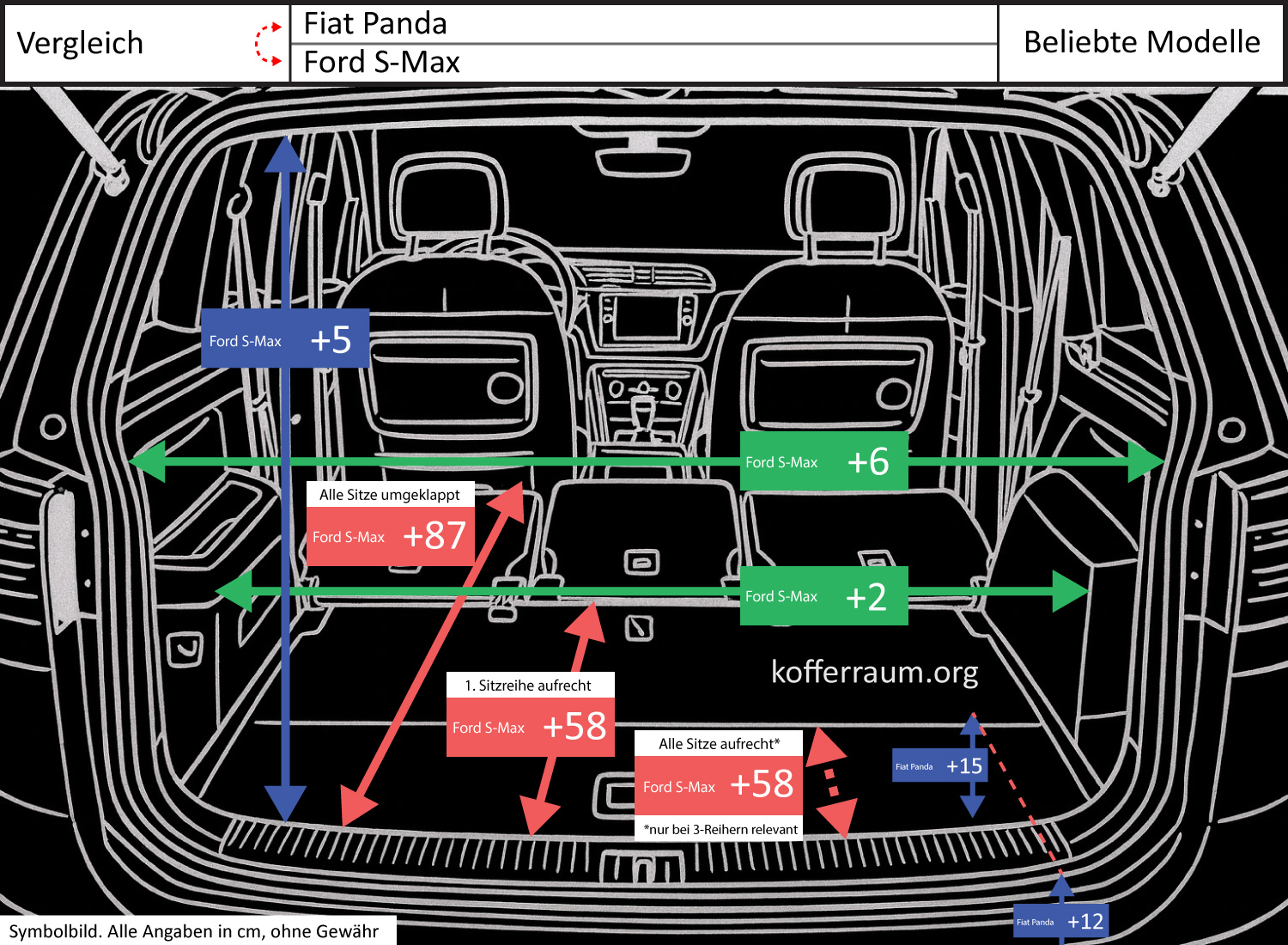
The Ford S‑Max offers significantly more cargo length, while the Fiat Panda has a notably deeper cargo floor and a higher load lip. These four differences determine the practical usability of both models.
Main Differences (over 10%)
When all seats are folded down, the trunk of the Ford S‑Max is 34.3 in (≈78%) longer than that of the Fiat Panda; with the first row of seats upright, the S‑Max's advantage is even 22.8 in (≈107%). This makes the S‑Max clearly superior for longer or bulky items.
The Fiat Panda, on the other hand, has a 5.9 in (≈500%) deeper cargo floor (distance from load lip to trunk floor) – it therefore has a distinctly pronounced cargo well. Additionally, the load lip of the Panda is 4.7 in (≈21%) higher above the road, which makes lifting heavy loads more difficult.
Practical Implications
For transporting long items (skis, slats, furniture parts) and for maximum flexibility with folded seats, the S‑Max is clearly advantageous: the significantly greater cargo length allows for flat, level loading and reduces the need to disassemble or tilt cargo.
The slightly larger opening dimensions of the S‑Max (small advantages in height/width under 10%) also support loading but are secondary.
The Panda is better suited if items are to lie in a deeper cargo well or if a small, separated cargo area is preferred (e.g., loose parts that should not shift).
However, the 4.7 in higher load lip increases the physical effort required to lift heavy loads into the trunk; this is noticeable in everyday use, especially in urban contexts without lifting aids.
Conclusion
For families, transport, or regular use with long/bulky items, the Ford S‑Max is the more practical choice due to its significantly greater cargo length.
The Fiat Panda offers a deeper cargo well, which can be useful for certain small or low-lying loads but comes at the expense of loading and unloading comfort due to the higher load lip.