
Trunk comparison: Fiat Panda vs Opel Grandland
Key Differences (Summary)
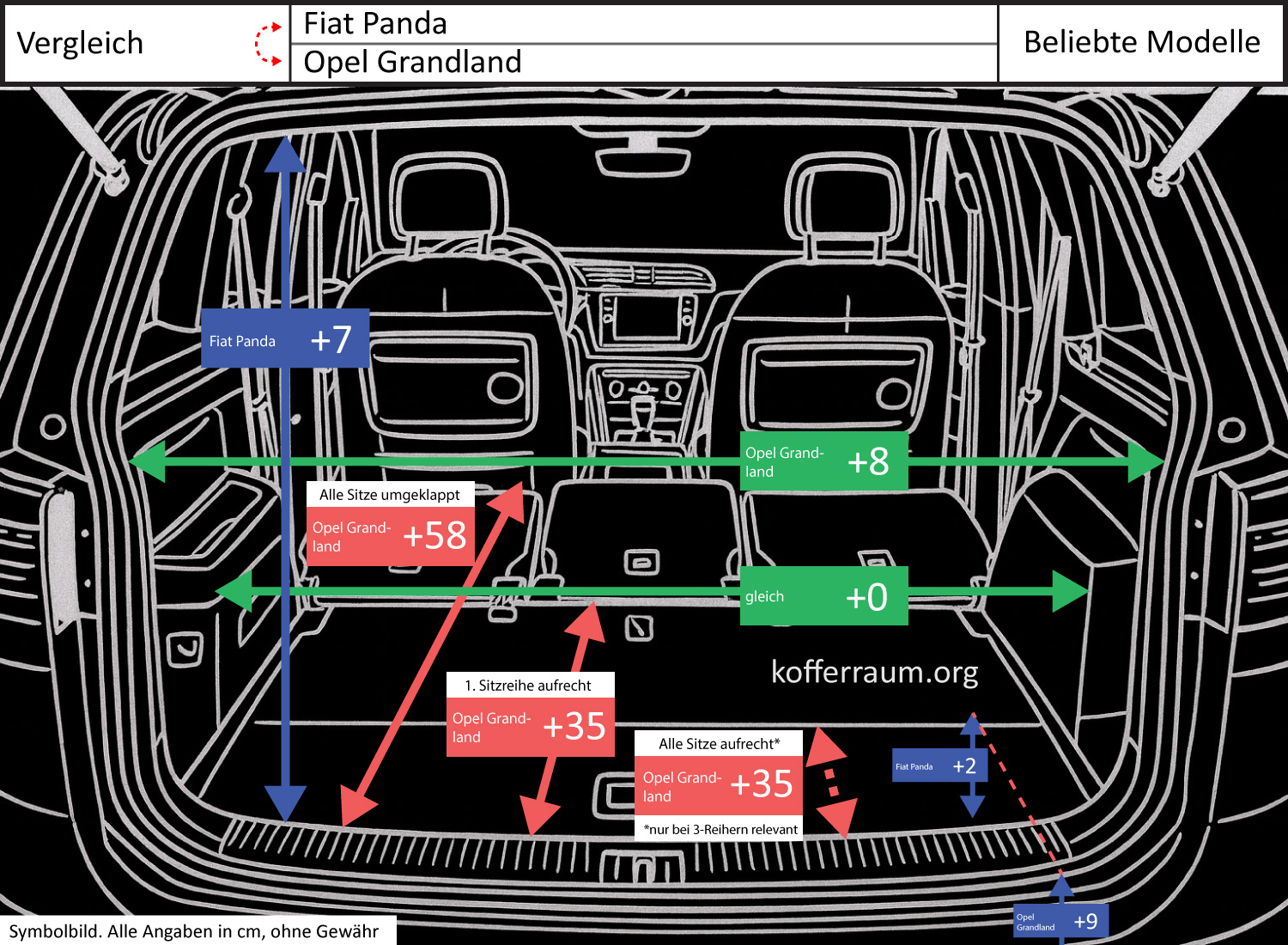
Opel Grandland offers significantly more cargo length: With the seats folded down, the Grandland's trunk is +22.8 in (52%) longer, and with the first row upright, it is +13.8 in (65%) longer than the Fiat Panda's.
Fiat Panda has greater trunk depth and a lower loading edge: The depth (loading edge → trunk floor) is +0.8 in (13%) greater in the Panda, and the Grandland's loading edge is +3.5 in (13%) higher above the road – meaning the Panda has the lower loading edge.
Smaller or not significant differences: The height of the trunk opening is +2.8 in (9%) greater in the Panda (under 10%), the width of the opening is +3.1 in (8%) greater in the Grandland (under 10%), and the narrowest trunk width is the same in both.
What practical effects result from this?
For longer or bulky items, the Opel Grandland is clearly advantageous: the significantly greater cargo length (52% or 65% more) allows transporting longer furniture, sports equipment (e.g., bicycles with the front wheel removed), or transport boxes without complicated folding/repositioning.
If long items need to be transported regularly, the Grandland is the more practical choice.
The Fiat Panda scores when loading and unloading heavy or frequently carried items: the lower loading edge (13% lower) reduces lifting over the sill, and the greater trunk depth (13%) can make storing tall or bulky luggage easier.
In the city, when shopping, or frequently handling boxes and luggage, the Panda is more comfortable.
Since the narrowest loading width is the same and the differences in opening width and height are under 10%, both vehicles offer similar possibilities for wide but not particularly tall items; there is no clear advantage here.
Conclusion
Opel Grandland = better for long, bulky cargo and higher overall capacity. Fiat Panda = better for simple, ergonomic loading and unloading as well as frequent, heavy, or tall individual items in everyday use. The decision depends on the typical usage profile: length/volume vs. handling and comfort when loading.