
Trunk comparison: Fiat Panda vs Volvo XC60

Key Differences
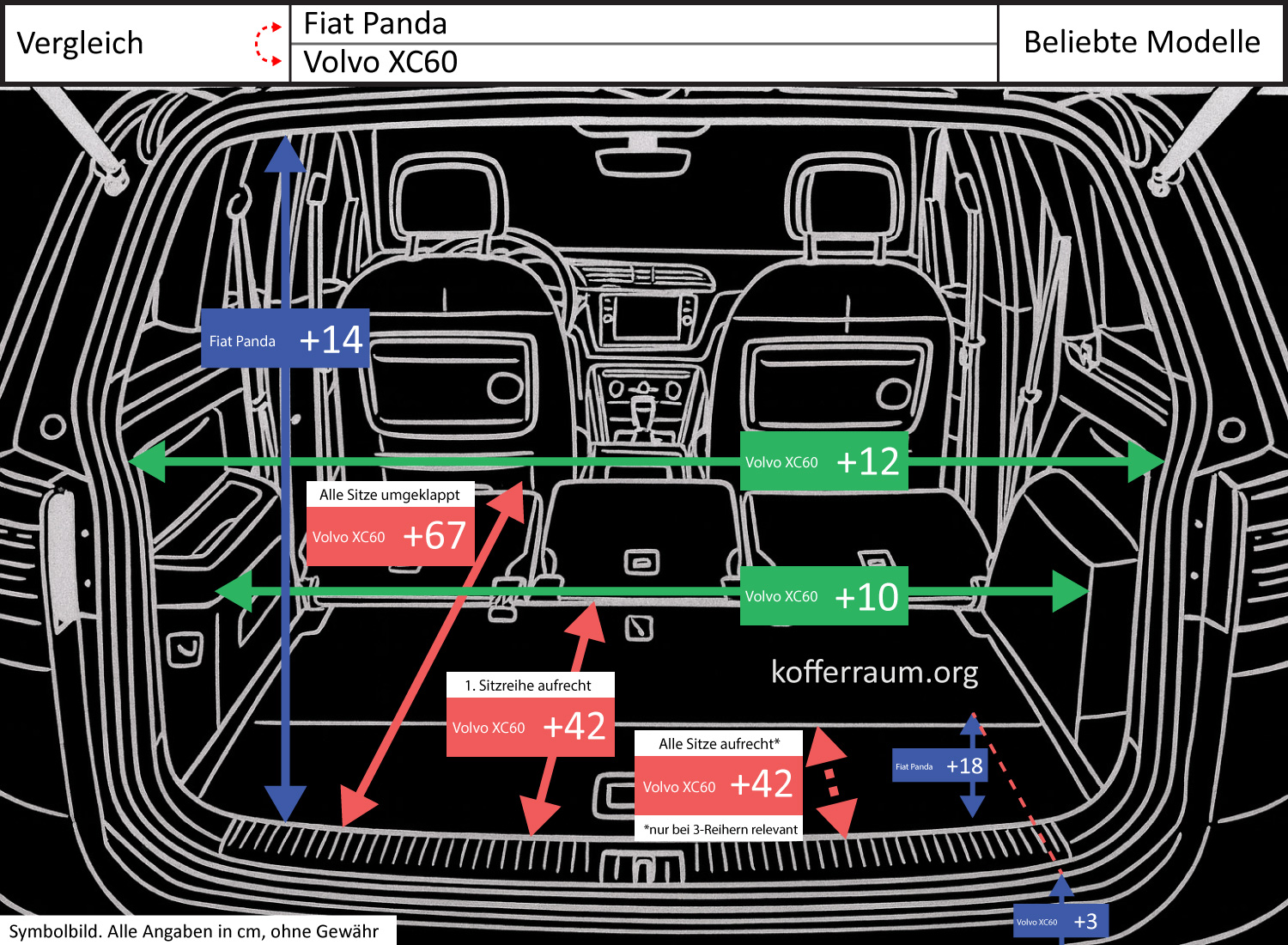
The Volvo XC60 offers significantly more cargo length: with the seats folded down, the trunk is 26.4 in (60%) longer and with the first row of seats upright, 16.5 in (78%) longer than the Fiat Panda. This means noticeably more usable cargo space in the longitudinal direction.
The width of the trunk opening is also larger in the Volvo: by 4.7 in (12%), which makes loading and unloading wider items easier.
The Fiat Panda, on the other hand, scores with a higher opening and a significantly deeper cargo well: the trunk opening is 5.5 in (19%) higher, and the distance from the loading edge to the trunk floor is 7.1 in (1700%) greater than in the XC60. This combination results in a deeper loading surface below the loading edge.
The loading edge height of the XC60 is only slightly higher (+1.2 in / 4%) and the narrowest trunk width in the XC60 is 10% larger — these values are smaller in comparison and affect practical use less strongly.
Impact on Usability
For transporting long or bulky items (boards, furniture parts, skis, long luggage), the Volvo XC60 is clearly more advantageous: the longer loading dimensions and the wider opening make loading easier and provide more flexible storage space for trips or moves.
The Fiat Panda is better suited when a high opening and a deep cargo well are important: the higher opening allows easy loading of tall, upright items, and the deeper loading surface offers space below the loading edge (good for bulky but not very long cargo or for hidden/staggered storage).
At the same time, the deeper cargo well can make lifting heavy items in somewhat more cumbersome because more leverage or effort may be required to place them.
In short: Those who need longer, wider cargo or significantly more volume in the longitudinal direction are better served by the Volvo XC60. Those who frequently load tall items or benefit from a deeper cargo well (e.g., staggered storage below the loading edge) will find advantages in the Fiat Panda.