Trunk comparison: Fiat Panda vs VW T-Cross
Key Differences (>10%)
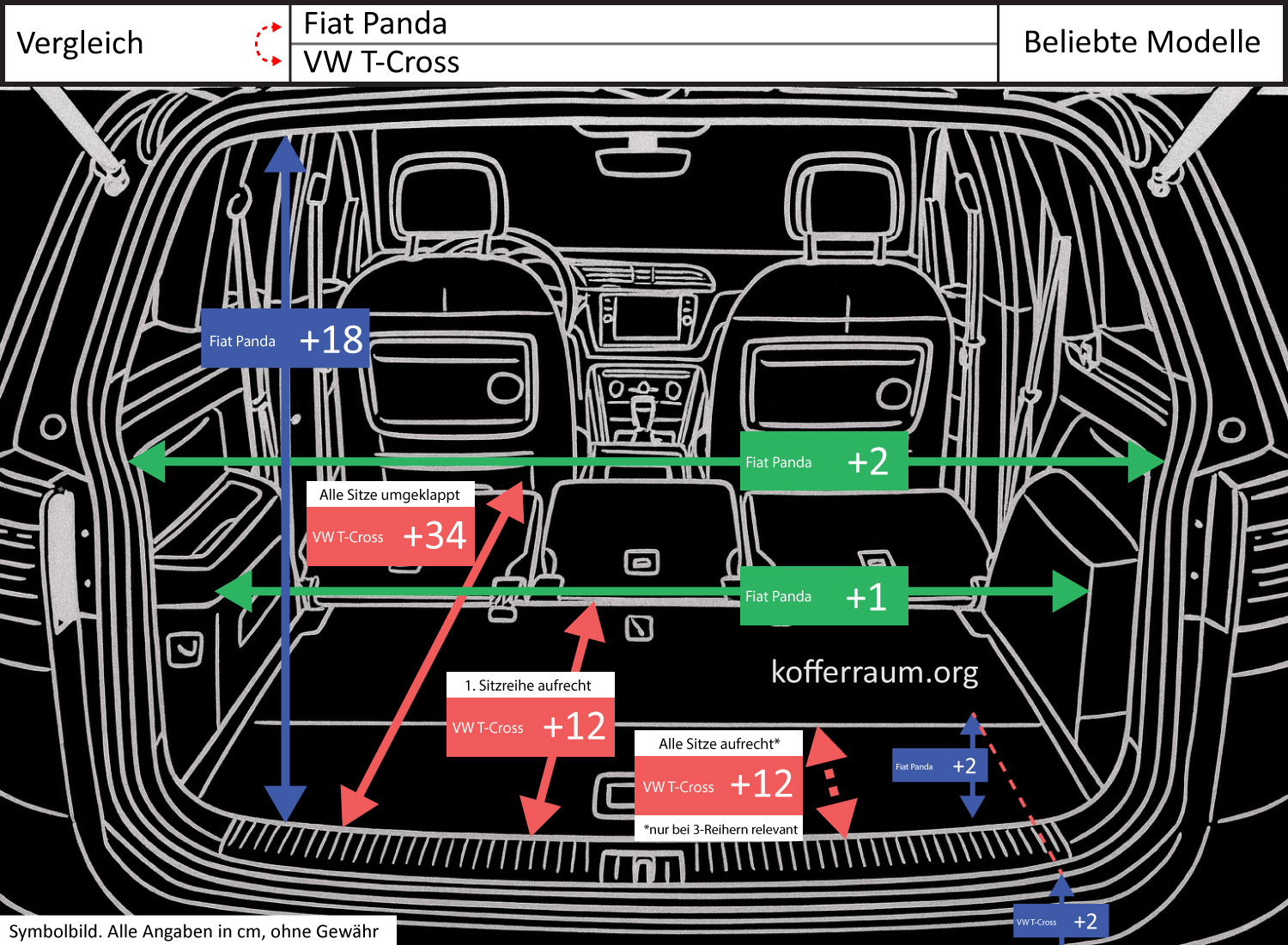
The VW T‑Cross offers significantly more cargo length: With the seats folded down, the trunk is 13.4 in (≈31%) longer, and with the seats upright, it is 4.7 in (≈22%) longer than the Fiat Panda.
This makes the T‑Cross noticeably more practical for long or flat items (furniture parts, slats, long boxes, skis) and increases flexibility when transporting larger objects — often it is enough to fold the seats partially or not at all.
The Fiat Panda has significantly more vertical space: The trunk opening is 7.1 in (≈26%) higher and the interior height from the loading edge floor is 0.8 in (≈13%) greater than in the T‑Cross.
As a result, higher or bulky items are easier to load in the Panda, bulky boxes or taller loads are less likely to touch the roof edge in the cargo area.
Additionally, the slightly lower loading edge height of the Panda is advantageous when lifting heavy items (the loading edge of the T‑Cross is only about 0.8 in higher).
What does this mean in practice?
- Those who frequently transport long, flat, or bulky items (e.g., DIY supplies, long sports equipment) have a clear advantage with the T‑Cross due to the greater cargo length.
- Those who often load tall or voluminous items (tall boxes, plants, bulky suitcases) and value easy vertical loading benefit more from the Panda because of the higher opening and greater interior height.
- For everyday shopping and normal luggage, both are practical; the differences in side width are small, so the usable cargo width is comparable.
Smaller Differences (<10%)
The width at the narrowest point is only 0.4 in (≈1%) larger in the Panda, and the width of the trunk opening is 0.8 in (≈2%) larger. The loading edge of the T‑Cross is 0.8 in (≈3%) higher above the road. These values are small and have little impact on usability in everyday life.