
Trunk comparison: Ford Focus Wagon vs Kia Stonic
Key Differences
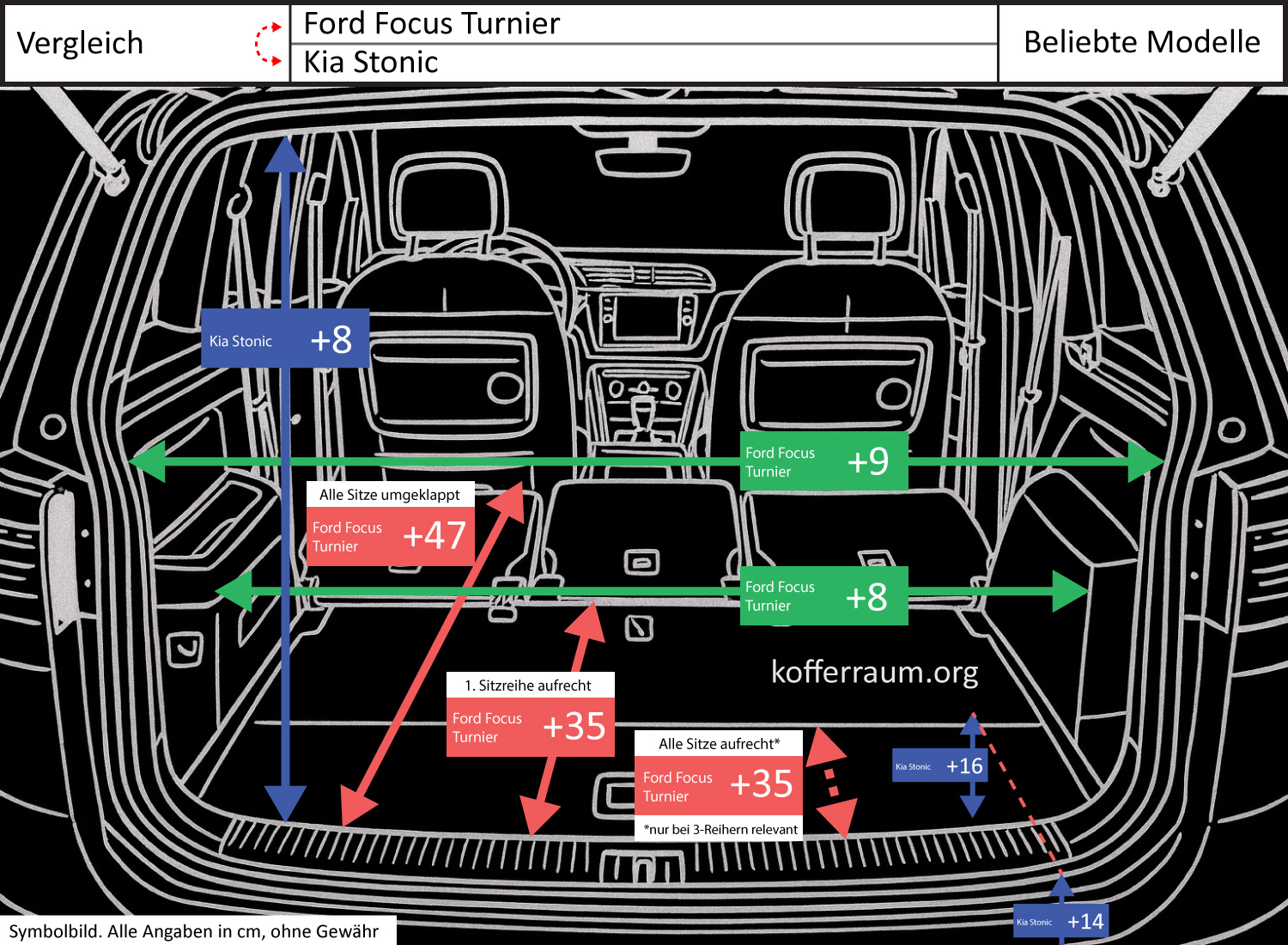
The Ford Focus Wagon offers significantly more cargo space: with the seats folded down, the trunk is 18.5 in (34%) longer, and with the first row of seats upright, it is even 13.8 in (51%) longer than in the Kia Stonic.
In contrast, the Kia Stonic has a higher opening and a deeper cargo well: the trunk opening is 3.1 in (11%) higher, the depth from the loading edge to the trunk floor is 6.3 in (800%) greater, and the loading edge is 5.5 in (22%) higher above the road.
The width of the trunk at its narrowest point (+3.1 in / 8%) and the width of the trunk opening (+3.5 in / 9%) are larger in the Focus but fall below the 10% threshold and are not highlighted here.
Impact on Usability
The greater usable length in the Focus Wagon makes it more practical for long or flat cargo: furniture parts, long planks, skis, or multiple suitcases can be transported more easily, especially when the seats are folded down.
The slightly greater width (under 10%) supports loading wider items but contributes only marginally to everyday usability.
The Kia Stonic scores in handling tall and vertically challenging cargo: the higher opening makes it easier to load tall items, the greater depth (loading edge to floor) provides additional "seating space" downward, allowing bulky or tall cargo to sit deeper and more stable.
At the same time, the 5.5 in higher loading edge makes lifting heavy items into the trunk more strenuous — especially with frequent loading and unloading, this can be a disadvantage.
In summary: For long, flat, or predominantly bulky cargo, the Ford Focus Wagon is the better choice. For tall or vertically bulky cargo, where space below the loading edge and a larger opening are important, the Kia Stonic is more suitable — albeit at the cost of significantly higher loading height effort.