
Trunk comparison: Ford Focus Wagon vs Volvo V90


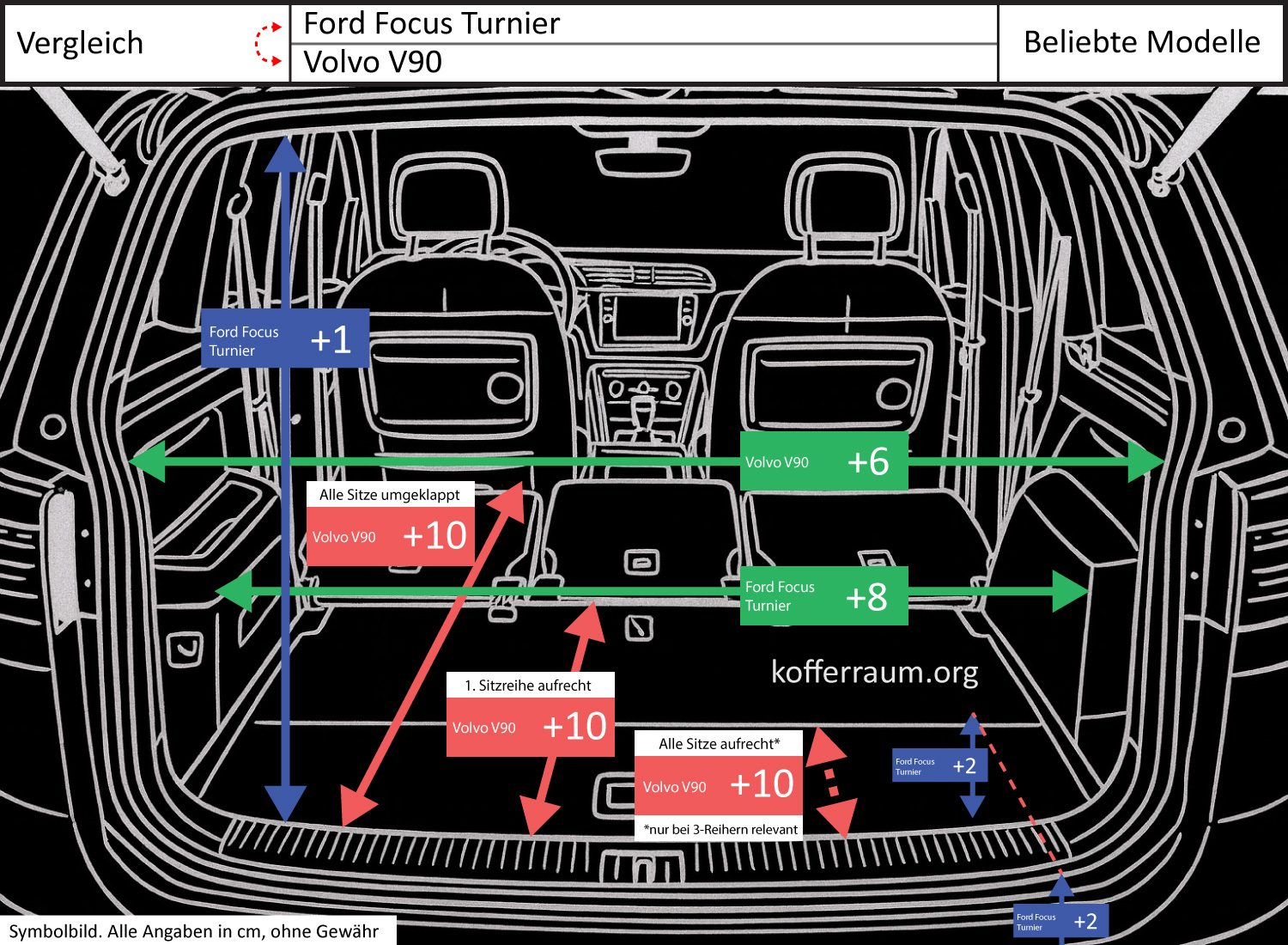
Key Differences and Implications for Usability
The Volvo V90 offers more cargo length: with the seats folded down, the advantage is +3.9 in (≈5%), and with the first row upright +3.9 in (≈10%). The trunk opening is +2.4 in (≈6%) wider on the Volvo, which makes loading wider items easier. The Ford Focus Wagon has +3.1 in (≈8%) more width at the narrowest point inside, an opening height that is +0.4 in (≈1%) higher, and a loading edge that is +0.8 in (≈3%) higher above the road.
Practically, this means a significantly larger usable recess directly behind the loading edge in the Ford: angular or tall items can be more easily accommodated there, loose cargo sits more stably, and when stacking from the loading edge up, more space remains. This is especially useful for crates, toolboxes, or other items that are to be placed immediately behind the loading edge. For everyday usability, this means: - Those who need to transport longer items (boards, skis, etc.) benefit more from the Volvo due to the longer loading surface and the wider opening. - Those who often have bulky but less long or compactly placeable cargo (crates, tools) benefit from the Ford due to the greater floor depth directly behind the loading edge and the larger usable interior width at the narrowest point. - The slightly higher loading edge of the Ford (+0.8 in) makes lifting minimally more strenuous; however, the differences in opening height and width are relatively minor and only noticeably affect special loading cases. Conclusion: Volvo = advantage in length and easier loading of wider parts; Ford = advantage in usable floor depth directly behind the loading edge and at the narrowest interior width, which facilitates storing space-intensive, compact goods.