
Trunk comparison: Ford Focus Wagon vs VW ID.3
Key Differences (>10%)
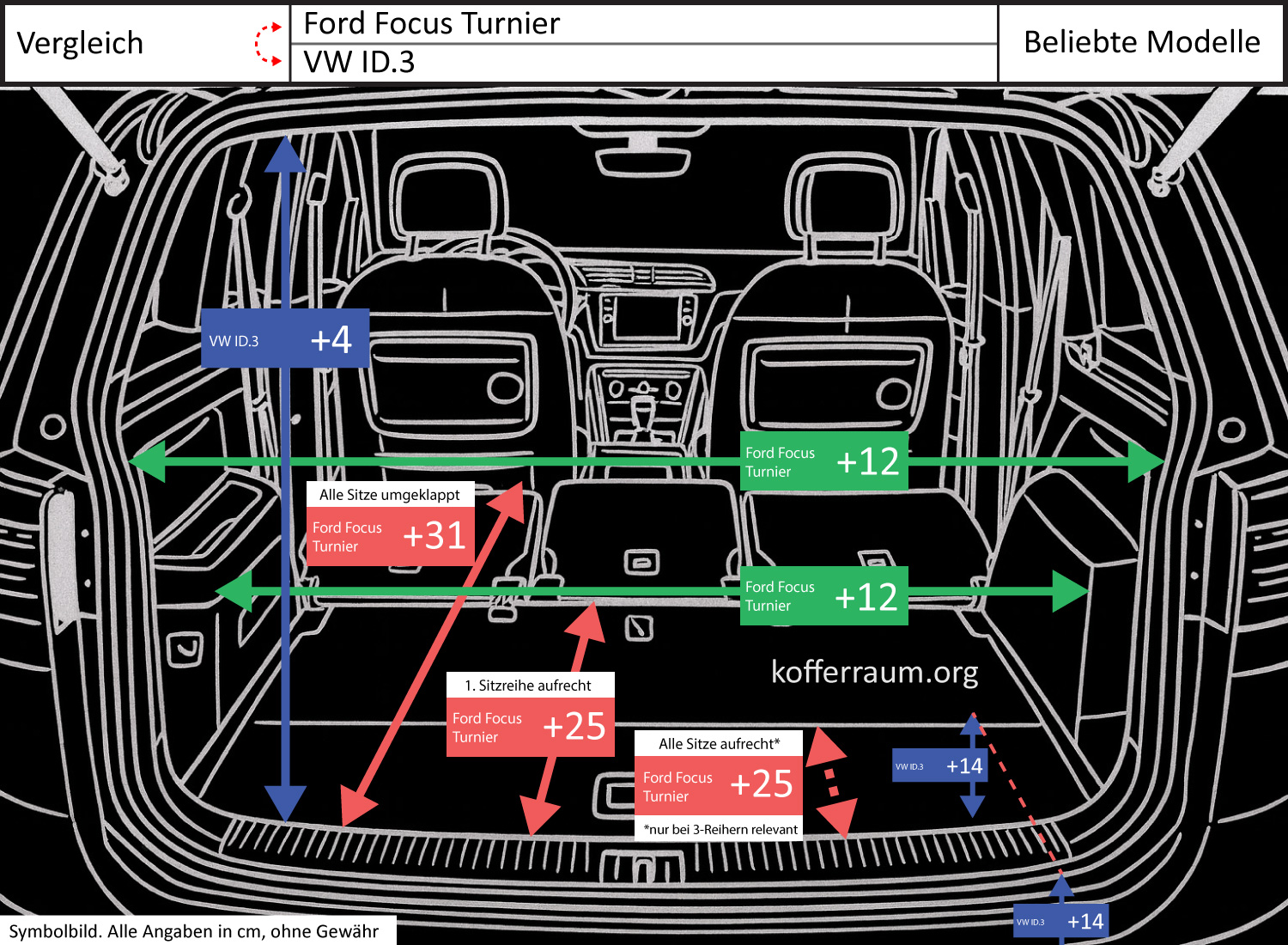
The Ford Focus Wagon offers a significantly longer cargo space: with the seats folded down, it is 12.2 in (20%) longer, and with the front seats upright, 9.8 in (32%) longer.
This makes the Focus clearly more suitable in practice for long items (e.g., slats, skis, furniture parts) and for transports where the rear seats are to be used without sacrificing length.
The trunk depth (loading edge to trunk floor) is 5.5 in (700%) greater in the VW ID.3. This means a significantly deeper cargo well in the ID.3: items sit further below the loading edge.
This increases the usable installation depth and allows storing taller or bulkier cargo below the edge, but makes handling and removing items more cumbersome.
The loading edge of the VW ID.3 is 5.5 in (22%) higher above the road. Together with the greater trunk depth, this results in a different loading experience: with the ID.3, more lifting is required to load items into the trunk, and larger movements are needed when removing them.
For heavy or frequently loaded items, this is a disadvantage compared to the lower-positioned Focus.
The Ford Focus Wagon is wider in the cargo area and at the opening: at the narrowest point and at the opening about +4.7 in (12–13%). This simplifies storing wider or bulkier items and maneuvering when loading – bulky parts fit more easily through the opening.
Other, Smaller Differences
The height of the trunk opening is 1.6 in (6%) greater in the VW ID.3. This smaller advantage helps when handling tall items but is less decisive compared to the differences mentioned above.
Conclusion on Usability
For users who often transport long or wide items or value easy, low-fatigue loading, the Ford Focus Wagon is more advantageous: more length, wider cargo space, and a lower loading edge make loading easier and more practical for everyday transports.
The VW ID.3 offers a different usability through its significantly deeper cargo well: it allows storing cargo further below the loading edge (potentially safer and more space-saving) but makes lifting heavy loads more difficult due to the higher loading edge.