
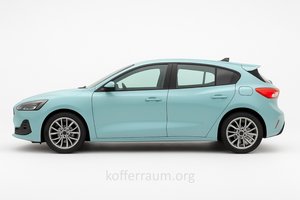
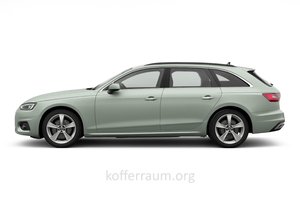
Trunk comparison: Ford Focus vs Durchschnitt Wagon
Biggest Differences
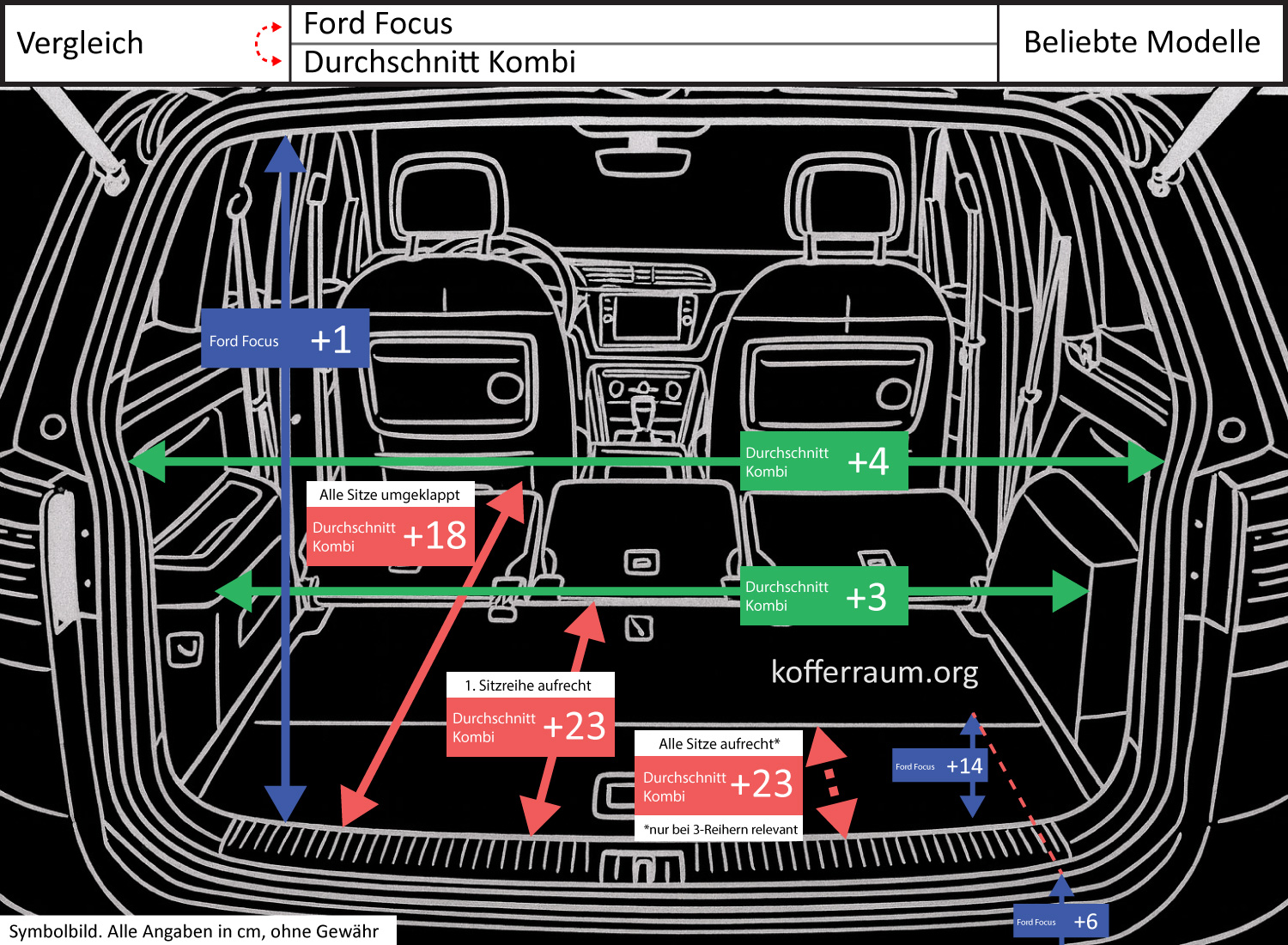
The average wagon offers significantly more cargo length: with seats folded down +7.1 in (12%) and with the front seat row upright +9.1 in (30%) compared to the Ford Focus. Conversely, the Focus has a significantly greater depth between the loading edge and the trunk floor: +5.5 in (350%).
What does this mean in practice?
More cargo length in the wagon means longer items (e.g., furniture boards, skis, long boxes) can be accommodated more easily and more often without tricks—both with folded seats and in everyday use with the rear seat upright.
This makes the wagon the better choice if you frequently transport long loads or need a lot of flexibility in cargo length for family use.
The significantly greater depth of the Focus between the loading edge and floor increases the usable installation depth directly behind the loading edge.
Practically, this means bulky or tall items can be placed lower, creating more "depth" when loading and allowing smaller stacks to be better secured. This can be advantageous for transporting deeper, bulky cargo (e.g., stacked crates, low-lying boxes).
Other differences are small and affect everyday usability less noticeably: The loading edge of the Focus is 2.4 in higher above the road (making lifting heavier loads somewhat more strenuous), and the trunk opening and narrowest width are only a few centimeters larger on the wagon—this hardly changes usability for wide items.
Conclusion
For frequent transport of long items or when a lot of space is needed with the rear seat upright, the wagon is clearly advantageous.
The Ford Focus, on the other hand, offers an unexpectedly large depth behind the loading edge, which helps when storing deep or bulky cargo, while smaller differences in width and opening height hardly matter.