
Trunk comparison: Ford Focus vs Durchschnitt Compact SUV


Main Differences (>10%)
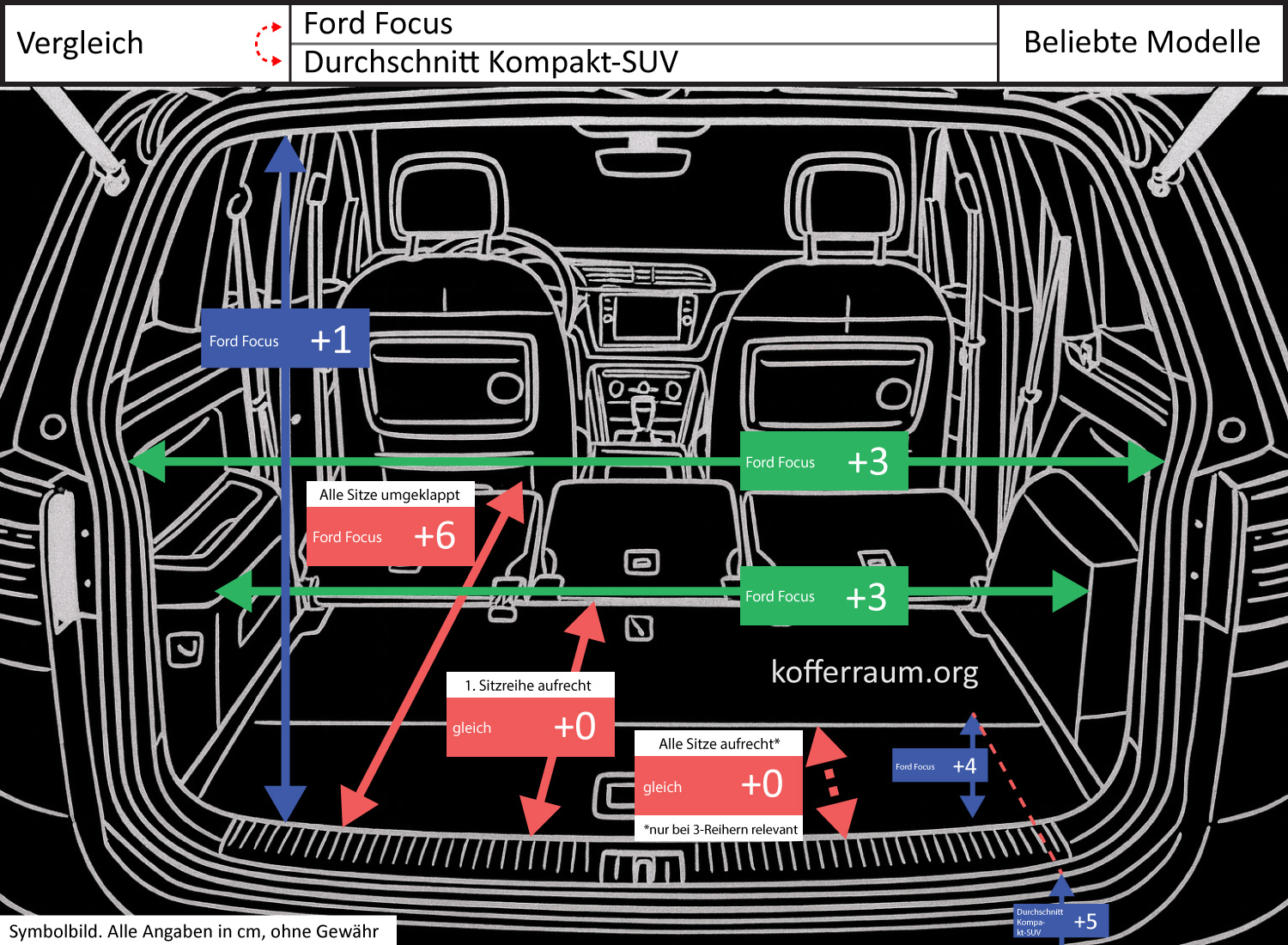
The most noticeable difference concerns the trunk depth: The Ford Focus has a loading floor that is 1.6 in deeper than the average of compact SUVs, which is +29%. This greater depth practically means more usable space in the driving direction for tall or bulky items. Suitcases, boxes, or sports equipment can be pushed further forward, remain more stable, and more volume is created with the same trunk opening – this is the biggest practical advantage of the Focus compared to the compact SUV.
Other, Smaller Differences (under 10%)
Other dimensions differ only slightly: With the rear seats folded down, the Focus is 2.4 in (4%) longer; with the front seats upright, both are the same length. The trunk opening is 0.4 in (1%) higher on the Focus and 1.2 in (3%) wider at the narrowest point as well as at the opening. The loading edge of the compact SUV is 2 in (7%) higher above the road than that of the Focus. These differences are small but can be noticeable in individual cases: the slightly larger opening and width of the Focus make loading wide items slightly easier; the higher loading edge of the SUV requires a bit more effort when lifting but may reduce the need to lower items deeply into the vehicle when loading.
Practical Implications
For everyday uses like shopping or suitcases, both vehicles offer similar handling because length and opening are mostly the same. If you often transport tall, deep, or long items (e.g., multiple large suitcases, stacks of boxes, sports equipment), the Focus has the advantage: the significantly greater trunk depth increases capacity and load stability. However, those who frequently lift heavy loads or prefer a higher entry will notice the higher loading edge of the compact SUV – this can make lifting more strenuous but offers a higher seating/loading height. Overall, the practical utility of the Focus in pure cargo use is most improved by the greater depth; the other differences are rather marginal.