
Trunk comparison: Ford Focus vs Hyundai Kona
Main Differences
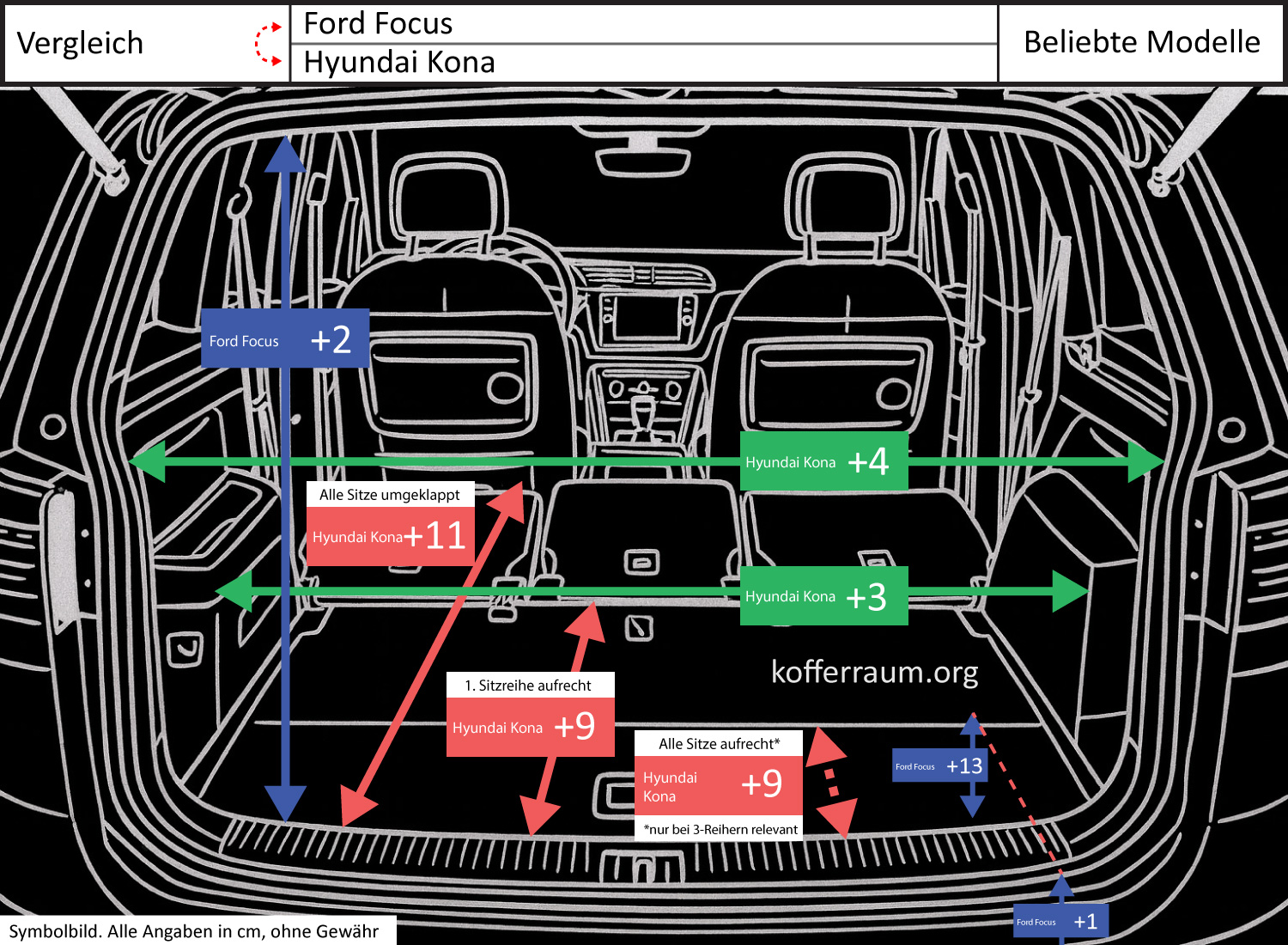
In a direct comparison, it is especially notable that the Hyundai Kona with the first row of seats upright is 3.5 in longer (+12%) than the Ford Focus. Conversely, the Focus has a significantly greater depth between the loading edge and the trunk floor: it is 5.1 in deeper (+260%) than the Kona.
All other differences are much smaller (under 10%) — such as the wider trunk opening and narrowest point at the Kona, as well as a slightly higher trunk opening and loading edge on the Focus.
Impact on Usability
The longer cargo floor of the Kona with the rear seat upright makes it more practical for longer items that need to be transported without folding the seats down (e.g., skis, slats, long boards, or flat furniture parts). This reduces the need to fold the rear seat when length is important.
The significantly greater depth of the Focus means more usable interior space vertically: larger or bulkier items can be set deeper and often stacked more neatly.
This increases the capacity for bulky cargo and ensures that luggage or groceries lie lower and therefore more stably. Because the loading edge is only minimally higher (+0.4 in), lifting heavy items remains largely comparable in practice.
In summary: The Kona scores with length with the rear seat upright (better for long, flat cargo without folding), while the Focus offers more volume and flexibility for taller or bulkier cargo due to the significantly deeper cargo floor.
Smaller advantages in opening width and narrowest width only marginally affect handling.