
Trunk comparison: Ford Focus vs Opel Corsa
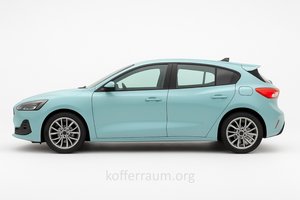
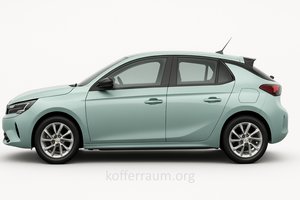
Key Differences
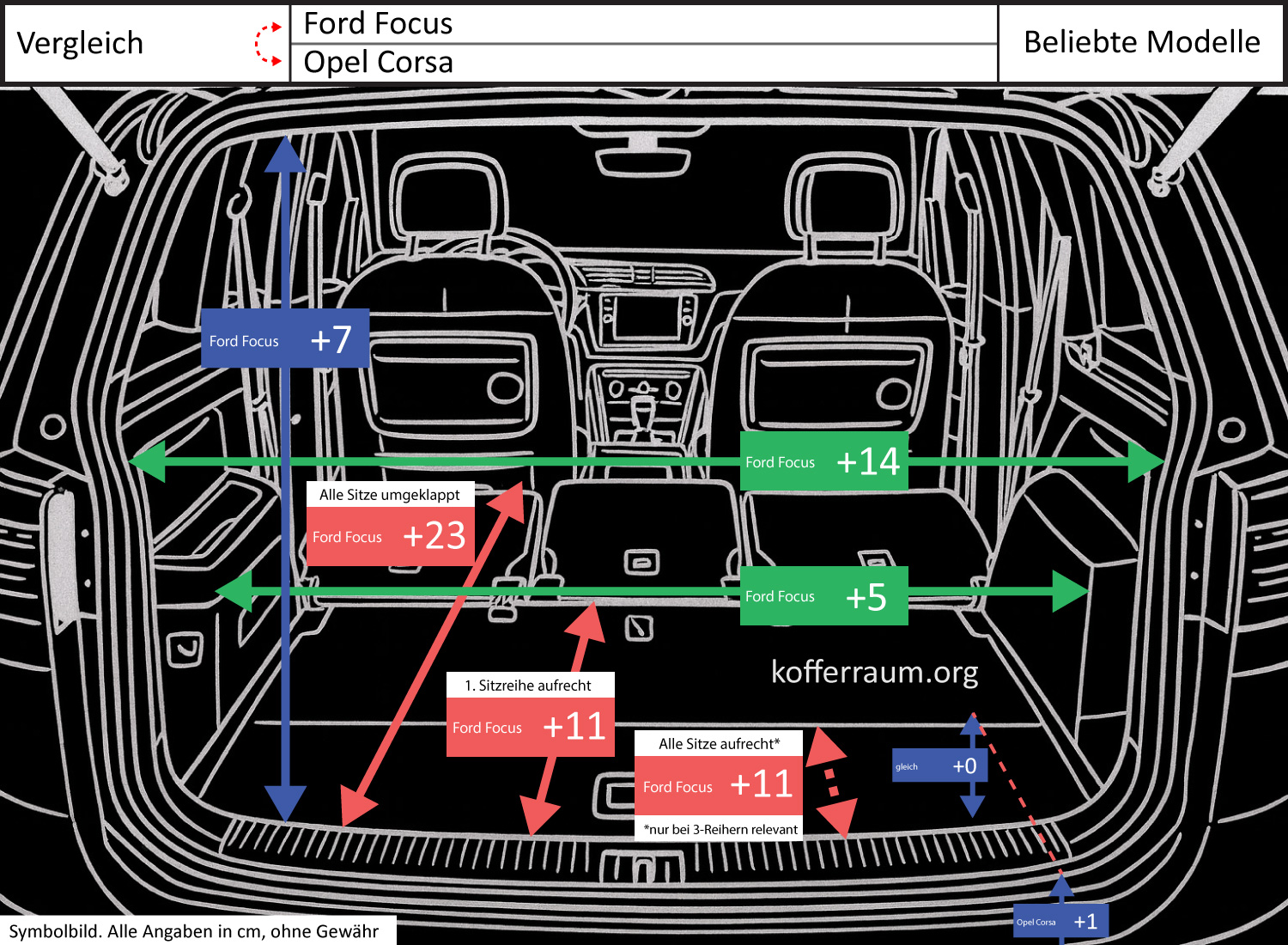
The Ford Focus offers significantly more cargo space for longer items: with the seats folded down, the trunk of the Focus is 9.1 in (17%) longer than that of the Opel Corsa. Even with the front seats upright, the advantage remains large: the Focus has a 4.3 in (17%) longer cargo area.
Additionally, the loading opening of the Focus is 5.5 in (16%) wider than that of the Corsa, making it easier to fit wider items inside.
Other Differences (less than or equal to 10%)
The height of the trunk opening is 2.8 in (10%) greater in the Focus — a noticeable difference, but not rated as >10%. The narrowest width inside the trunk is 2 in (5%) larger in the Focus.
The depth from the loading edge to the trunk floor is the same in both models. The loading edge of the Opel Corsa sits 0.4 in higher above the road than that of the Focus.
Implications for Practical Use
Due to the larger length dimensions (with and without folded seats), the Focus is clearly better suited for transporting long items such as slats, longer furniture parts, skis, or folded strollers.
Practically, this means items can be loaded without or with less tilting of the seatbacks, and folding the seats creates a larger continuous cargo area.
The significantly wider loading opening in the Focus makes loading and unloading wide, bulky items (e.g., furniture parts, larger boxes) easier. In practice, this reduces maneuvering when loading and lowers the chance of hitting edges while loading.
The other differences are rather minor: the same depth means comparable floor space usability between the loading edge and floor; the 0.4 in higher loading edge in the Corsa is hardly noticeable in daily use, as is the slightly larger narrowest width in the Focus (+2 in).
The 2.8 in higher opening in the Focus helps when lifting tall items in, but is at the threshold for required emphasis.
Conclusion
If regularly transporting long or wide items is important, the Ford Focus offers clear advantages due to the longer cargo area and wider loading opening. For mostly city-typical, smaller transport tasks, the differences are functionally less relevant.