Trunk comparison: Ford S-MAX vs Durchschnitt Subcompact


Key Differences
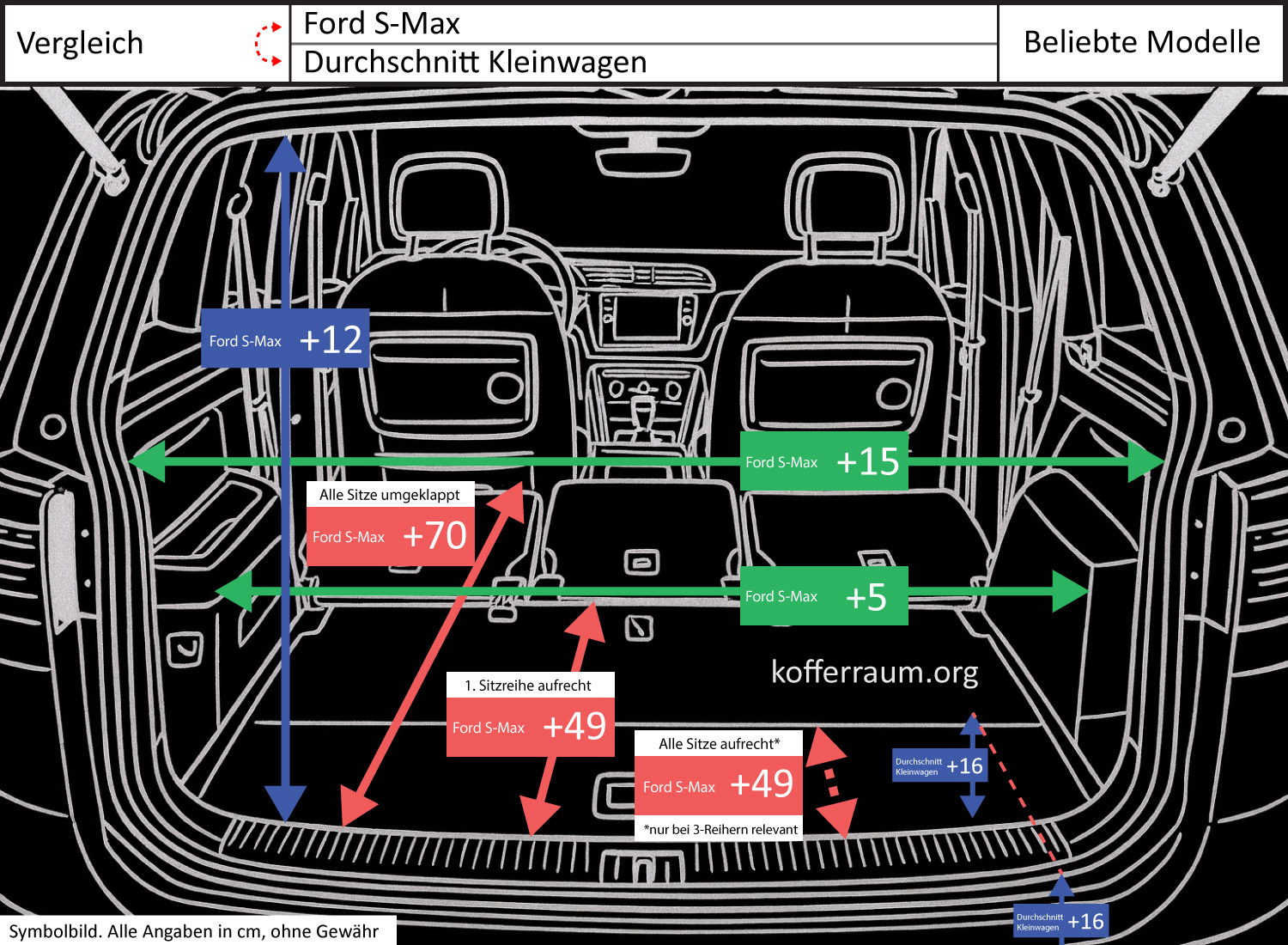
The Ford S‑Max offers significantly more cargo space and a more user-friendly opening than the average subcompact. Specifically, the trunk with folded seats is 27.6 in (+55%) longer and with the first row upright 19.3 in (+78%) longer – these are the biggest advantages for transporting long or bulky items.
The height of the trunk opening on the S‑Max is 4.7 in (+15%) larger, and the width of the opening is 5.9 in (+16%) larger, which makes loading wide or tall items much easier.
At the loading edge, it also shows: the loading lip of the subcompact is 6.3 in (+28%) higher above the road, while the depth of the trunk (loading lip → trunk floor) in the subcompact is 6.3 in (+533%) greater.
Impact on Usability
The longer cargo areas of the S‑Max practically mean: you can transport significantly longer items (skis, slats, furniture parts, long boxes) without or with less folding of the rear seats. This increases everyday usability for tradespeople, families on trips, and during moves.
The larger opening height and width make loading and unloading bulky or awkward items easier – furniture, strollers, or large boxes can be maneuvered more simply. A wider opening also reduces the risk of damaging edges.
The higher loading lip in the subcompact makes lifting heavy items more strenuous; the S‑Max is clearly more favorable here because the loading lip is lower, reducing the lifting angle.
Although the greater depth behind the loading lip in the subcompact can offer more vertical storage space immediately behind the opening, it is less convenient for loading heavy or bulky items – in practice, the combination of a lower loading lip and flatter loading area in the S‑Max leads to easier, back-friendly loading and better everyday usability.
The smaller (under 10%) differences in the narrowest trunk width are negligible and hardly affect usability. Overall, the Ford S‑Max is clearly more practical than an average subcompact for anyone who regularly needs to transport long, wide, or heavy loads.