
Trunk comparison: Ford S-MAX vs Durchschnitt Compact SUV


Key Differences
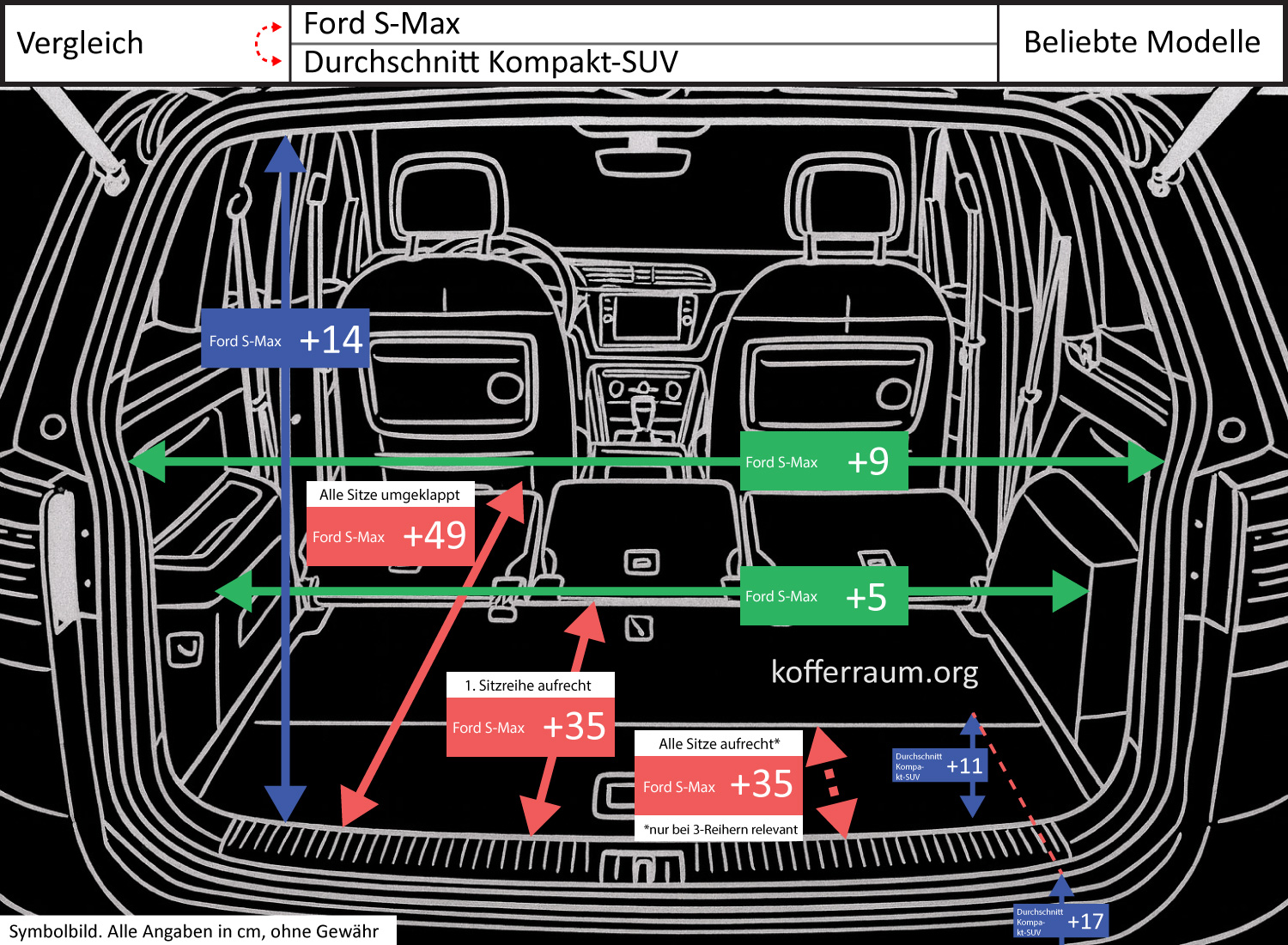
The Ford S‑Max offers a cargo space length that is 19.3 in (≈+33%) longer with the seats folded down than the average compact SUV. Even with the first row of seats upright, the S‑Max is significantly longer: +13.8 in (≈+45%). The trunk opening of the S‑Max is 5.5 in (≈+18%) higher than the compact SUV average.
In contrast, the trunk depth (distance from loading edge to trunk floor) of the average SUV is 4.3 in (≈+367%) higher than that of the S‑Max. Additionally, the loading edge of the average SUV is 6.7 in (≈+30%) higher above the road than the S‑Max.
Smaller differences: the narrowest trunk width of the S‑Max is only 5% (+2 in) wider, and the opening width is 9% (+3.5 in) wider — both under 10% and thus objectively minor.
Impact on Usability
The significantly greater loading length of the S‑Max (with seats folded down and with the first row upright) makes it clearly more practical for long items (e.g., furniture parts, skis, roof box preparation) and for lots of luggage when carrying passengers.
The higher trunk opening facilitates loading tall items and reduces the risk of hitting the opening.
The greater depth and higher loading edge of compact SUVs mean more vertical capacity inside the trunk but can make loading and unloading more difficult: heavy luggage must be lifted higher, and the lifting is onto a higher edge.
The S‑Max, with its significantly lower loading edge, is noticeably more ergonomic in practice for frequent loading and unloading (shopping, child seat accessories, heavy suitcases).
The slightly greater width and opening width of the S‑Max (each <10%) are advantageous for maneuvering wider items but have a much weaker effect than the above-mentioned differences in length, opening height, depth, and loading edge height.
Conclusion
For users who regularly transport long or many items or frequently load and unload heavy loads, the Ford S‑Max is more advantageous due to the longer cargo floor, higher opening, and lower loading edge.
Compact SUVs offer more vertical depth in the cargo space but require more effort to lift onto the higher loading edge and are less ergonomic in daily loading and unloading.