
Trunk comparison: Ford S-MAX vs Hyundai i10

Biggest Differences (only deviations >10% highlighted)
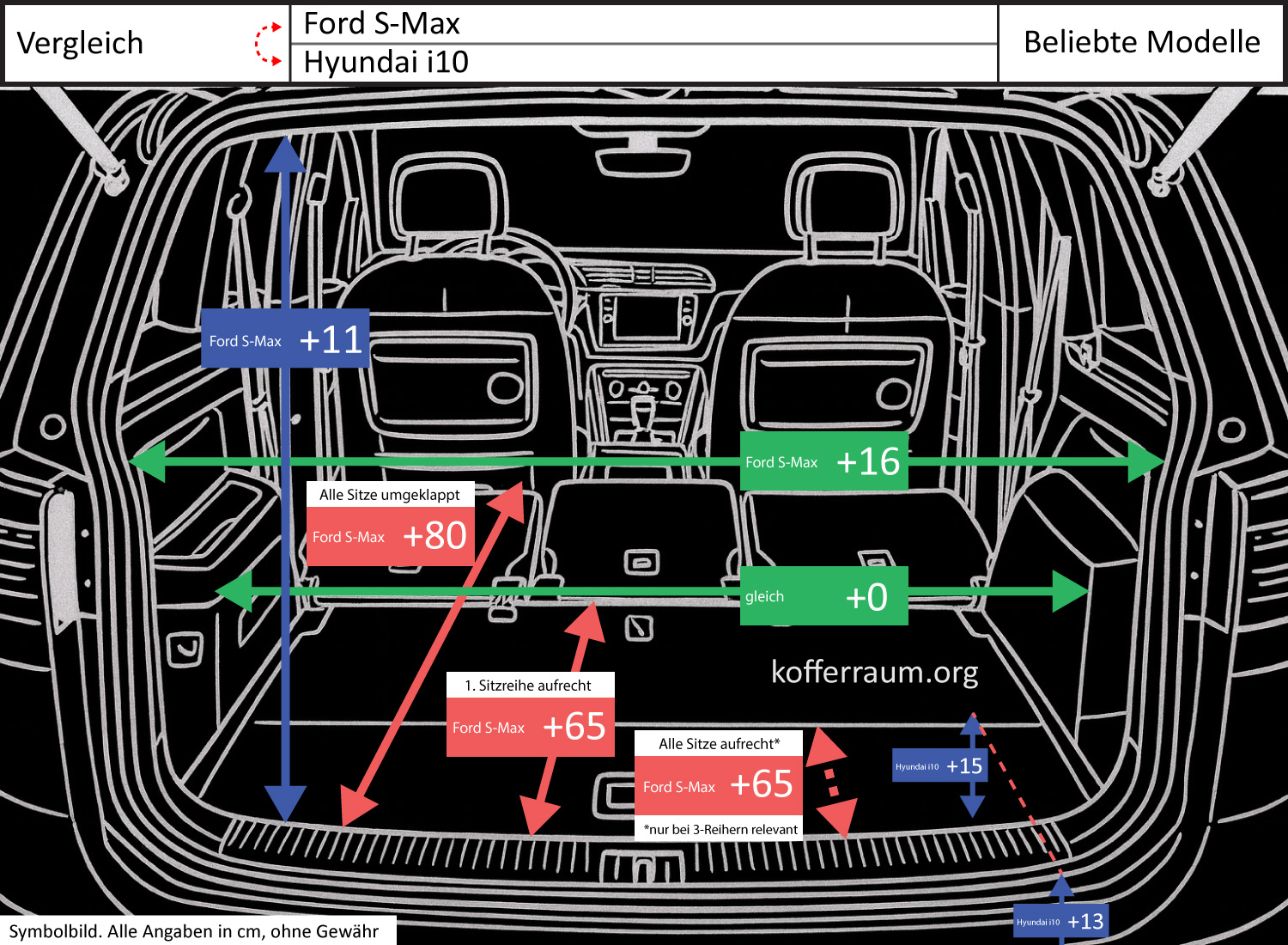
The Ford S‑Max offers significantly more usable cargo space: with the seats folded down, its trunk is 31.5 in or 68% longer, and with the first row upright, it is 25.6 in or 138% longer than the Hyundai i10. The trunk opening of the S‑Max is 4.3 in (13%) taller and 6.3 in (18%) wider than that of the i10. Two dimensions clearly favor the Hyundai i10 as a compact car: the distance between the loading edge and the trunk floor is 5.9 in (500%) greater, and the loading edge itself is 5.1 in (23%) higher above the road.
The narrowest width of the trunk is the same in both vehicles.
Impact on Usability
For transport and volume-intensive use, the Ford S‑Max is clearly advantageous: the significantly longer cargo areas (both with folded seats and with the first row upright) plus the larger opening height and width make it easier to load long or bulky items (e.g., furniture, sports equipment, strollers) and allow for more overall cargo.
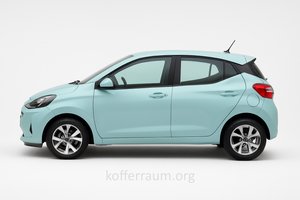
The Hyundai i10 is primarily a compact car; its advantages do not concern larger payloads but the geometry of the loading area: however, the greater distance between the loading edge and trunk floor and the higher loading edge above the road mean practical limitations.
The higher loading edge (≈5.1 in) makes lifting heavy items more strenuous. The significantly larger distance from loading edge to floor inside (≈5.9 in) requires additional lifting or lowering when loading and unloading and complicates rolling in/out with trolleys or carts.
In summary: Those who need a lot of volume, longer cargo areas, and easy loading are better served by the Ford S‑Max.
Those looking for a very compact vehicle who rarely transport large or heavy loads will find the Hyundai i10 a space-saving city car — but with noticeably less favorable loading accessibility for bulky or heavy items.