
Trunk comparison: Ford S-MAX vs Hyundai Kona

Key Differences and Impact on Usability
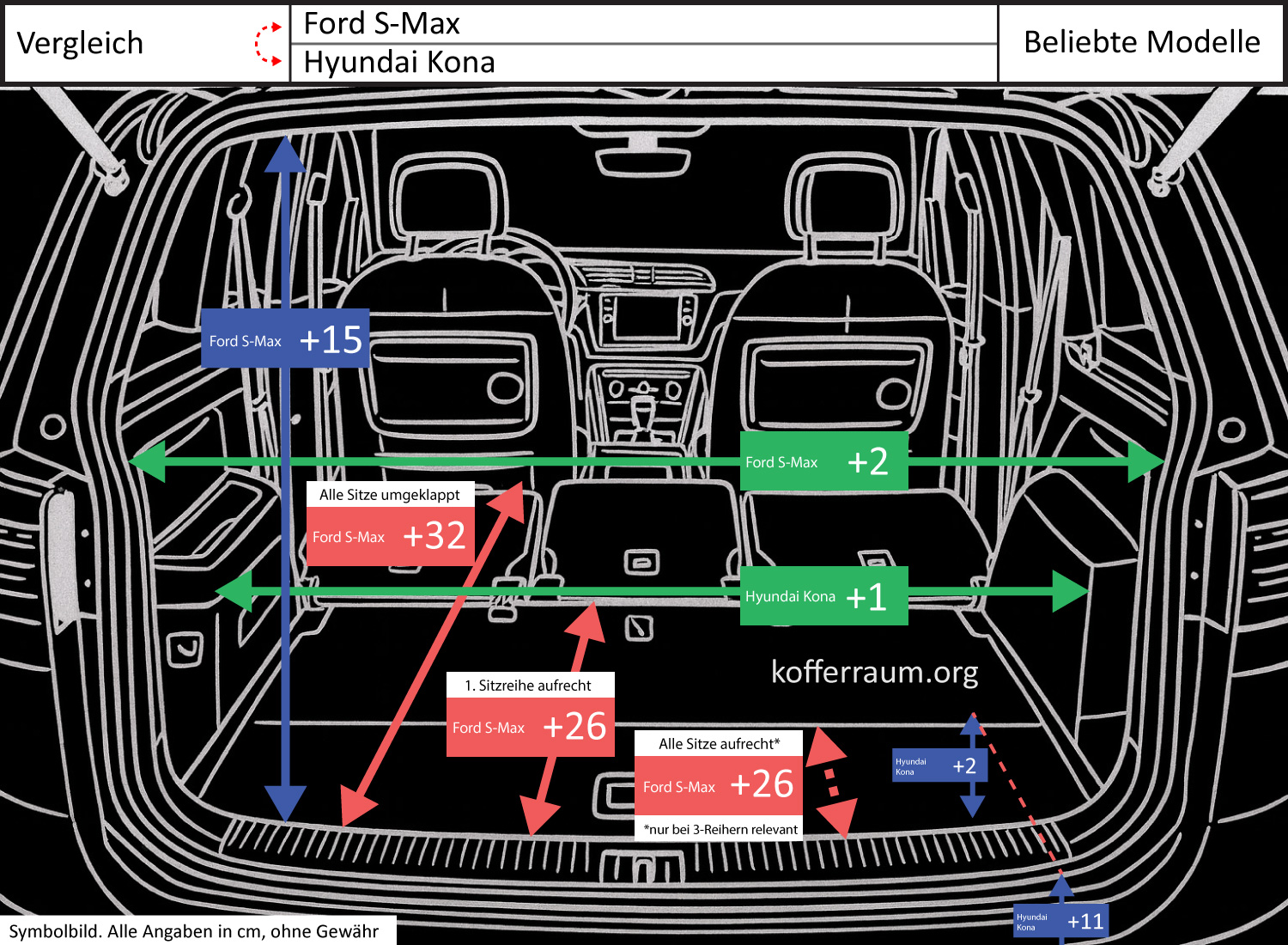
The Ford S‑Max offers significantly more cargo length: with the seats folded down, the trunk is 12.6 in (19%) longer and with the first row of seats upright, 10.2 in (30%) longer than the Hyundai Kona.
Practically, this means the S‑Max is much better suited for long or bulky items (e.g., furniture parts, skis, long boxes) and overall offers more flexibility when loading for families or transport tasks.
The trunk opening of the S‑Max is 5.9 in (19%) higher, allowing taller cargo to pass through the opening more easily. Together with the greater cargo length, this makes the S‑Max the better choice when it comes to bulky, tall, or long loads.
In the Hyundai Kona, however, the loading edge is 4.3 in (19%) higher above the ground, and the depth from the loading edge to the trunk floor is 0.8 in (67%) greater than in the S‑Max.
The higher loading edge means more effort is required to lift heavy items in; the slightly greater depth (only 0.8 in absolute) allows items to sit deeper in the cargo area, thus increasing usable interior height below the loading edge, but this has only a limited practical effect.
Width differences are minimal (<10%) and therefore negligible: the narrowest point of the trunk is only 0.4 in wider in the Kona, and the opening width of the S‑Max is only 0.8 in larger. In summary: For frequent transport of long or tall items and for easier lifting of heavy loads, the Ford S‑Max has the advantage. The Kona offers only a slightly deeper cargo well but does not gain significantly in practically relevant loading situations.