
Trunk comparison: Ford S-MAX vs Renault Austral


Key Differences (only >10% highlighted)
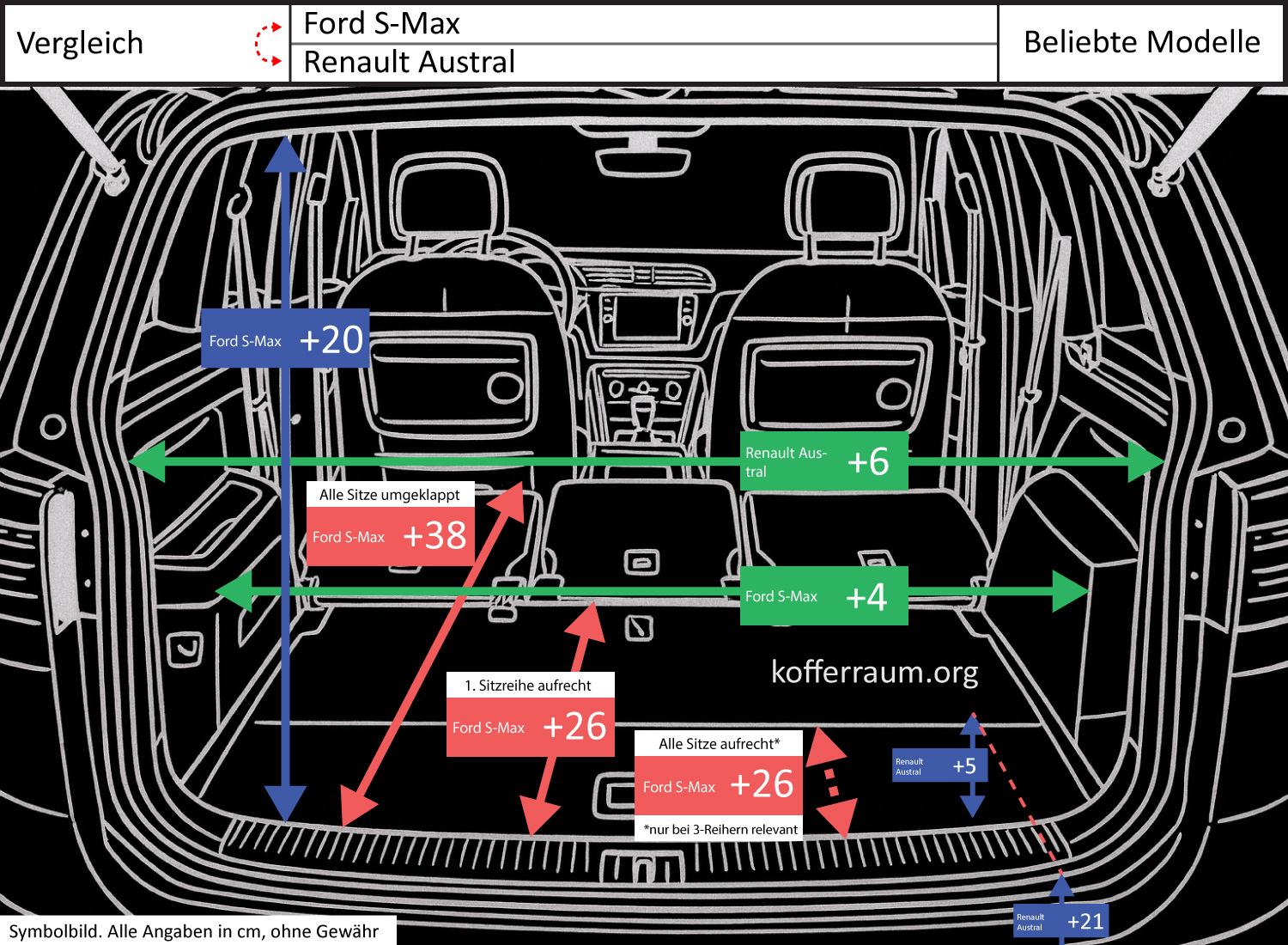
The Ford S‑Max offers a significantly longer cargo space: With the seats folded down, the trunk of the S‑Max is +15 in (24%) longer, and with the first row upright, it is +10.2 in (30%) longer compared to the Renault Austral.
The height of the trunk opening is also noticeably larger in the S‑Max: +7.9 in (27%). On the other hand, the Renault Austral has a significantly greater trunk "depth" measured from the loading edge to the trunk floor: +2 in (167%), and the loading edge of the Austral sits higher above the road: +8.3 in (37%).
Implications for Usability
The longer cargo areas of the S‑Max (both with folded seats and with the first row upright) make it more practical for transporting long items such as slats, furniture parts, or skis and offer more flexibility when passengers also need to be accommodated.
The higher trunk opening facilitates loading tall or bulky items without severely limiting the installation height.
In the Austral, the higher loading edge and greater interior depth have different effects: The higher loading edge (+8.3 in) increases the lift height when loading heavy items, making loading more strenuous.
The greater depth (loading edge→floor) can ensure that bulky items lie further "lowered" in the trunk and may be better secured against shifting, but it does not reduce the necessary lifting effort at the loading edge.
Width differences are minor (<10%): The narrowest trunk width is minimally wider in the S‑Max (+1.6 in, 4%) and the opening width is slightly larger in the Austral (+2.4 in, 6%) – these differences have little impact on everyday usability.
Conclusion
For users who frequently transport long or tall loads or want flexible space arrangements with passengers, the Ford S‑Max is more advantageous.
Those who prefer a somewhat lower-lying cargo floor inside and can live with the higher loading edge will find in the Renault Austral a different expression of cargo space that can offer advantages in certain situations (e.g., lower cargo floor for bulky but lower items).