Trunk comparison: Ford S-MAX vs Tesla Model 3
Key Differences (highlighted: >10%)
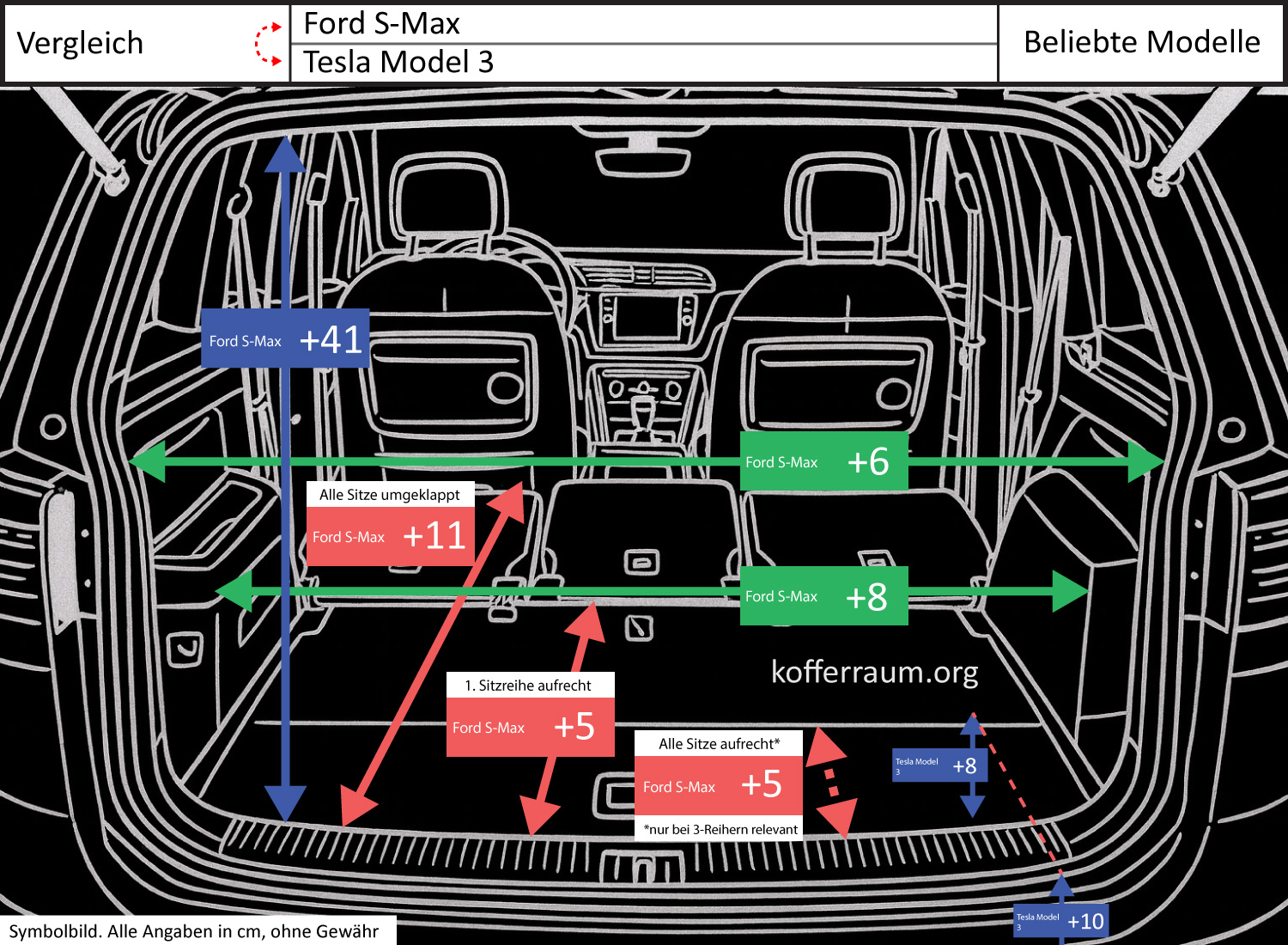
The height of the trunk opening of the Ford S‑Max is 16.1 in (79%) higher than that of the Tesla Model 3. Practically, this means: the S‑Max can accommodate significantly taller or boxy items standing upright, and loading large boxes or furniture requires less tilting and maneuvering.
In the Tesla, the lower opening limits the maximum standing height; bulky, tall items must be stored lying down or at an angle depending on their shape.
The depth of the trunk (loading edge to trunk floor) of the Tesla Model 3 is 3.1 in (267%) greater than that of the Ford S‑Max. Specifically, the Model 3 has a deeper "trunk well" below the loading edge.
Advantage: more volume below the loading edge, items can be recessed deeper. Disadvantage: heavier or bulky loads must be lifted higher or lowered into the recess, and items on the floor are harder to reach.
The loading edge of the Tesla Model 3 is 3.9 in (18%) higher above the ground than that of the Ford S‑Max. This increases the effort required to lift heavy items into the car and makes loading bulky, heavy items less comfortable. The S‑Max is ergonomically better for lifting and pushing boxes, strollers, or groceries.
Other, Smaller Differences
- When all seats are folded down, the trunk of the Ford S‑Max is 4.3 in (6%) longer than that of the Tesla Model 3. This difference is moderate in practice and improves the loading area of the S‑Max mainly in specific cases (very long items).
- With the first row of seats upright, the S‑Max is 2 in (5%) longer. This is also a small advantage for longer luggage without making a decisive difference in many everyday situations.
- The narrowest width of the trunk is 3.1 in (8%) greater in the Ford S‑Max; the width of the trunk opening is 2.4 in (6%) greater in the S‑Max. Both values are advantageous for wide items but have only a moderate effect.
Practical Conclusion
- Ford S‑Max: Better suited for tall, bulky, or frequently loaded items and for users who want easier ergonomic loading (lower loading edge, significantly higher opening). Recommended for families, craftsmen, or users with regular transport of large/boxy items.
- Tesla Model 3: Offers a deeper loading well that creates more usable volume below the loading edge but is associated with a higher loading edge and smaller opening. Suitable when volume in a recess is important; less practical for bulky, tall items or frequent lifting of heavy loads.