
Trunk comparison: Ford S-MAX vs Volvo XC40


Key Differences
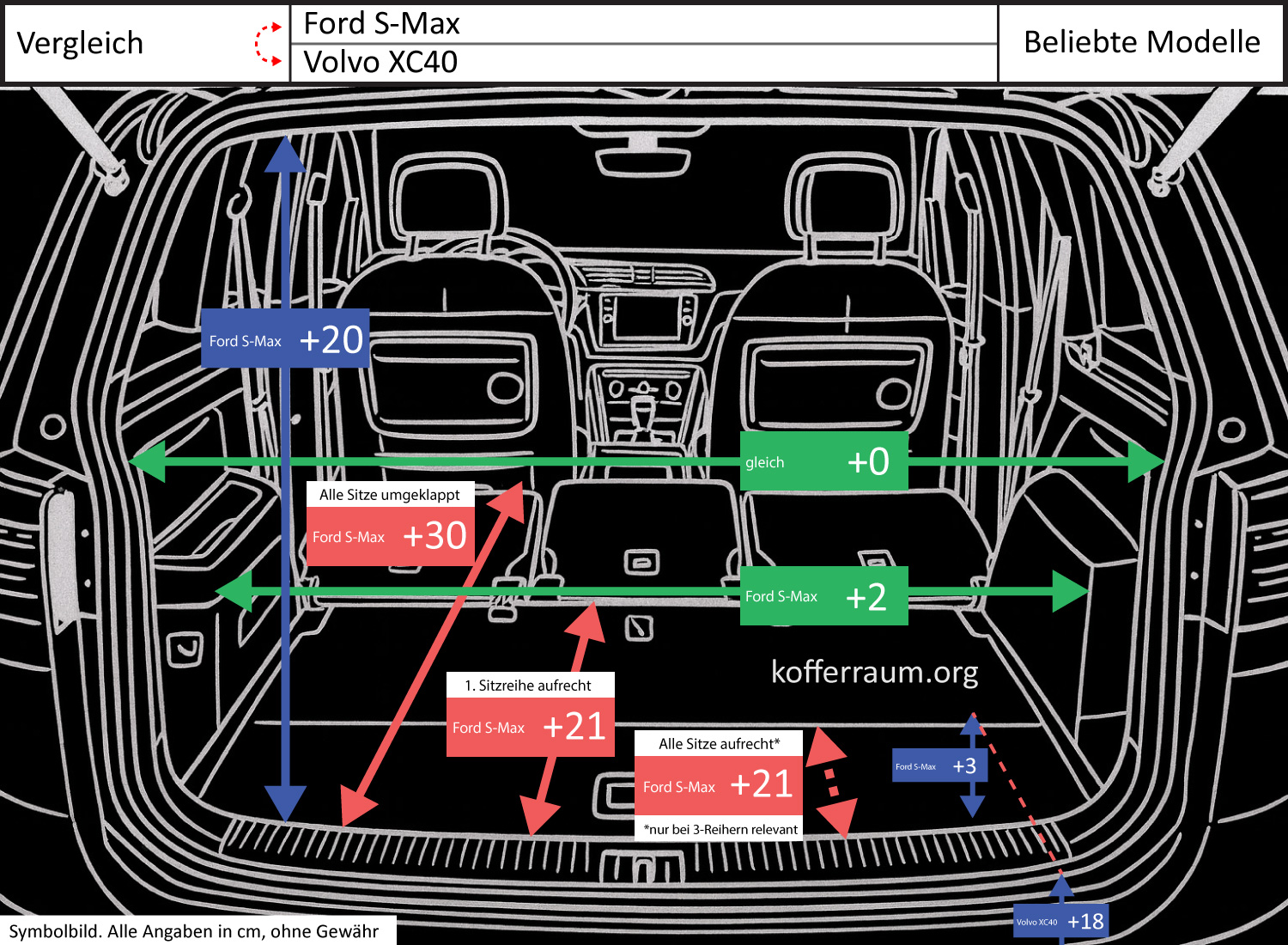
The Ford S‑Max offers significantly more cargo space in length and height than the Volvo XC40: with the seats folded down, the trunk of the S‑Max is +11.8 in (18%) longer, and with the first row upright, it is +8.3 in (23%) longer. The trunk opening is also +7.9 in (27%) higher in the S‑Max.
The depth of the trunk (loading edge to trunk floor) is +1.2 in (200%) greater in the S‑Max. In contrast, the loading edge of the Volvo XC40 is +7.1 in (32%) higher above the ground than that of the S‑Max. The width at the narrowest point differs hardly (+0.8 in / 2%) and the width of the trunk opening is the same.
Implications for Usability
The greater interior length of the S‑Max (both with folded seats and with the first row upright) makes it better suited for long items (e.g., slats, furniture parts, or surfboards) and for larger amounts of luggage overall.
The significantly higher trunk opening also allows easier loading of tall or bulky items and increases headroom when loading.
The lower loading edge of the S‑Max reduces the effort required to lift heavy loads into the vehicle; conversely, the higher loading sill of the XC40 requires more lifting effort and is noticeably less practical with repeated loading and unloading.
The slightly greater depth of the S‑Max behind the loading edge helps to push items further into the vehicle and store them more stably — the absolute difference is small (1.2 in) but effective in combination with the longer loading surface.
Width-wise, there are hardly any differences; usability for very wide items remains unchanged. In summary, the Ford S‑Max is clearly advantageous when frequently transporting long, tall, or heavy cargo.
The Volvo XC40 remains a more compact solution with a higher loading edge, which may be visually or dynamically relevant in urban situations but limits practical loadability.