
Trunk comparison: Ford S-MAX vs VW Taigo


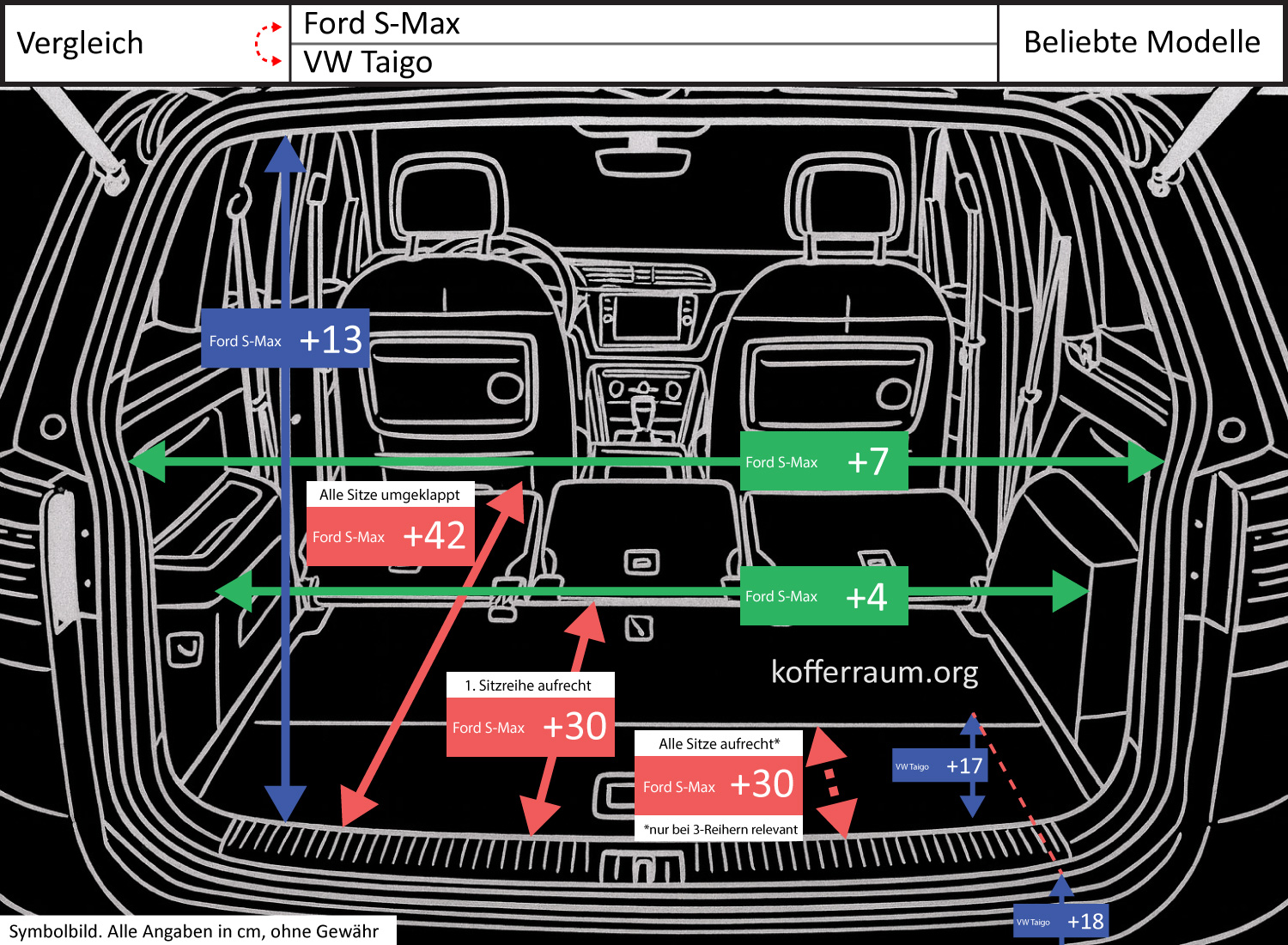
Key Differences (only values >10% highlighted)
The Ford S‑Max offers a significantly longer cargo length with the seats folded down: +16.5 in (27%) compared to the VW Taigo. Even with the first row of seats upright, the S‑Max has a longer trunk space: +11.8 in (37%). The trunk opening of the S‑Max is higher: +5.1 in (16%) compared to the Taigo.
The VW Taigo has a significantly greater vertical difference between the loading edge and the trunk floor: +6.7 in (567%) compared to the S‑Max. Additionally, the loading edge of the Taigo is generally higher above the road: +7.1 in (32%).
Smaller differences, which are under 10% and therefore less relevant: the narrowest trunk width of the S‑Max is only +4% larger, the opening width of the S‑Max is +7% larger than that of the Taigo.
What impact do these differences have on usability?
Space for long items: Due to the significantly greater cargo length (27–37%), the S‑Max is better suited for long or flat loads (e.g., laminate, slats, long boxes). The higher trunk opening makes loading and unloading bulky parts easier because more vertical space is directly accessible through the opening.
Handling heavy or bulky loads: The higher loading edge of the Taigo (above the road) makes lifting heavy items into the trunk more strenuous.
Although the Taigo has a deeper position between the loading edge and trunk floor, which in some cases creates additional vertical storage space below the loading edge, in practice this usually means more bending when loading and greater effort when lifting over the threshold.
Everyday use: For families, craftsmen, or users who frequently transport long and bulky items, the S‑Max is overall more practical — more usable length, higher opening, and at the same time a lower loading edge simplify loading and storing.
The Taigo can offer advantages with items stored deeper and stacked in depth but requires more physical effort when loading and unloading due to the higher loading edge.
Conclusion
Those who regularly transport long or bulky cargo and want more comfortable loading and unloading are better off with the Ford S‑Max. Those who mostly have smaller goods to store in depth and prefer the SUV look can live with the Taigo — but must take the higher loading edge into account when loading.