
Trunk comparison: Hyundai i10 vs Durchschnitt Subcompact
Key Statement
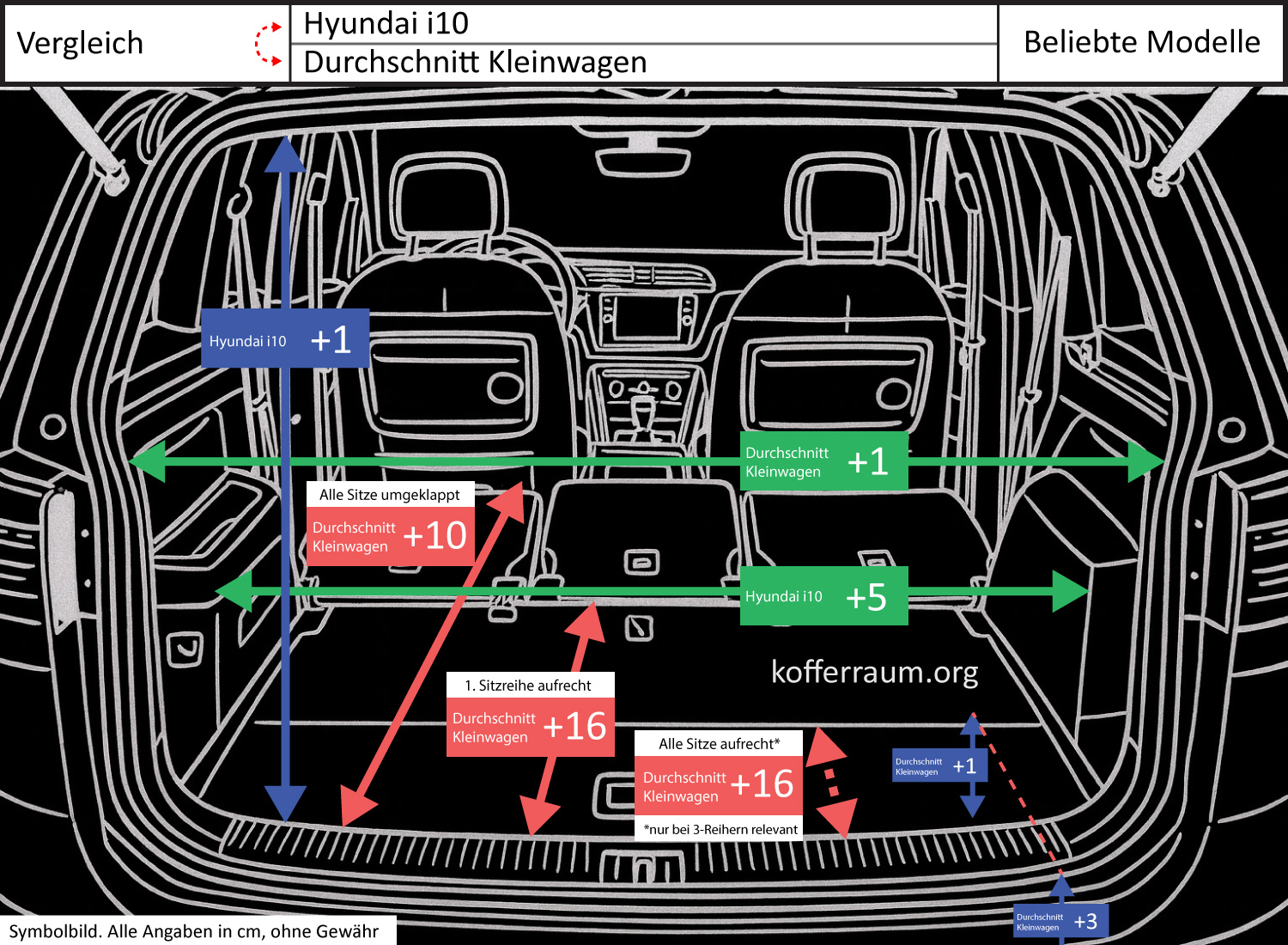
The most significant difference is seen in the trunk length with the front seats upright: the average subcompact offers
than the Hyundai i10 when the rear seats are not folded down. All other measured deviations are below the 10-percent mark and are therefore comparatively small: the average has about +3.9 in (8%) more length with folded seats, the trunk opening of the i10 is about +0.4 in higher, the depth from the loading edge to the floor and the opening width differ by about 0.4 in or a few percent each, the loading edge of the average is about 1.2 in higher, and the narrowest trunk width is about 2 in larger in the i10.
Impact on Usability
Because the average subcompact offers a significantly longer cargo area in the normal state (seats upright), it is better suited for longer or bulky items that cannot be transported with the seats folded down — e.g., long boxes, individual skis, furniture parts, or multiple suitcases behind a fully occupied rear seat. In the Hyundai i10, the shorter usable length reduces everyday flexibility: items often need to be placed crosswise, stacked differently, or the rear seats folded down. The other differences are practically minor: the slightly greater width at the narrowest point in the i10 can make maneuvering wider but flatter cargo easier; the slightly higher loading edge and minimal depth and opening differences hardly affect loading once or twice but can be noticeable when frequently transporting heavy loads or lining up large volumes. Overall, this means: for regular transport of longer items, the average subcompact is clearly more advantageous; for predominantly urban, smaller transports, the i10 remains practical, compact, and somewhat more affordable for entry into narrow or shorter loading solutions.