
Trunk comparison: Hyundai i10 vs Durchschnitt Compact SUV

Main Differences
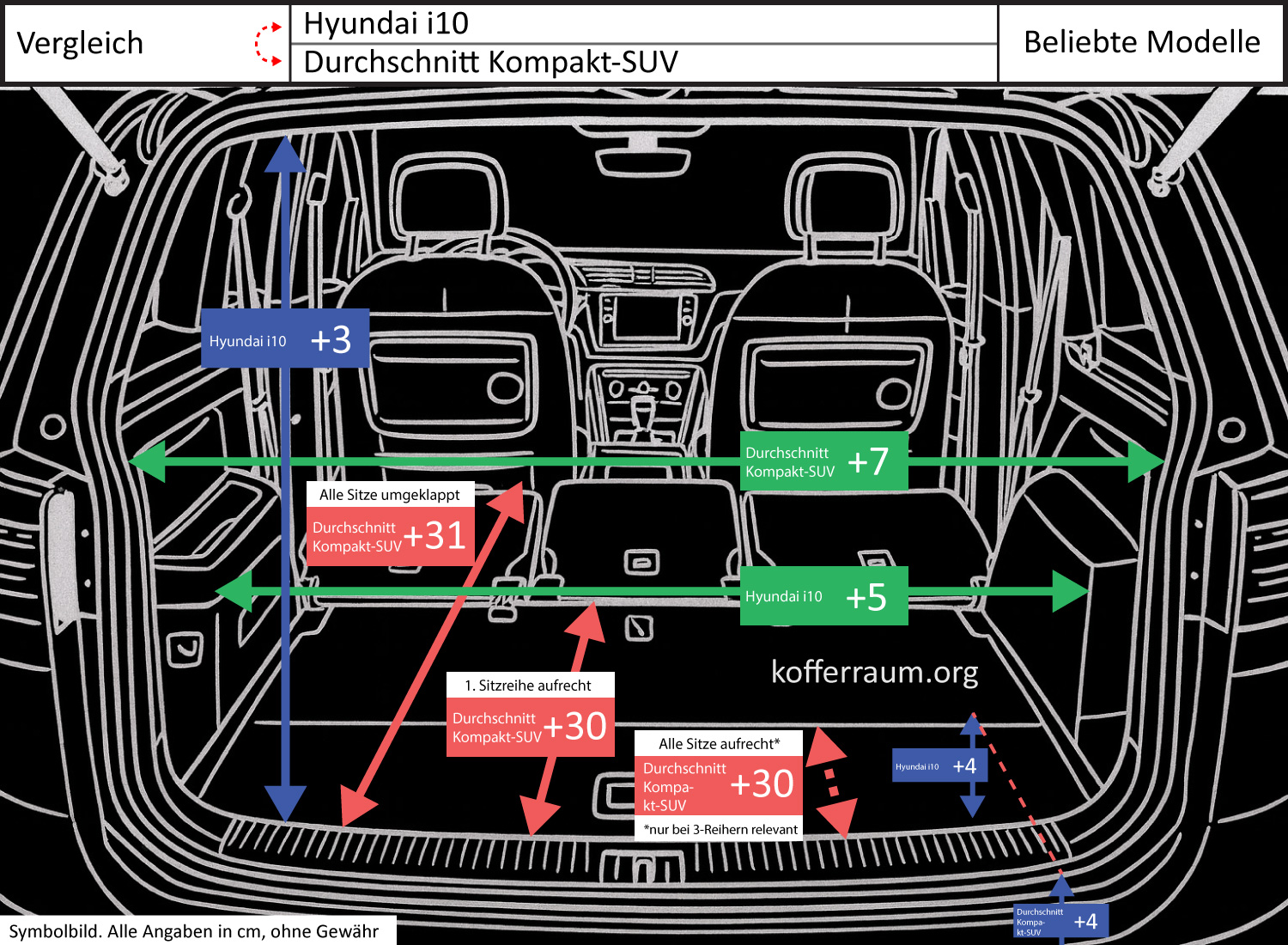
The average compact SUV offers significantly more cargo length: with the seats folded down, the trunk is 12.2 in (26%) longer and with the first row of seats upright, 11.8 in (64%) longer than the Hyundai i10. In contrast, the Hyundai i10 has a deeper cargo well: the depth (loading edge to trunk floor) is 1.6 in (29%) greater than the average compact SUV.
Smaller differences (≤10%): The trunk opening of the i10 is 1.2 in (4%) higher, the loading edge of the compact SUV is 1.6 in (6%) higher above the ground. The narrowest trunk width is 2 in (5%) larger in the i10, while the width of the opening is 2.8 in (8%) larger in the compact SUV.
Impact on Usability
More cargo length in the compact SUV means practical advantages when transporting long or flat items: with folded seats, longer furniture parts, skis, or bulky packages can be accommodated more easily; with upright seats, the SUV offers significantly more space for luggage and shopping – useful for families or regular transport of larger quantities.
The deeper cargo well of the Hyundai i10, on the other hand, creates advantages in securing and stacking cargo: items sit lower in the vehicle, allowing the packing volume to be layered better and reducing the risk of shifting.
Additionally, a deeper loading floor often improves the perceived usability despite the shorter length.
The smaller differences have supportive effects: The slightly lower loading edge of the i10 makes lifting heavy items easier (simpler handling), while the wider opening of the compact SUV simplifies loading wide items.
Overall: those who regularly transport long or large quantities benefit more from the compact SUV; those who mainly drive in urban areas and want compact exterior dimensions with a well-usable, deep cargo well are better served by the Hyundai i10.