
Trunk comparison: Hyundai i10 vs Hyundai Kona
Main Differences
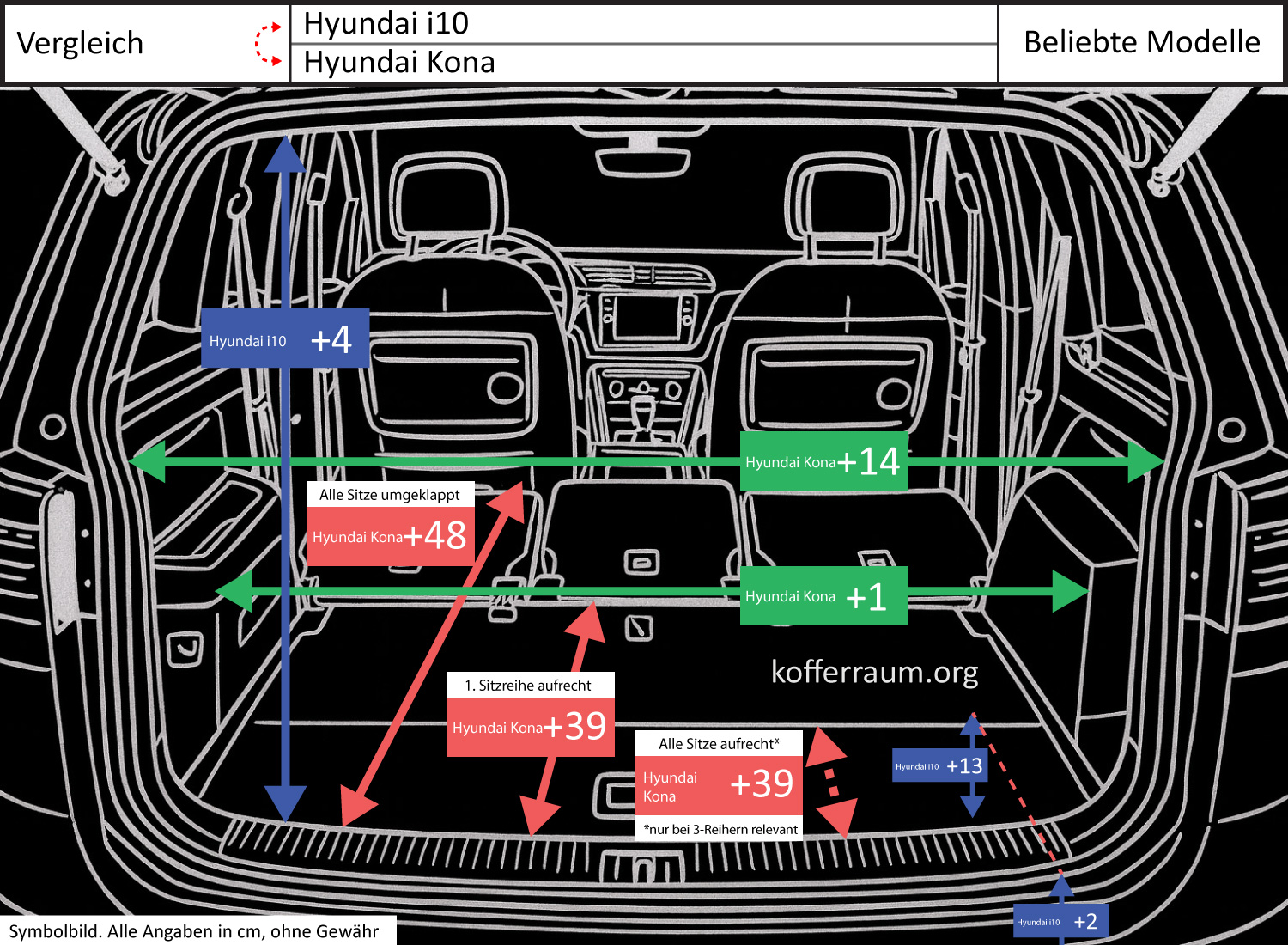
The Hyundai Kona offers significantly more cargo length: with the seats folded down, the trunk is 18.9 in (≈41%) longer and with the front seats upright, the trunk is 15.4 in (≈83%) longer than in the Hyundai i10. The trunk opening of the Kona is also 5.5 in (≈16%) wider, which makes loading and unloading wider items easier.
In contrast, the i10 has a significantly larger interior recess in the floor area: the depth from the loading edge to the trunk floor is 5.1 in (≈260%) greater in the i10 than in the Kona.
Smaller differences under 10% (e.g., opening height +5% in the i10, loading edge height +3%, and minimal width differences) are not highlighted here.
What impact does this have on usability?
For transport tasks requiring length and width, the Kona is clearly more practical: the longer cargo areas (both with folded seats and with normal seat use) and the wider opening make it easier to store long items (e.g., furniture parts, skis, long boxes) and wide luggage.
This makes the Kona more versatile for moving, larger shopping trips, or leisure equipment.
The i10, on the other hand, scores with a deeper floor recess in the trunk. This greater "depth" means more usable volume below the loading edge and is better suited for stacking or hiding bulkier but less long items (e.g., taller boxes, portable tools, or shopping bags that do not fill the length).
Due to the shorter cargo length, the i10 is limited when it comes to very long items.
In summary: Those who frequently transport long or wide loads are better served by the Kona. Those who mainly have compact, voluminous, or deeper-placed cargo and prefer a smaller vehicle will find advantages in the i10.