
Trunk comparison: Hyundai i10 vs Mazda Mazda CX-60
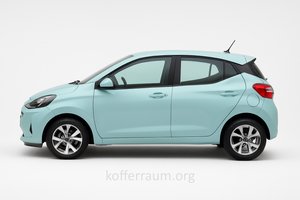
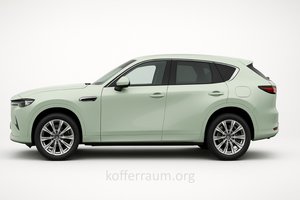
Key Differences (highlighted: >10%)
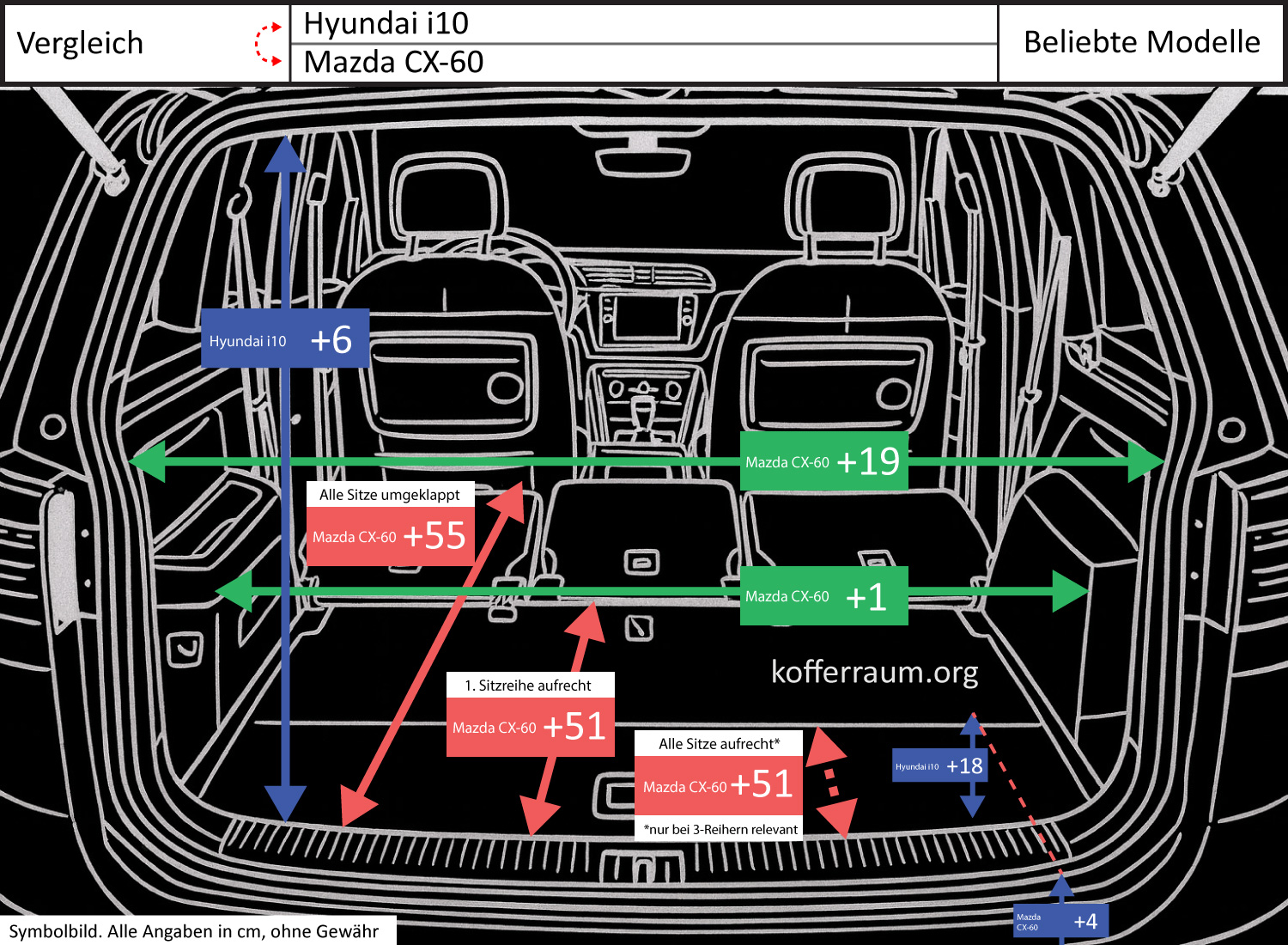
The Mazda CX-60 offers significantly more cargo length: with the seats folded down, the trunk is +21.7 in (47%) longer than the Hyundai i10, and with the first row upright, it is even +20.1 in (109%) longer.
Additionally, the width of the trunk opening on the CX-60 is +7.5 in (21%) larger. In contrast, the Hyundai i10 has a significantly larger gap between the loading edge and the trunk floor: this distance is +7.1 in (1700%) greater on the i10 than on the CX-60.
Impact on Usability
The longer loading areas and wider opening of the CX-60 make it considerably more practical for long and bulky items: long sports equipment (e.g., skis, snowboards), long furniture parts, boards, or multiple suitcases can be loaded more easily—often without adjusting the seats (due to the +109% length with the first row upright).
The larger opening width also reduces the problem of wide items that only fit diagonally or not at all in the i10.
The greater distance between the loading edge and trunk floor in the i10 creates a deeper loading well or a more pronounced step at the loading edge. This can have two effects: on one hand, small luggage can be hidden more securely and shifts less because the load sits deeper.
On the other hand, the larger vertical offset makes loading heavy or rolling items (e.g., large suitcases) more difficult because more lifting or a bigger step at the loading edge is required.
For occasional transport of smaller shopping bags or city use, the i10 remains practical; for regular transport of large, long, or bulky loads, the CX-60 is clearly superior.
In summary: Those who regularly transport long or wide items benefit significantly from the Mazda CX-60. Those who mainly drive in the city and have lower loading demands can manage with the Hyundai i10—but must accept limited length, a narrower opening, and a more pronounced vertical loading offset.