
Trunk comparison: Hyundai i10 vs Mercedes Benz GLB
Key Differences
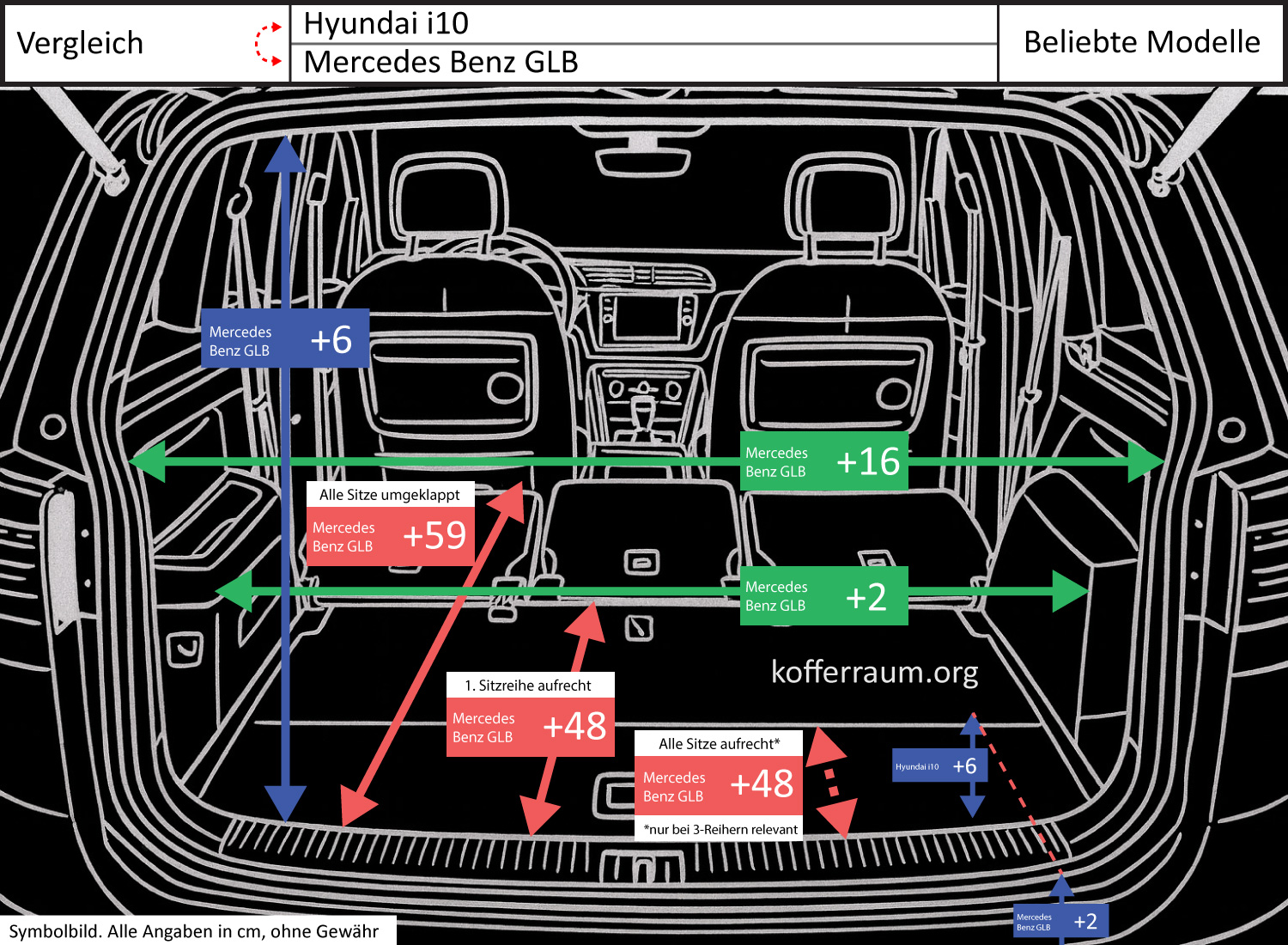
In terms of trunk volume and loading dimensions, the Mercedes‑Benz GLB differs significantly from the Hyundai i10: The GLB offers +23.2 in (50%) more cargo length with seats folded down and +18.9 in (102%) more length with the first row of seats upright than the i10. The width of the trunk opening is also +6.3 in (18%) larger on the GLB.
In contrast, the Hyundai i10 has a greater internal trunk depth (loading edge to trunk floor): +2.4 in (50%) compared to the GLB. Smaller differences (trunk opening height +2.4 in/7%, loading edge height +0.8 in/3%, narrowest width +0.8 in/2%) are comparatively insignificant.
Implications for Usability
The significantly greater cargo length of the GLB makes it practical for long or bulky items: furniture panels, longer sports equipment (skis, surfboards), or folded bicycles can be transported more easily in the GLB.
The wider trunk opening facilitates lifting wide suitcases, boxes, or furniture parts inside and reduces the risk when maneuvering bulky loads.
The greater depth in the i10 (loading edge to floor) means more vertical space in the trunk floor: this is advantageous when deeper storage of suitcases or items that should lie in a recess is desired.
However, the overall length in the i10 is significantly more limited, so long items cannot be accommodated even with greater floor depth.
In practice, this means: Those who regularly transport long or wide loads clearly benefit from the GLB. Those who mainly have smaller, deeper stackable luggage or groceries and prefer a compact city car will find a sensibly sized cargo area in the i10 — but with limited usability for bulky or long goods.