Trunk comparison: Hyundai i10 vs Peugeot 208
Summary of the Biggest Differences
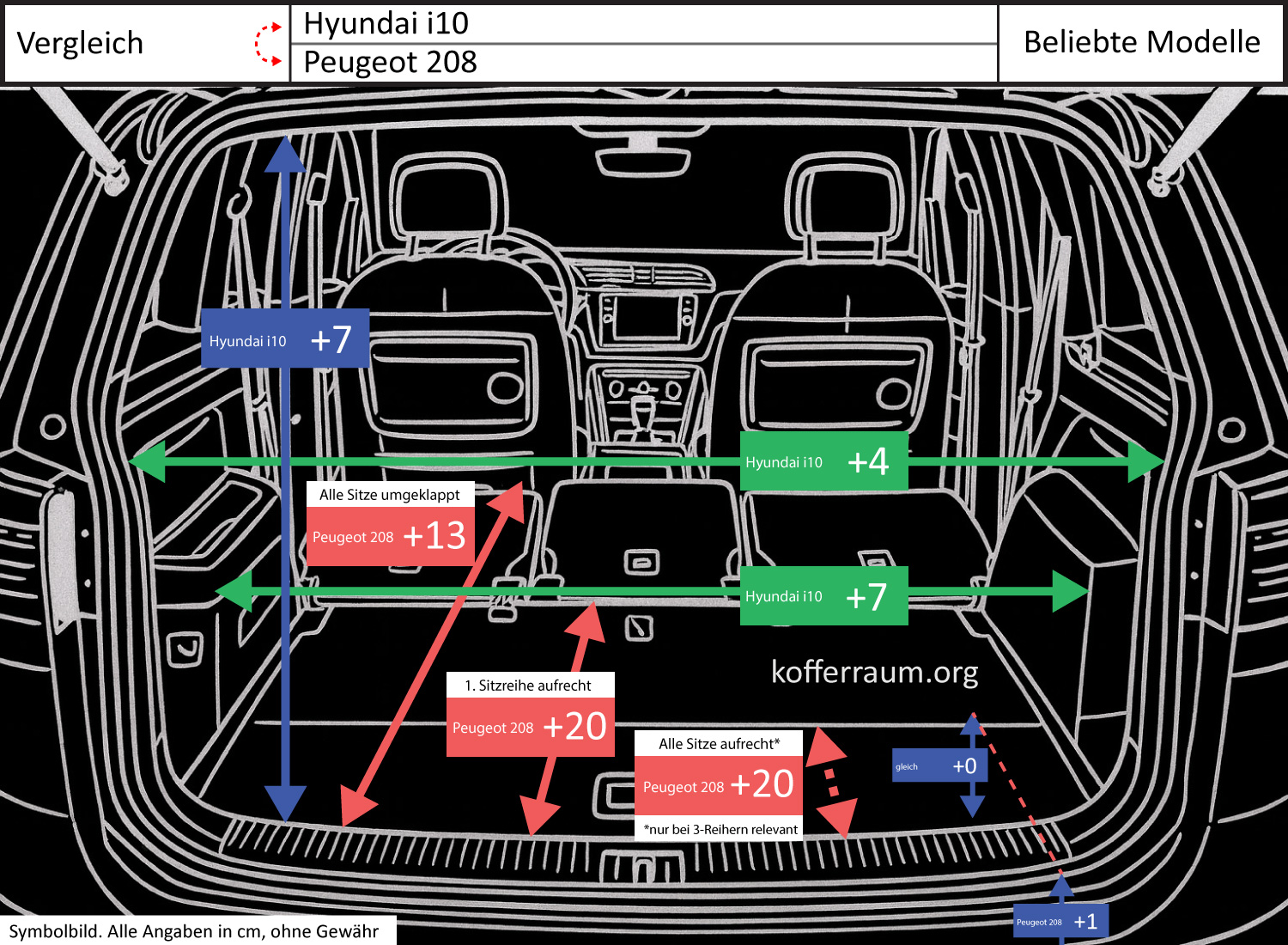
The Peugeot 208 offers significantly more cargo length: with the seats folded down, the trunk is +5.1 in (11%) longer and with the first row upright even +7.9 in (43%) longer than in the Hyundai i10. Specifically, this means: the 208 clearly gains usable loading length, especially when no seats are to be folded down or longer items need to be transported.
Other measurements differ only slightly.
The height of the Hyundai i10's trunk opening is 2.8 in (9%) larger than that of the Peugeot 208; depth (loading edge to trunk floor) is the same; the loading edge of the 208 is only 0.4 in (1%) higher above the road; the narrowest trunk width is 2.8 in (7%) larger in the i10 and the opening width is 1.6 in (5%) larger in the i10. These values are below the 10% mark and are therefore less significant.
Implications for Usability
For users who frequently transport long or bulky items (e.g., slats, boards, skis, long boxes), the Peugeot 208 is the more practical choice: the significantly greater length extension, especially with the first row upright, makes loading long cargo easier without folding down seats.
Even when fully loaded with folded seats, the 208 offers more space for longer cargo.
The Hyundai i10 has smaller but relevant advantages when loading heavier or bulky, not too long items: the higher trunk opening makes it easier to lift larger, taller objects; the slightly larger narrowest width and opening width facilitate sliding through wider parts.
Overall, this means: for wide but not very long cargo, the i10 can offer more practical handling in everyday use, while the 208 is clearly superior for longer cargo.
Conclusion: Those who frequently transport longer items or need maximum cargo length benefit from the Peugeot 208. Those who more often load and unload bulky, relatively wide parts and value easier handling during loading will find small but noticeable advantages in the Hyundai i10.