Trunk comparison: Hyundai i10 vs Peugeot 5008
Key Differences
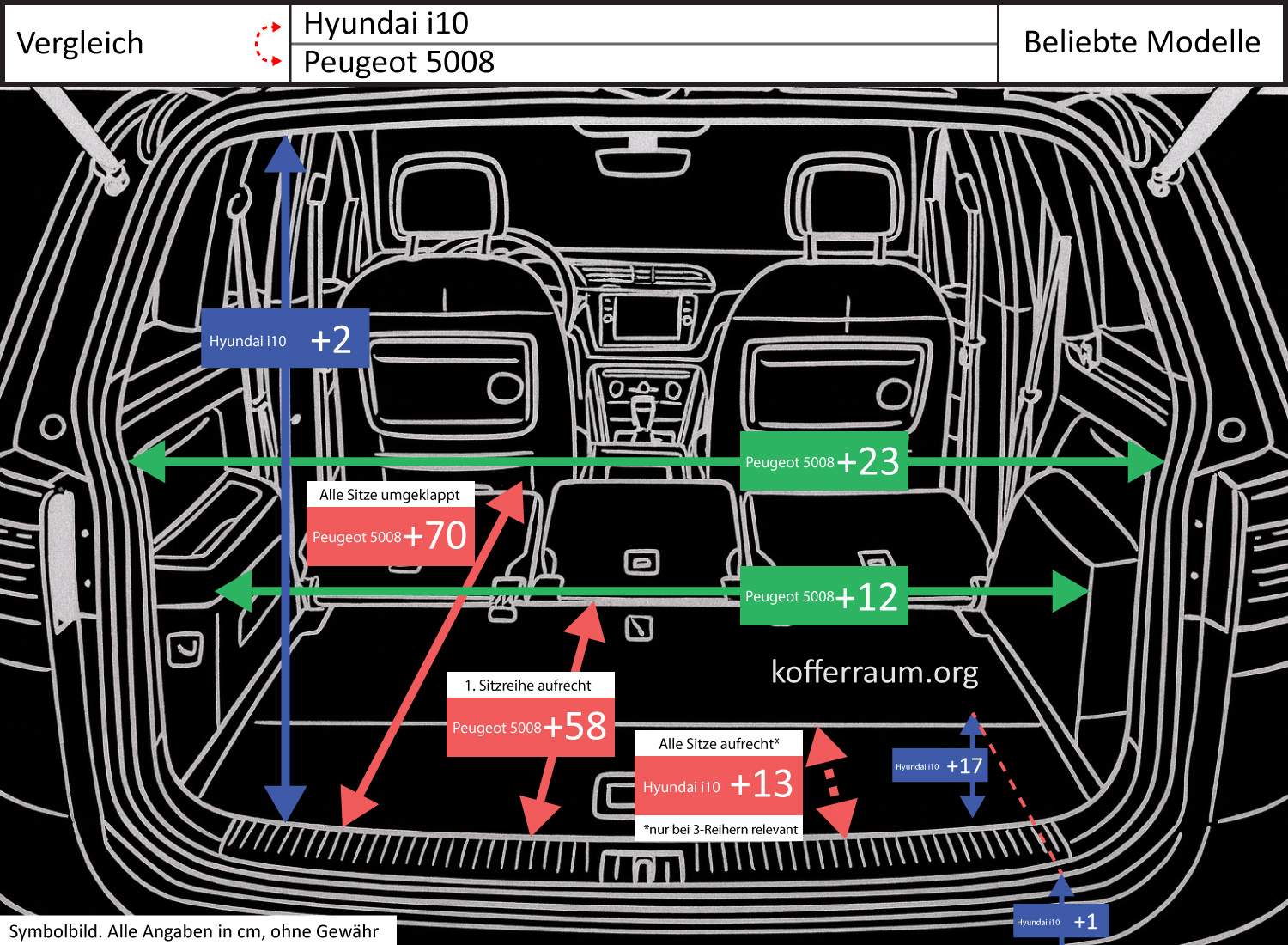
The Peugeot 5008 offers significantly more loading length once the seats are folded down: +27.6 in (59%) with fully folded seats and +22.8 in (123%) when the first row of seats is upright. In everyday use with all seats in place, the Hyundai i10 has a trunk that is 5.1 in (38%) longer.
In terms of width, the 5008 has advantages: the narrowest point in the trunk is 4.7 in (12%) larger and the trunk opening is 9.1 in (26%) wider than in the i10. Also notable is the greater depth (loading edge to trunk floor) of the i10: +6.7 in (1700%) compared to the 5008. Smaller differences (e.g., opening height +0.8 in in the i10, loading edge height +0.4 in) are negligible.
Implications for Usability
Because the 5008 is significantly longer and opens wider with folded seats, it is clearly better suited for long or bulky cargo (e.g., furniture, bicycles, long boards) and for loading large boxes: the wider opening and greater width at the narrowest point make maneuvering bulky items easier.
The strong increase in length when seats are folded is also practical—ideal for varying transport needs.
The i10, on the other hand, scores in everyday transport with all seats in use: its longer loading floor in this configuration makes it more suitable for suitcases, shopping bags, or strollers when fully occupied.
The significantly greater depth of the i10 creates more vertical volume in the trunk, so it can offer more storage space for bulky but not too wide items; at the same time, a lower trunk floor can make lifting and removing heavy loads somewhat less convenient.
In short: Those who frequently transport long or wide cargo or need flexible space configurations benefit from the Peugeot 5008. Those who mostly drive fully occupied and transport smaller, bulky everyday items will find the Hyundai i10 a more practical solution.